Pond Aeration Calculator
Estimate airflow, horsepower, diffuser count, and pond volume from pond size, depth, fish load, temperature, and aeration goal.
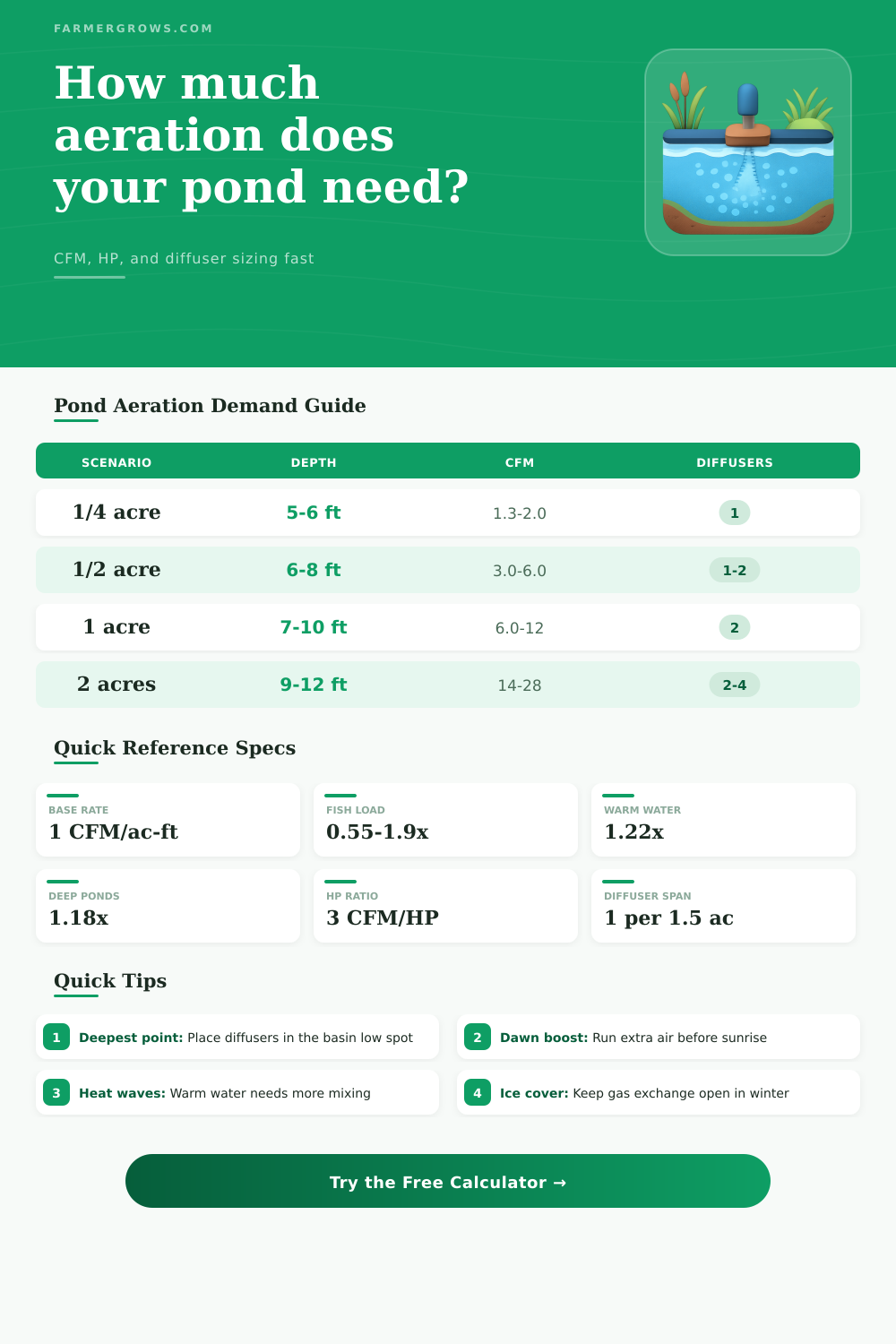
| Pond Size | Avg Depth | Base CFM | Diffusers |
|---|---|---|---|
| 1/4 acre | 5-6 ft | 1.3-2.0 | 1 |
| 1/2 acre | 6-8 ft | 3.0-6.0 | 1-2 |
| 1 acre | 7-10 ft | 6.0-12 | 2 |
| 2 acres | 9-12 ft | 14-28 | 2-4 |
| Load | Stocking | Factor | Typical Use |
|---|---|---|---|
| No fish | Wildlife | 0.55x | Low demand |
| Light | 0-500 lbs | 0.80x | Quiet pond |
| Moderate | 500-1500 | 1.10x | Mixed pond |
| Heavy | 1500-3000 | 1.50x | Koi / catfish |
| Intense | 3000+ | 1.90x | Grow-out |
| Water Temp | Oxygen Hold | Factor | Season |
|---|---|---|---|
| Under 50°F | High | 0.75x | Winter |
| 50-65°F | Good | 0.88x | Spring |
| 65-78°F | Normal | 1.00x | Mild |
| 78-90°F | Low | 1.22x | Summer |
| Above 90°F | Very low | 1.48x | Heat wave |
| Pond Acres | Diffusers | CFM Each | Notes |
|---|---|---|---|
| 0.1-0.25 | 1 | 1-3 | Small basin |
| 0.25-0.75 | 1-2 | 3-6 | Compact pond |
| 0.75-2.0 | 2-3 | 6-14 | Split zones |
| 2.0-5.0 | 3-5 | 14-35 | Broad lake |
Best for: Deep ponds and full turnover
Strength: Strong basin circulation
Watch: Needs enough compressor pressure
Best for: Emergency oxygen relief
Strength: Quick top-layer exchange
Watch: Weak at breaking stratification
Best for: Return lines and waterfalls
Strength: Mixes air into moving water
Watch: Pump head changes output
Best for: High-density fish ponds
Strength: Aggressive oxygen transfer
Watch: Splash and power use rise
Pond aeration is the process of adding oxygen to pond water. Pond aeration is necessary to maintain healthy fish and to assist in the control of algae in the pond. Should a person not provide enough dissolved oxygen in the pond, the fish will gasp at the surface in an attempt to obtain the dissolved oxygen necessary to survive.
Dissolved oxygen are essential to the life of the pond ecosystem and the levels of dissolved oxygen in the pond fluctuate. Some of the factors that determine dissolved oxygen level in pond water include the temperature of the water, the depth of the pond, and the number of fish that live in the pond. Warm water hold less dissolved oxygen than cold water.
Pond Aeration Basics
Therefore, ponds with warmer water will require more aggressive aeration methods than ponds with cool water. Additionally, fish requires more dissolved oxygen when the water is warm and when there are more fish in the pond. Fish will consume oxygen while they swim and while they sleep in the pond.
The plants stop producing the amount of oxygen that is produced in the pond at night when the plants are not performing their photosynthetic activity. The shape and depth of the pond will also have an impact on how aeration is sized for that particular pond. Shallow ponds require less aeration than deep ponds because shallow ponds are easier to aerate than deep ponds.
Deep ponds require more aeration because the bottom of deep ponds requires aeration to mix the water and provide dissolved oxygen to the life forms living at the bottom of the pond. The average depth of the pond is one of the measurements that will determine the total volume of the pond that must be aerated. High volume of water in a pond will require a larger sized aeration system to aerate the entire pond.
There are different types of aeration systems that can be used in a pond. Bottom diffusers work by moving water through the pond and creating bubbles at the bottom of the pond. These type of aerators are effective because they create a movement of the entire pond that ensures that all of the water is circulated.
Surface splashers work by splashing the water at the surface of the pond. However, these splashers are often insufficient because they do not reach the area of the pond that are hypoxic. Paddlewheels work best in shallow ponds with a high density of fish.
Venturi systems are useful in ponds because these systems blend air with the water as it pass through the pond. The size of the aeration system that is placed into the pond can be calculated by using specific measurements of the pond. For instance, the rate of Cubic Feet per Minute (CFM) that the aeration system dispenses represents the lungs of the pond aeration system.
The amount of horsepower that is required for the aeration system to run the compressor that provides the CFM is another calculation that must be made. The number of diffusers that is placed into the pond will ensure that the aeration system aerates the entire pond. One way of calculating the number of diffusers is to place one diffuser for every one and a half acre of the pond area.
Many people make mistakes when sizing their pond aeration systems. One of the most common mistake is ignoring the depth of the pond and placing the aeration system bubbles into only the upper portion of the pond. Bubbles should be placed in the deepest portion of the pond to ensure that the entire pond water circulates.
Another mistake is ignoring the need to vary the aeration system rates, such as high rate during the daytime and lower rate during the nighttime when the oxygen levels in the pond begin to drop. The user should adjust aeration rates to take into account the low dissolved oxygen rates in the pond prior to sunrise. These rates should be boosted during these times when the fish are not performing their daily activity.
Aeration systems should also be set up to provide for the condition of heat waves in the area. Because warm water contains less dissolved oxygen than cool water, an aeration system should be preemptively run during a heat wave to avoid creating a dissolved oxygen crisis in the pond. Pond aeration systems provide benefits beyond the survival of the fish in the pond.
One of the main benefit is that aeration helps to curb the growth of algae in the pond. Additionally, aeration prevents methane gas from the mud in the pond from rising to the surface. Aeration systems also provide benefits to the beneficial bacteria in the pond because the bacteria breaks down the waste in the pond water.
Because the fish in the pond have more uniform access to oxygen from the aeration system, the fish will grow faster in the pond. Additionally, the aeration system will produce more clearer water in the pond. There are steps that should be taken to maintain the aeration system in the pond.
The compressor for the aeration system should be placed in a dry location in the pond. Additionally, the air lines for the aeration system should be weighted to the bottom of the pond so they do not float to the surface of the water. The membranes for the diffusers should be cleaned every quarter to ensure the aeration system continue to function efficiently.
Finally, dissolved oxygen probes can be used to monitor the dissolved oxygen levels in the pond water to ensure that the fish are not becoming stressed from too low level of dissolved oxygen in the pond water.