Loading Ramp Calculator
Estimate ramp length, slope angle, deck area, and build weight for farm equipment, trailer, and livestock ramps.
Treated lumber
Aluminum plank
Steel plate
Steel grating
Composite deck
Plywood deck
| Grade | Angle | Run per rise | Best for |
|---|---|---|---|
| 10% | 5.7 deg | 10 ft | ATV |
| 12% | 6.8 deg | 8.3 ft | Pickup |
| 15% | 8.5 deg | 6.7 ft | Tractor |
| 20% | 11.3 deg | 5 ft | Short lift |
| Rise | Length | Width | Use |
|---|---|---|---|
| 24 in | 16 ft | 48 in | ATV |
| 30 in | 18 ft | 60 in | Pickup |
| 36 in | 20 ft | 72 in | Trailer |
| 48 in | 24 ft | 72 in | Heavy |
| Spacing | Use | Span | Note |
|---|---|---|---|
| 3 ft | Heavy | Short span | Wet ground |
| 4 ft | Farm | Mid span | Most builds |
| 5 ft | Light | Long span | Dry use |
| 6 ft | Wide | Wide span | Small carts |
| Material | lb/sq ft | kg/m2 | Note |
|---|---|---|---|
| Treated lumber | 3.8 | 18.5 | Common use |
| Aluminum plank | 2.4 | 11.7 | Lightweight |
| Steel plate | 10.5 | 51.3 | Heavy duty |
| Steel grating | 8.7 | 42.4 | Open tread |
A loading ramp can be use to move equipments or livestock from the ground onto a trailer. Loading ramps are often necessary to prevent damage to the equipment or to prevent injury to an person. For instance, if a loading ramp is too steep for the type of equipment or livestock to be loaded onto the trailer, the tires may spin or the livestock may refuse to move up a ramp.
In contrast, if a loading ramp is too shallow for the trailer and the equipment to be loaded onto the trailer, the loading ramp will take up too much space within the pasture. The slope of a loading ramp are calculated as the rise over the run of the ramp. Furthermore, people often express that slope as a percentage.
How to Build and Use a Loading Ramp
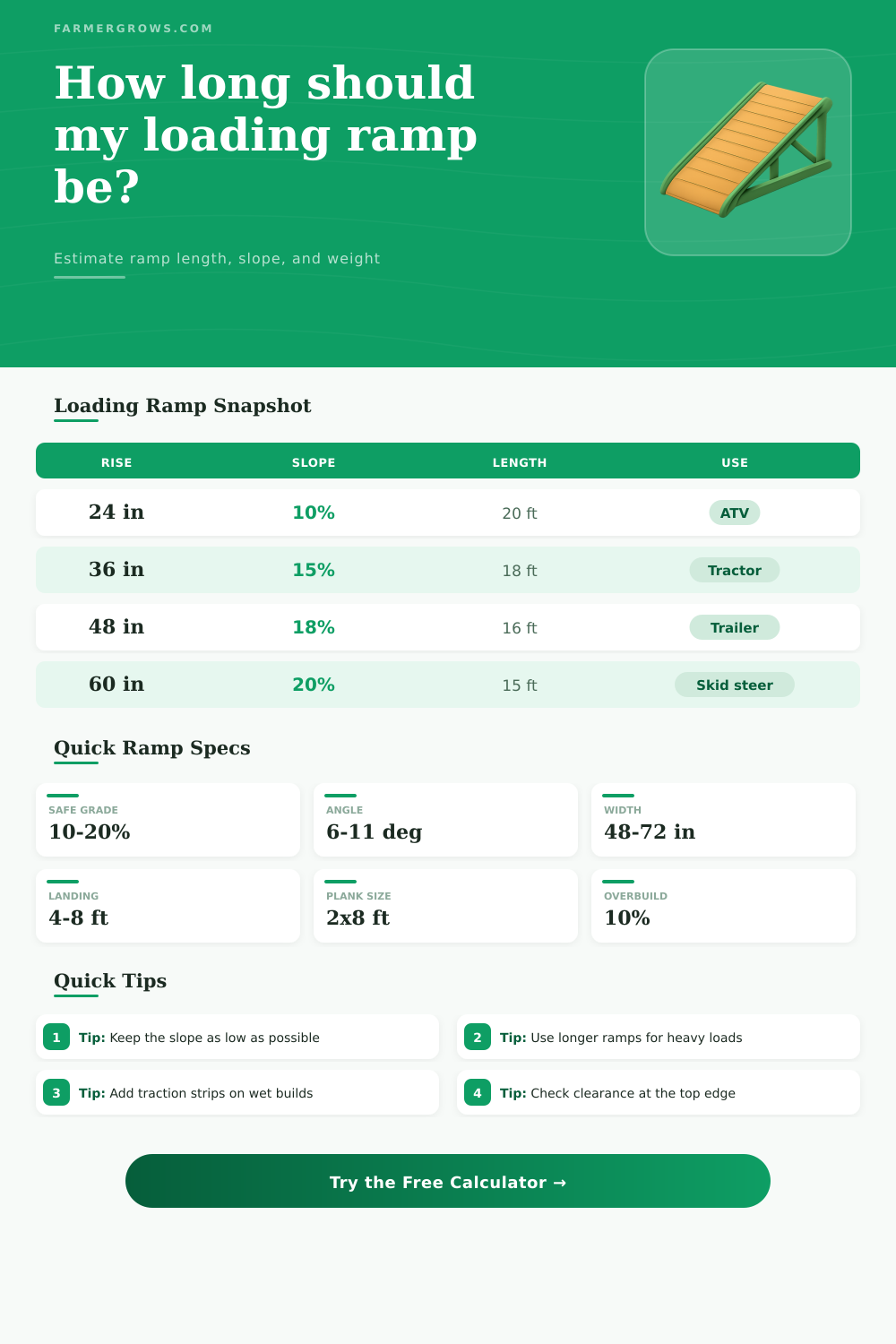
A 12% slope is often considered to be a manageable slope for farm vehicle. However, a slope that is more steeper than 20% can be difficult for those farm vehicles to navigate. A person must measure the rise of the trailer from the ground to determine the length of the loading ramp that is necessary to accommodate that trailer.
Additionally, it is also often useful to include a flat landing area at the top of the loading ramp to allow vehicles to level out prior to driving onto the trailer. The width of the loading ramp should be at least as wide as the equipment that is to be loaded onto the trailer, but it should not be so wide as to pose a threat of instability to the loading ramp. For instance, equipment like an ATV may require a rise that is shorter than a tractor, which require a longer loading ramp to accommodate the wider implement.
Likewise, livestock ramps often have different specifications due to the need for good traction by the livestocks. The material of the loading ramp will impact the weight and the durability of the ramp. For instance, wood is a common material for loading ramps.
Treated lumber weighs approximately 4 pound per square foot. Aluminum is also a common material for loading ramps and it is useful in that it is relatively light and easy to move to different location as needed. Steel is a common material for loading ramps, as well.
Steel is strong and provide good traction on the ramp if the ground is muddy, but it is much heavier than aluminum or wood planks. Therefore, you should of purchase 10% extra of each material for the loading ramp to account for any damage that may occur in cutting the materials to the necessary size. The supports for the loading ramp must often be spaced correctly according to both the length of the ramp and the soil upon which you will construct it.
Supports may be spaced four feet apart for most types of loading ramps and most soil type. However, if the soil is wet clay or if a tractor will use the loading ramp, the supports should be spaced three feet apart. The width of the planks that are to be constructed for the loading ramp should be sufficient to ensure the planks dont create weak area of the loading ramp where the tires of the vehicle will pass.
A person must also consider certain environmental factor in the use of loading ramps. For instance, loading ramps used in wet weather should have grating or cleats to provide traction for the vehicles. Furthermore, it is also useful to test the loading ramp by first loading a light vehicle onto the ramp, and then loading a heavy vehicle to ensure that the loading ramp can handle that weight.
Additionally, loading ramps should have side rail to prevent the livestock or equipment from falling off of the ramp. Finally, the ramp should have enough clearance at the lip of the trailer so that the bumper of the vehicle does not hit the trailer when the vehicle is being load.