Cistern Size Calculator
Size a cistern from daily demand, roof catchment, rainfall, reserve days, and fill target so storage matches dry spells and harvest.
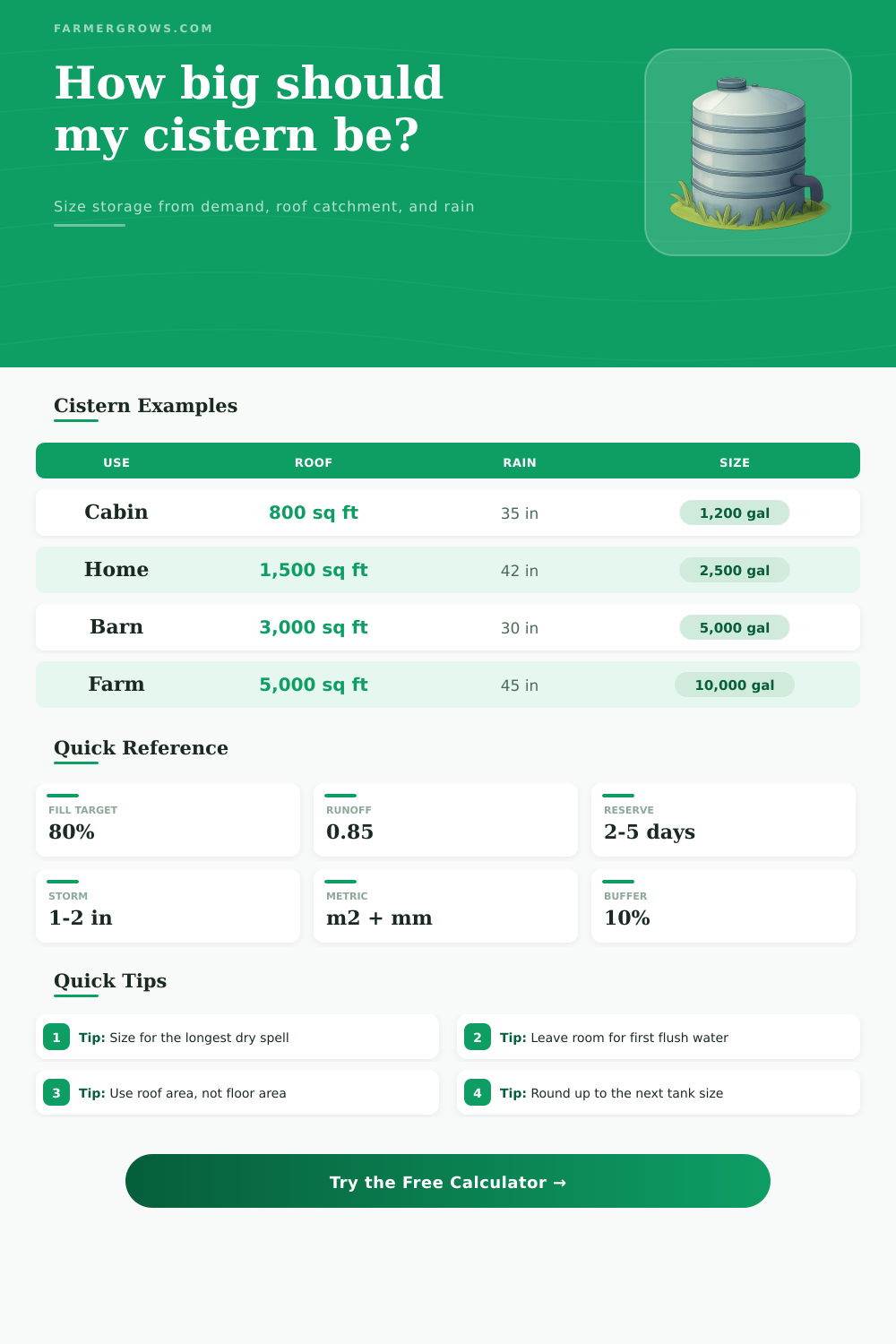
This calculator balances water demand, roof harvest, and reserve storage so the cistern can bridge dry weather and refill between storms.
Daily demand is measured from all uses. Roof catchment and rainfall drive how much the cistern can harvest.
Cistern Sizing Results
These values balance demand, harvest, and storage so the cistern can bridge dry periods while still leaving room for capture.
| Use | Daily need | Reserve | Cistern range |
|---|---|---|---|
| Cabin | 40-80 gal | 3-4 days | 800-1500 gal |
| 3-bed home | 120-240 gal | 2-3 days | 1500-3000 gal |
| Barn washdown | 200-500 gal | 2-4 days | 2500-6000 gal |
| Farm reserve | 400-900 gal | 3-7 days | 5000-12000 gal |
| Roof type | Runoff | Quality | Note |
|---|---|---|---|
| Metal roof | 0.95 | Very high | Best capture |
| Tile roof | 0.85 | High | Check first flush |
| Shingle roof | 0.80 | Good | Needs cleanup |
| Concrete pad | 0.90 | High | Good for tanks |
| Fill target | Freeboard | Use case | Note |
|---|---|---|---|
| 70% | 30% | Hot climate | More room |
| 80% | 20% | Standard use | Good default |
| 85% | 15% | Clean roof | Tighter storage |
| 90% | 10% | Pressurized | Smaller cistern |
Tip: Size for the longest dry spell first.
Tip: Leave room for first flush and debris.
In order to size a cistern, a person must balance the amounts of water that the person or farm demands with the total supply of water that can be harvested from the roof. A person must calculate the amount of water that the various use of water by the household and farm (like drinking water, laundry, and irrigation) will demand, and the amount of water that will fall on the roof during periods of rain. If the cistern contains too little water, a person will run out of water during dry periods of the year.
Conversely, if the cistern contains too much water, a person will spend too much moneys purchasing the tank. The amount of water that the individual or farm demands are the total amount of water that is removed from the cistern each day to fulfill the needs of the individual or farm. These demand may include water for drinking, laundry, dishwashing, water for livestock, and water for irrigation of crops.
How to Size a Water Cistern
For instance, an individual living in a small cabin may require around 40 gallon of water per day, while a family of several individuals may require hundreds of gallons of water each day. Thus, the total demand for water is each individual’s daily water requirements multiply by the number of days that may occur within the longest dry period of the year. The total supply of water that the farm may collect come from the amount of rainfall that falls on the farm’s roof, which is collected in the gutters that run down the farm buildings to the cistern.
The amount of water that the farm’s roof may collect is dependent upon both the size of the farm’s roof, as well as the materials of which the roof is comprised. For example, metal roofs will allow the majority of the rainwater to flow into the gutters, as metal roofs are typically clean and do not contain the type of debris that may be released into the collected water. In contrast, asphalt shingle roofs tend to hold some of the water, as the asphalt adheres to the shingle and may release that debris into the collected water.
A person must also account for the way that the collected water from the gutters may become unusable. For instance, some of the water that may be collected may evaporate during warm weather climate. In addition, some of the collected water may become unusable if the water contains debris from the environment (like leaves or bird droppings).
Additionally, although there may be devices like first-flush diverter that remove some of this unusable water from the system, a person will not want to plan for the use of all of the volume that will be collected in the cistern. Instead, a person should aim to use only 80% of the volume of the cistern; the remaining 20% will be used to allow for the addition of incoming water to the cistern, as well as to account for the silt that may collect at the bottom of the cistern over time. Beyond considering the capacity of the cistern, the location of the cistern also impact the type of cistern that may be installed.
For instance, polyethylene cisterns are often used for above ground setups, as polyethylene cisterns are portable and they tend to be UV-resistant if they are shaded from the sun. In contrast, fiberglass and concrete cisterns are often buried in the ground. For example, concrete cisterns are very heavy, but they are often used for very long-term storage of water.
However, their heavy weight require the use of a crane when they are to be installed. Both types of cisterns should be placed on level ground so that the water pump for the cistern does not strain from attempting to move the water against the gravitational pull. The size of the cistern can be planned according to the rainfall that occurs on the farm each year, as well as the depth of those rainstorms.
Annual rainfall can tell a person if the total amount of water that is harvested each year are sufficient to supply the demands of the individual and farm. The depth of the rainstorms tells a person how quick the rain can refill the cistern after dry periods. If the harvest of water from the rainfalls is less than the demands of the individual and farm, then that individual will require a backup water source.
In contrast, if the amount of harvested water is more greater than the demands of the individual and farm each year, then there is an abundance of water that can be used for other systems on the farm, like greywater systems. Thus, by calculating the demands and the supply of water, a person can select a cistern that will provide sufficient water to the individual and farm during the dry period of the year.