Well Water Tank Size Calculator
Size storage from daily demand, reserve days, pump recovery, and fill target so your well system can bridge outages and weak recharge.
This calculator balances demand and recharge. If the well cannot refill fast enough, the tank is sized to carry the gap before the system runs dry.
Daily use is measured per person, animal, or zone. Recovery rate is the steady refill rate from the well, not the pump nameplate.
Recommended Tank Size
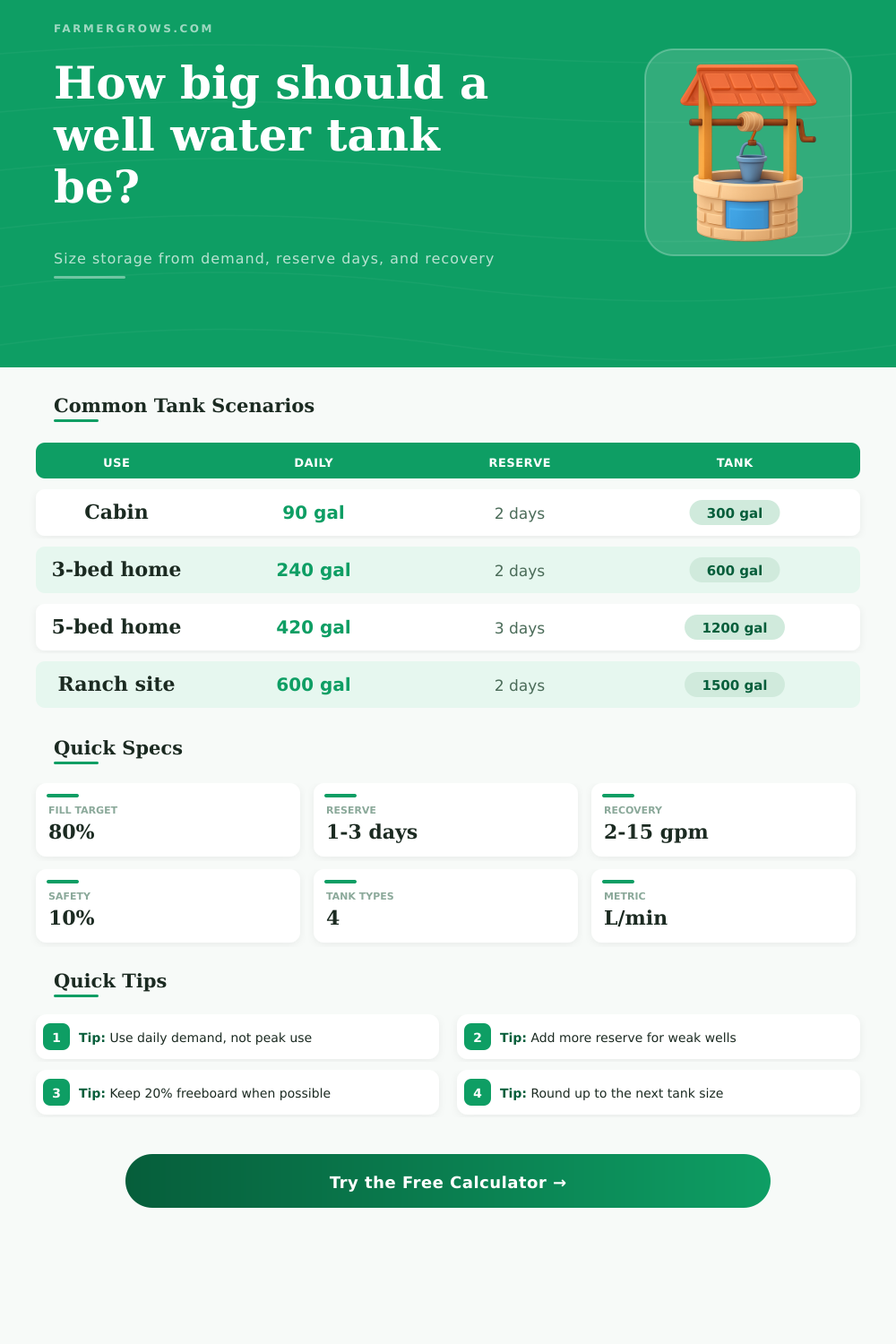
These values balance demand, recovery, and storage so the tank can carry the shortfall before refill catches up.
| Use | Daily use | Reserve | Tank range |
|---|---|---|---|
| Cabin | 60-120 gal | 2 days | 200-400 gal |
| 3-bed home | 180-320 gal | 2-3 days | 600-1000 gal |
| 5-bed home | 320-500 gal | 2-3 days | 1k-1.6k |
| Ranch site | 500-900 gal | 2-4 days | 1.5k-3.6k |
| Well yield | Gap risk | Storage need | Note |
|---|---|---|---|
| 0.5-1 gpm | High | 3-5 days | Use large tank |
| 2-5 gpm | Medium | 2-3 days | Standard fit |
| 6-10 gpm | Low | 1-2 days | Smaller tank |
| 15+ gpm | Very low | 1 day | Buffer only |
| Fill target | Freeboard | Use case | Note |
|---|---|---|---|
| 70% | 30% | Hot climate | More room |
| 80% | 20% | Standard use | Good default |
| 85% | 15% | Clean well | Less empty space |
| 90% | 10% | Pressurized | Smaller tank |
Tip: Start with real daily use, then add reserve for dry periods or weak recharge.
Tip: If recovery is slow, choose a larger tank and a higher freeboard target.
A well water storage tank is a container that hold the water that a household use. Using a well to obtain water is problematic because the well may not be able to refill the water storage tank as quick as the individuals in the household utilize the water that is in the tank. Furthermore, if the water storage tank is too small for the household, the household may run out of water to use because the well cannot refill the tank fastly enough.
In order to avoid this issue, the household must size the tank according to the water intake and the amount of water that is produced by the well. To size the tank for the household, the household must determine its daily water demand. The daily water demand of the household is the total amount of water that the household use in one day.
How to Size and Choose a Well Water Tank
The daily water demand can be calculated by multiply the number of individuals in the household by the amount of water that each individual use. In many instance, people make mistakes in determining water demand if they do not account for the peak demand for water within the household. For instance, the water demand may be high in the morning when many members of the household take shower or run laundry machine.
Another factor to consider in sizing the well water storage tank is the recovery rate of the well. The recovery rate of the well is the amount of water that the well produce per minute. If the recovery rate is low, then the tank must be larger to provide water to the household if the well is not able to refill the tank at the same rate that the household utilize the water.
For instance, if the well produces only three gallon of water per minute, the tank should contain enough water to supply the household need if the well is not producing water at such a rate. If the well has a low recovery rate, the well water storage tank should provide it with three to five days of reserve water. However, if the well has a high recovery rate of over 10 gallon of water per minute, the well water storage tank should provide only one day of reserve water to it.
Another factor to consider is the number of day that the tank should provide water to the household if the well stop producing water. Most water storage tank provides two days of reserve water to the household. However, if the recovery rate for the well is low, the well water storage tank may provide more reserve days to the household.
Furthermore, it is important to include a safety margin for the water tank. The safety margin is used to account for water that may be used by the household in ways that are not consider in creating the water supply estimate for the household. By including a safety margin, the household will not ever be empty the water tank.
The material from which the tank is make will impact the way that the tank is installed and maintained. For instance, if polyethylene is used in the construction of the water storage tank, the tank will be lightweight and easy to sanitize. If fiberglass is used in the construction of the tank, you could bury it in the ground in which the well is installed, because fiberglass does not corrode in damp soil.
Steel can be used in the construction of the water storage tank, but it must be treat to prevent rusting. Furthermore, another material that can be used to construct the tank is concrete, which is often used for permanent installation of well water storage tanks because the concrete tanks do not change temperature as quickly as other material. Each material has different considerations that should be made prior to the installation of the well water storage tank, such as whether the material is suitable for potable water use, and if the tank will be located above the ground, it should have UV resistance.
There are some mistake that should be avoided when installing a water storage tank for a households well. One mistake is using the rating for the pump instead of the recovery rate of the well. The recovery rate of the well is the amount of water that the well release each minute.
The rate for the pump is the amount of water that the pump can move. Using the rate of the pump will result in the water storage tank being too small for the household that use water. Another mistake is to ignore the hour of the day that the pump is allowed to run.
For instance, if the pump is only allowed to run for 12 hour a day, then the well water storage tank must contain enough water to supply the household need for the remaining 12 hour of the day. In addition to the household that use the water from the well, there are additional factor that can increase the water demand on the tank. For instance, if the household own any livestock, such as horses, those animal will drink gallons of water each day.
Additionally, if the land owned by the household contain plant that must be watered, the irrigation system will require gallons of water to water those plants. To account for these additional water demand, the size of the tank will have to be increased. Finally, a low water cutoff switch should be installed in the tank.
The low water cutoff switch will prevent the pump from running if the water tank is empty, which will prevent damage to the pump.