💧 Water Well Pump Size Calculator
Estimate total dynamic head, brake horsepower, and a practical pump motor size from water demand, lift, pressure, pipe loss, and well yield.
This calculator uses common well-sizing assumptions and Hazen-Williams friction loss estimates for water. Use actual pumping water level, not drilled depth, for the most reliable result.
Pump Sizing Results
Use these results to compare horsepower, head, and pressure before choosing a pump.
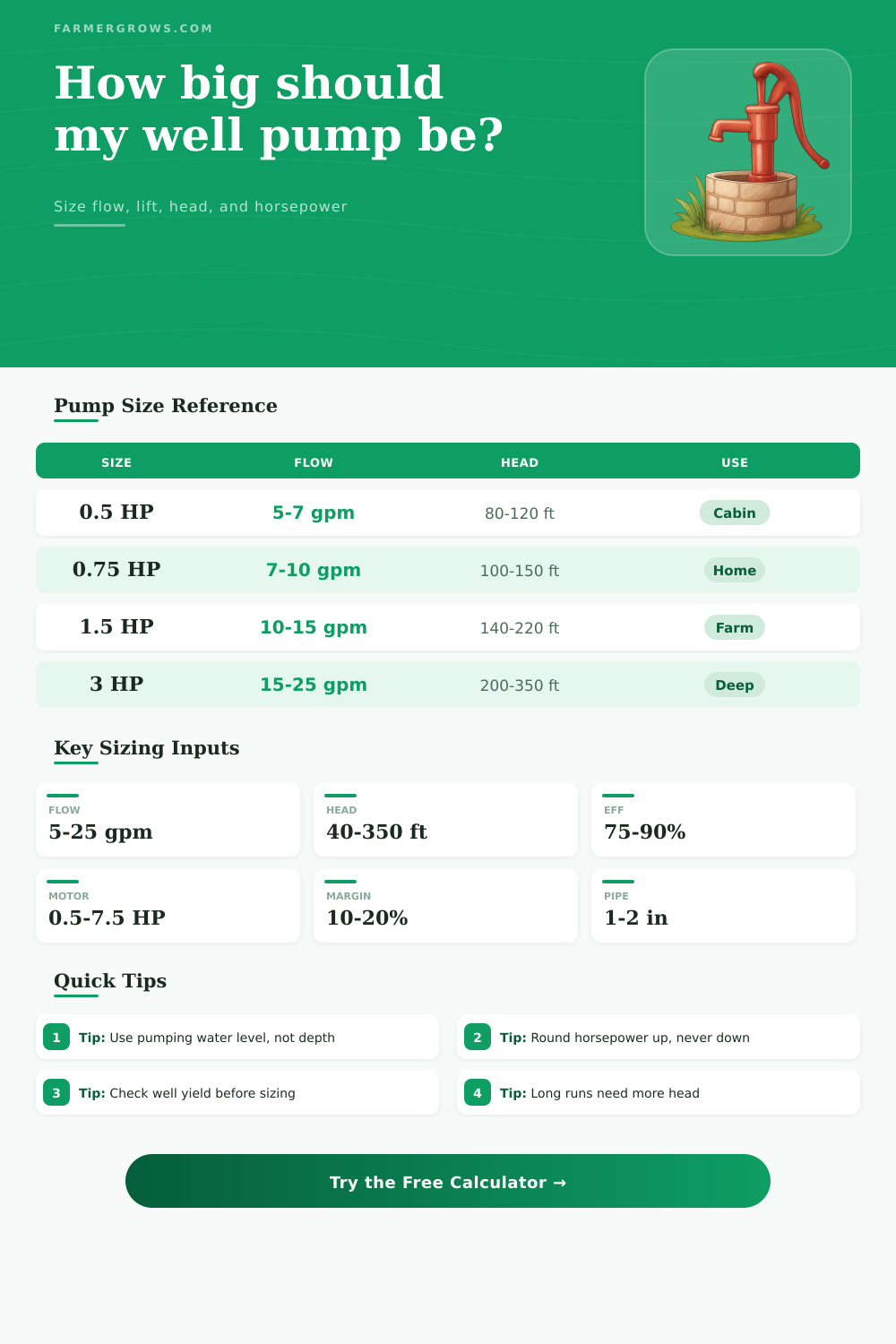
| Motor | Typical flow | Typical head | Best use |
|---|---|---|---|
| 0.5 HP | 5-7 gpm | 80-120 ft | Cabin |
| 0.75 HP | 7-10 gpm | 100-160 ft | Small home |
| 1.5 HP | 10-15 gpm | 140-220 ft | House |
| 3 HP | 15-25 gpm | 200-350 ft | Deep well |
| Use | Flow | Pressure | Comment |
|---|---|---|---|
| Single cabin | 4-6 gpm | 30-40 psi | Low demand |
| 2-bath home | 6-10 gpm | 35-50 psi | Typical home |
| Farmhouse | 10-15 gpm | 40-55 psi | More fixtures |
| Stock water | 8-12 gpm | 30-45 psi | Refill duty |
| Pressure | Feet of head | Bar | Use case |
|---|---|---|---|
| 20 psi | 46 ft | 1.4 bar | Low pressure |
| 30 psi | 69 ft | 2.1 bar | Light demand |
| 40 psi | 92 ft | 2.8 bar | Home standard |
| 50 psi | 115 ft | 3.4 bar | Higher pressure |
| Step | Formula | Input | Output |
|---|---|---|---|
| 1 | Pressure head | psi x 2.31 | feet of head |
| 2 | Friction head | Hazen-Williams | pipe loss |
| 3 | Total head | lift + rise + loss | TDH |
| 4 | Horsepower | flow x head | motor size |
Use this water well pump size calculator to match flow, lift, and pressure to a practical motor size. It helps you avoid undersizing, manage head loss, and choose a pump with confidence.
When choosing a well pump, you must ensure that you size the well pump corectly according to the needs of your home and the conditions of the well. If the well pump is too small, it wont be able to supply the necessary water pressures and flow to your home. To determine the proper size of the well pump, you must calculate two variable: the total dynamic head and the flow demand of the well pump.
These two variables will determine the power that the well pump should have in order to meet the requirement of your home. The total dynamic head of your well is the total amount of resistance that the well pump must overcome in order to move the water. To calculate the total dynamic head, you must first determine the depth of the water in the well.
How to Size a Well Pump for Your Home
You should not use the static depth of the well (the depth of the water when there is no one using the water from the well) but, instead, you should use the depth of the water when the well pump is in use. The depth of the water when the well pump is in use is referred to as the pumping water level. You should add the distance from that pumping water level to the highest faucet in your home to the total dynamic head.
Additionally, you should add the required pressure (in pounds per square inch) at the tap to the total dynamic head. However, since each pound per square inch of water pressure is approximately equal than 2 feet of head, the required pressure will have to be converted from pounds per square inch to feet. Finally, you should also adjust the total dynamic head for pipe friction.
Pipe friction is the resistance of the water moving through the pipes of the home; friction will increase with longer distances of water pipe, smaller diameter of the pipes, and with the roughness of the pipes. Flow demand is the amount of water that the well pump requires for your home per minute. Homes with only a few bedrooms and a single bath may require only 5 gallons of water per minute.
However, homes with several bathrooms will require more water; homes with two bathrooms may require 8 to 10 gallon of water per minute. You should consider the yield of the well (the amount of water that the well can actualy produce) in determining the flow demand. If the flow demand is higher than the yield of the well, then the well pump will begin to pull air from the well (which can lead to cavitation), and the motor of the well pump will burn out.
Therefore, a flow demand that is 15 to 20% less than the actual demand of the home will prevent the well pump from working too hard. The diameter of the pipes and the material of those pipes will also affect the performance of the well pump. Pipes with a larger diameter will have less friction than those with a smaller diameter.
Smooth pipes, like PVC or HDPE plastic pipes, will have less friction than the steel pipes. Because friction can significantly increase the total dynamic head, it is essential to include all friction caused by the pipes in the total dynamic head calculation. To determine the necessary brake horsepower of the pump, you will multiply the flow (in gallons per minute) by the total dynamic head.
You will then divide that product by the efficiency of the well pump. No well pump is 100% efficient, thus you should use the efficiency of that pump in the calculation of the brake horsepower. Finally, you will divide that number by a constant; the resulting number is the amount of brake horsepower that the well pump should have.
It is essential to round the brake horsepower to the next available size of motor for the well pump. If the motor is too small for the demands of the well pump, then the motor will overheat and fail. There are also presets that can be used to determine the size of the well pump.
For deep wells, one preset will work for various flow and lift parameters. For farm houses, though, there will be a different preset; the flow and the lift will be different. Presets can save time and effort when determining the size of a well pump; however, you should make sure they account for the specific parameters of the wells.
Additionally, pressure charts exist that will allow the necessary conversion of pounds per square inch into feet of head; this adjustment in units is necessary for calculating the total dynamic head. Finally, you should consider the needs of the season in which the well will be used in the pumping calculations. In the summer, when there is more watering of lawns and gardens, more water will be required than in the winter.
Therefore, during the winter, the water requirements of the home may be different than during the summer. You can test the well by allowing the well pump to run at its peak rate for a twenty-four hour period. During this twenty-four hour period, you can determine the yield of the well.
If the yield of the well is low, a storage tank will be beneficial in supplying the water requirements of the home; the storage tank will hold the water so the well pump does not have to run as often. However, the total dynamic head, the flow demand, and the yield of the well will determine the correct size of the well pump.