💧 Terrace Calculator
Estimate gravel footprint, fill volume, bag count, and material weight for Terraces, Terrace Beds, and Terrace beds.
Use the shape tool for a terrace bed, hillside pad, or garden footprint. The calculator converts metric or imperial entries, then adds your chosen overage for settling and compaction.
💧 Terrace Results
Estimate the gravel footprint and material demand for your Terrace layout.
Calculation Breakdown
| Depth | Sq ft per yd3 | M2 per m3 | Best use |
|---|---|---|---|
| 1 in | 324 | 39.0 | Thin top layer |
| 2 in | 162 | 19.5 | Shallow fill |
| 3 in | 108 | 13.0 | Common trench top |
| 4 in | 81 | 9.8 | Deeper bedding |
| 6 in | 54 | 6.5 | Heavy Terrace bed |
| Package | Volume | Per yard | Coverage at 3 in |
|---|---|---|---|
| 2 cu ft bag | 2 cu ft | 13.5 bags | 24 sq ft |
| 3 cu ft bag | 3 cu ft | 9 bags | 36 sq ft |
| 1 cu ft bag | 1 cu ft | 27 bags | 12 sq ft |
| Bulk yard | 27 cu ft | 1 yard | 324 sq ft |
| Project | Area | Cubic yards | 2 cu ft bags |
|---|---|---|---|
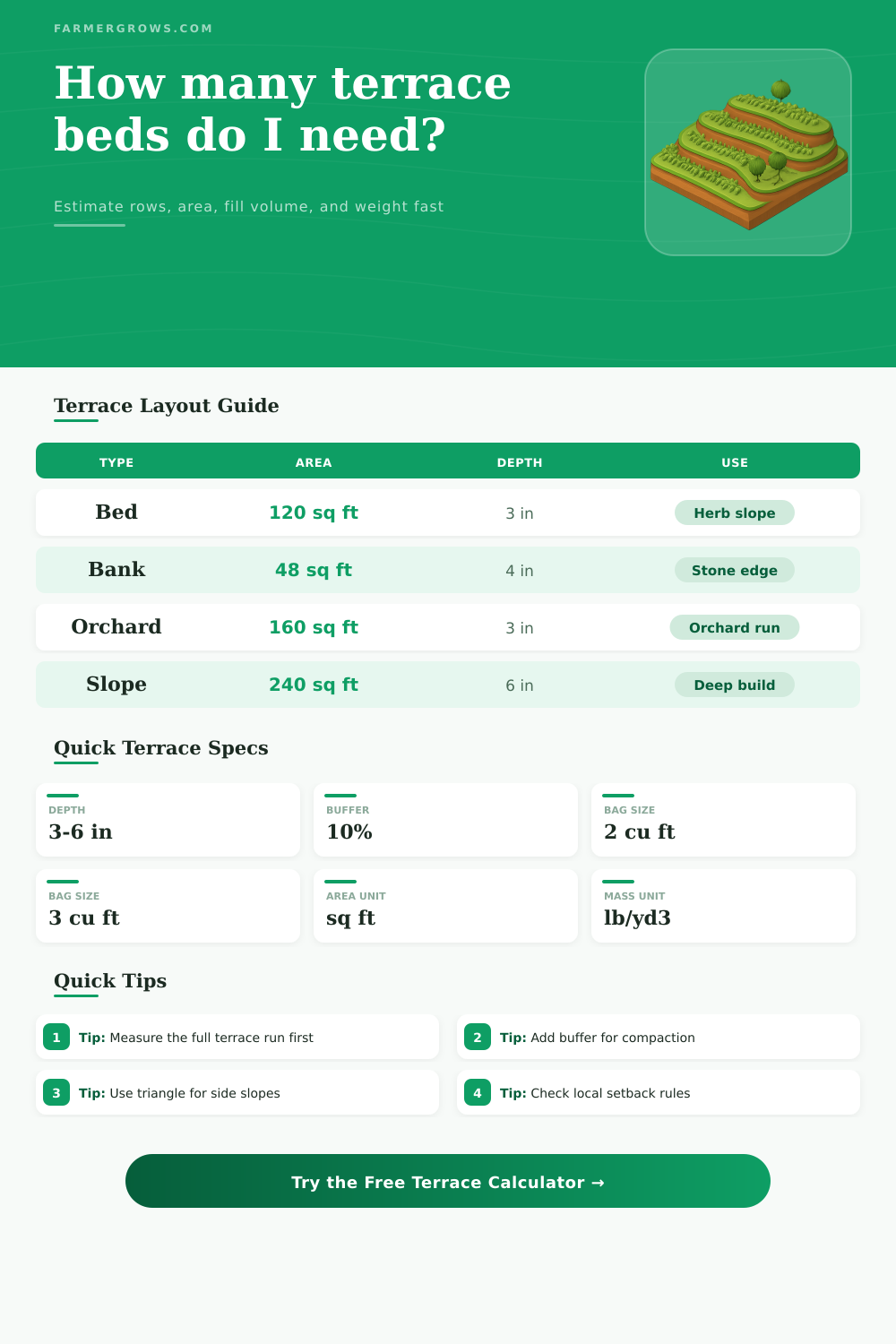
| Backyard slope | 120 sq ft | 0.37 yd3 | 6 bags |
| Small herb terrace | 60 sq ft | 0.19 yd3 | 3 bags |
| Orchard terrace | 180 sq ft | 0.56 yd3 | 9 bags |
| Full slope build | 240 sq ft | 0.74 yd3 | 10 bags |
Terracing are the method that can be used to create level planting beds in a sloped backyard. Terracing is a method of preventing soil erosion. When a backyard feature a slope, the water from precipitation will run off the slope and carry the soil away from the garden area.
Terracing will stop the runoff from the slope by carving a series of flat levels into the terrain. These level will hold the soil in place for the plants to grow. In order to create a terrace, a person must calculate the volume of material that will be needed to fill the terrace beds.
How to Measure and Buy Material for a Backyard Terrace
If the person calculates the volume of material corectly, the person will not order too much or too little of that material. A terrace bed will have a footprint and a depth. The footprint is the area of the terrace bed, which can be in the shape of a rectangle or a triangle.
The depth is the thickness of the layer of material that will be placed within the footprint. The depth of the material is an important measurement because it will determine how many material will be needed for the terrace. For instance, a three-inch depth of topsoil will be enough for herbs to be grown in the terrace.
For plants that has deep roots, six inches of topsoil will be a better choice. Different materials has different weights and volumes. For example, gravel is the most densest material.
Mulch is the least dense material. Topsoil is in the middle in terms of its density. When calculating the amount of material for a terrace, a person should include a buffer for the settling of the soil.
The soil will settle in the terrace beds over time. The settling is the result of the soil getting compacted in the terrace beds. If a buffer for soil settling is not included in the calculations, the terrace beds will sink over time due to the settling of the soil within those beds.
The sinking of terrace beds can crack the retaining edge of the terrace. If a terrace features triangles or wedges of terrain, more material will be needed to fill the deep end of those triangles compared to the narrow end of those triangles. These measuring tools will allow a person to convert measurements from imperial feet to metric meters to meet the requirements of the measurement of material to be ordered.
The full area of the slope should be measured prior to ordering the material for the terrace. If the person does not measure the area corectly, the person will end up running out of terrace material for the area of the backyard that feature the slope. For instance, if the terrace bed is in the shape of a triangle, the area can be calculated by multiplying the length of the base of the triangle by the height of the triangle and dividing by two.
If the area is under-measured, there will not be enough material to cover the area of the slope in the backyard. A series of tables can help a person to calculate how much material is needed based on the size of the area of the terrace. If the depth of the terrace is three inches, one cubic yard of material will cover 108 square feet of terrain.
However, if the depth of the terrace is six inches, one cubic yard will only cover 54 square feet. Large amounts of material can be bought in cubic yards for large slopes in a backyard. However, small bag of two cubic feet of material can be purchased for small terrace jobs.
The weight of the material is another important factor to consider when building a terrace. For example, topsoil weigh approximately 2,200 pounds per cubic yard of topsoil. Compost blends weigh approximately 1,100 pounds per cubic yard.
Gravel and sand weighs approximately 3,000 pounds per cubic yard. River rock weighs approximately 2,800 pounds per cubic yard. The weight of the material is important for determining how the material will be transported to the plot in the backyard.
For instance, if the backyard is located uphill from the location from which the material is delivered, it will be difficult to transport the heavy gravel or sand to the backyard. A person will need to consider these weights when planning the transport of the terrace material to the plot in the backyard. The weight of the material will change when the material become damp.
For instance, damp topsoil will weigh more than dry topsoil. This factor will have an impact on the transport of that material. It is also a good idea to use common size when calculating the amount of material for a terrace.
For instance, if a person has a 120 square foot area that needs to be covered in a terrace, and that terrace needs to have three inches of material depth, the person will need to order approximately one-third of a cubic yard of material, which is six bags of two cubic feet of material each. Similarly, if the area of the backyard that features a slope is 240 square feet, and if the depth of the terrace is three inches, then the person will need to order three-quarters of a cubic yard of material, which is ten bags of two cubic feet of material each. If the calculation of the amount of material yield unusual numbers, the measurements should be checked.
Common mistakes include the confusion of the depth of the excavation of the slope and the depth of the layer of material that will be used to create a terrace. When setting up a terrace, the depth of the fill material is the depth that should be considered. For example, a four-inch layer of gravel can be placed beneath the soil in the terrace bed to increase the stability of the terrace.
Additional considerations can include local rules regarding setbacks in the construction of terraces. Setbacks are area of the property that must be maintained as a buffer zone from the property lines. The terracing of a backyard will change the functionality of that backyard.
Terracing will control the amount of water that runs off of the slope of the backyard. Additionally, terracing will create new area for planting in the backyard. Terracing can start with the building of a single terrace bed in the backyard.
The soil in which the plants are planted can be fertilized annually by adding organic material to the soil. The volume of the terrace will help determine how much material should be ordered for construction of the terrace. Additionally, the weight of the material will help to indicate if the individual will be able to order and pick up that material themselves.
If the person calculates the volume and weight of the material correct, the person will have the correct amount of material for the terrace beds.