🌱 Scotts Rotary Spreader Settings Calculator
Calculate the correct spreader setting, product amount needed, and full lawn coverage for your project
| Product Type | EZ Broadcast | Turf Builder EdgeGuard | Wizz Handheld | Elite Spreader |
|---|---|---|---|---|
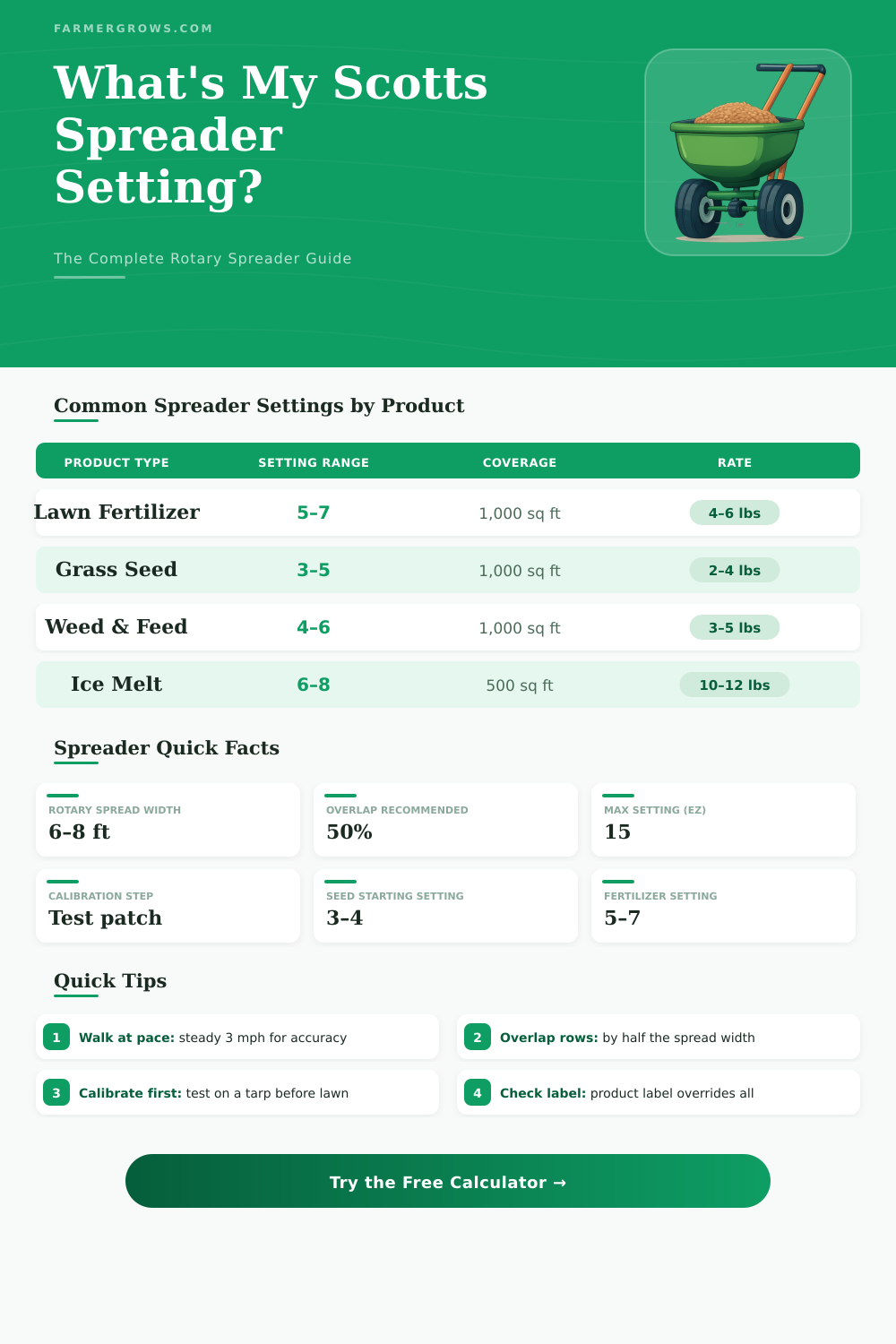
| Lawn Fertilizer | 5–7 | 5.5–7 | 4–6 | 5–7 |
| Grass Seed | 3–5 | 3–4.5 | 3–4 | 3–5 |
| Weed & Feed | 4–6 | 4–5.5 | 3–5 | 4–6 |
| Crabgrass Preventer | 5–6 | 5–6 | 4–5 | 5–6 |
| Starter Fertilizer | 4–5 | 4–5 | 3–4 | 4–5 |
| Lime | 7–9 | 7–9 | 6–8 | 7–9 |
| Ice Melt | 6–8 | 6–8 | 5–7 | 6–8 |
| Overseeder Mix | 3–4 | 3–4 | 2–3 | 3–4 |
| Product Type | Lbs per 1,000 sq ft | Kg per 100 m² | Coverage per 10 lb bag | Coverage per 20 lb bag |
|---|---|---|---|---|
| Lawn Fertilizer | 4–6 lbs | 1.95–2.93 kg | 1,666–2,500 sq ft | 3,333–5,000 sq ft |
| Grass Seed (overseeding) | 2–4 lbs | 0.98–1.95 kg | 2,500–5,000 sq ft | 5,000–10,000 sq ft |
| Grass Seed (new lawn) | 4–8 lbs | 1.95–3.9 kg | 1,250–2,500 sq ft | 2,500–5,000 sq ft |
| Weed & Feed | 3–5 lbs | 1.46–2.44 kg | 2,000–3,333 sq ft | 4,000–6,666 sq ft |
| Starter Fertilizer | 3–5 lbs | 1.46–2.44 kg | 2,000–3,333 sq ft | 4,000–6,666 sq ft |
| Crabgrass Preventer | 4–6 lbs | 1.95–2.93 kg | 1,666–2,500 sq ft | 3,333–5,000 sq ft |
| Lime | 40–50 lbs | 19.5–24.4 kg | 200–250 sq ft | 400–500 sq ft |
| Ice Melt | 10–12 lbs | 4.88–5.86 kg | 833–1,000 sq ft | 1,666–2,000 sq ft |
| Project | Dimensions | Total Area | Fertilizer Needed (5 lbs/1k) | Bags (20 lb) |
|---|---|---|---|---|
| Small Lawn | 50 x 30 ft | 1,500 sq ft | 7.5 lbs | 1 bag |
| Medium Lawn | 100 x 60 ft | 6,000 sq ft | 30 lbs | 2 bags |
| Large Lawn | 150 x 100 ft | 15,000 sq ft | 75 lbs | 4 bags |
| Full Yard | 200 x 100 ft | 20,000 sq ft | 100 lbs | 5 bags |
| Patch Repair | 10 x 10 ft | 100 sq ft | 0.5 lbs | — |
| Side Strip | 5 x 50 ft | 250 sq ft | 1.25 lbs | — |
| Circular Lawn | 30 ft dia | ~707 sq ft | 3.5 lbs | 1 bag |
To achieve an even application of fertilizer to your lawn using a spreader, you must first ensure that you are utilizing the correct setting on the spreaders dial. The setting that you choose on the spreader dial are dependent upon a variety of variables. Variables to consider prior to spreading the fertilizer include your expected walking speed, the size of the granules within the fertilizer, and the width of the spreaders throw.
If you choose a setting that is too high, you will end up applying too much fertilizer to your grass. Too much fertilizer can lead to “burn spots” in your grass. Conversely, if you choose a setting that is too low, you will apply too little fertilizer to your grass, which will lead to thin and possibly patchy grass growth.
How to Set Your Spreader Dial for Even Lawn Fertilizer
Many people attempts to use the numbers that are provided on the fertilizer bags to determine which setting to use on the spreader. However, the person applying the fertilizer will be walking at a constant speed, and there will be no wind moving the fertilizer granules from spot to spot, under the assumption that these numbers are provided. Your lawn may contain slopes and curves, therefore, adjusting the spreader dial setting will help to account for these feature.
Additionally, the size of the granules will also have an impact on the setting. Fine granules will move through the spreader at a faster rate than those with large granules, and, therefore, will require a lower setting on the spreader dial than those with large granules. In order to ensure that your grass is fertilized evenly, it is necessary to overlap the spreader pattern that the rotary head of the spreader created.
These spreaders will fling the fertilizer in a wide pattern, but spreading each pattern approximately three feet beyond the previous spreading will ensure even fertilization. If you do not include this overlapping step, your grass may experience gap in fertilizer application, which will again lead to uneven grass growth. As a result of this potential issue, it is recommended that you account for this in your spread calculations by adding a ten percent buffer to the total area calculations for your lawn.
This adjustment will account for spreading error and ensure even fertilizer distribution. The type of product that you decide to use on your lawn will also impact the setting that you use on the spreader dial. For instance, people often applied lawn fertilizer at a mid-range setting on the spreader dial, but grass seed will require a lower setting on the spreader.
Grass seed will require the use of a lower setting on the spreader than lawn fertilizer because grass seed should be applied more gentle to the lawn to avoid clumping of the grass. However, products like ice melt will require a higher setting on the spreader dial than grass seed because you must apply more ice melt to assist in melting the ice on the walkways and driveways. Additionally, lime will also require a higher setting on the spreader dial than grass seed because more lime should be applied to adjust the pH of the soil.
The make and model of your spreader will also impact the setting that you choose on the spreader dial. Different model of spreaders will have different calibration settings. For instance, a setting of five may spread fertilizer at a different rate on a broadcast spreader than another brand or model of spreader.
Therefore, you must ensure that the model of spreader that you are using is appropriately matched with the product you are applying to achieve the desired setting on the spreader dial. It is also necessary to calibrate your spreader dial to ensure even distribution of the fertilizer. To calibrate your spreader, you will spread fertilizer over a known area (one hundred square feet, for instance).
After spreading the product, you will weigh the remaining fertilizer to determine the amount of fertilizer that was applied to the area. If the amount of fertilizer that was spread is not equal to the amount that was calculated for that area, you must adjust the setting on the spreader dial to account for this difference. Calibration accounts for variables like the humidity in the air (which may cause the granules of fertilizer to clump together) and wear and tear on the component of your spreader.
In addition to the spreader setting calibration, there are additional factors in the spreaders environment that will impact the setting that you use. For instance, if your grass is wet, you will likely have to use a lower setting on the spreader dial to avoid spreading the fertilizer too quick and causing it to run off of the grass blades. Similarly, if the area that you are treating with fertilizer features slopes or curves, you may have to adjust your setting or your walking speed.
Finally, high wind can carry the granules of fertilizer away from your grass. Therefore, you will have to avoid using the spreader if the wind is particularly strong and high. Finally, another primary factor that will impact the setting on the spreader dial is your walking speed.
If you walk too fast, you can end up under-applying the fertilizer to your grass. Too slow, however, and you may over-apply the fertilizer to your grass. By managing each of these factors (walking speed, overlap of treatment areas, setting on the spreader dial), you can ensure that your fertilizer is even and properly distribute to your entire lawn.