Pole Barn Cooling Calculator
Estimate heat gain, ventilation demand, and practical cooling size for a pole barn, shop, or livestock bay. Test presets, compare fan capacity, and plan the right setup.
Pick a real starting point, then fine tune the numbers for roof color, insulation, door openings, and the hottest design day on your site.
Cooling Estimate
Results update from building size, sun exposure, insulation, heat sources, and temperature difference.
| Use | Insulation | ACH | BTU per sq ft |
|---|---|---|---|
| Workshop | Average | 4-6 | 8-12 |
| Livestock | Light | 8-12 | 12-18 |
| Storage | Sealed | 2-4 | 4-8 |
| Open sided | Open | 10-18 | 15-22 |
| Fan size | Typical use | CFM range | Notes |
|---|---|---|---|
| Small | Tight bays | 2,500-4,000 | Spot cooling |
| Medium | Shop walls | 5,000-8,000 | Most common |
| Large | Wide barns | 10,000-14,000 | High output |
| X-Large | Open sheds | 18,000+ | Big air movement |
| Barn | Use | Cooling load | Fans |
|---|---|---|---|
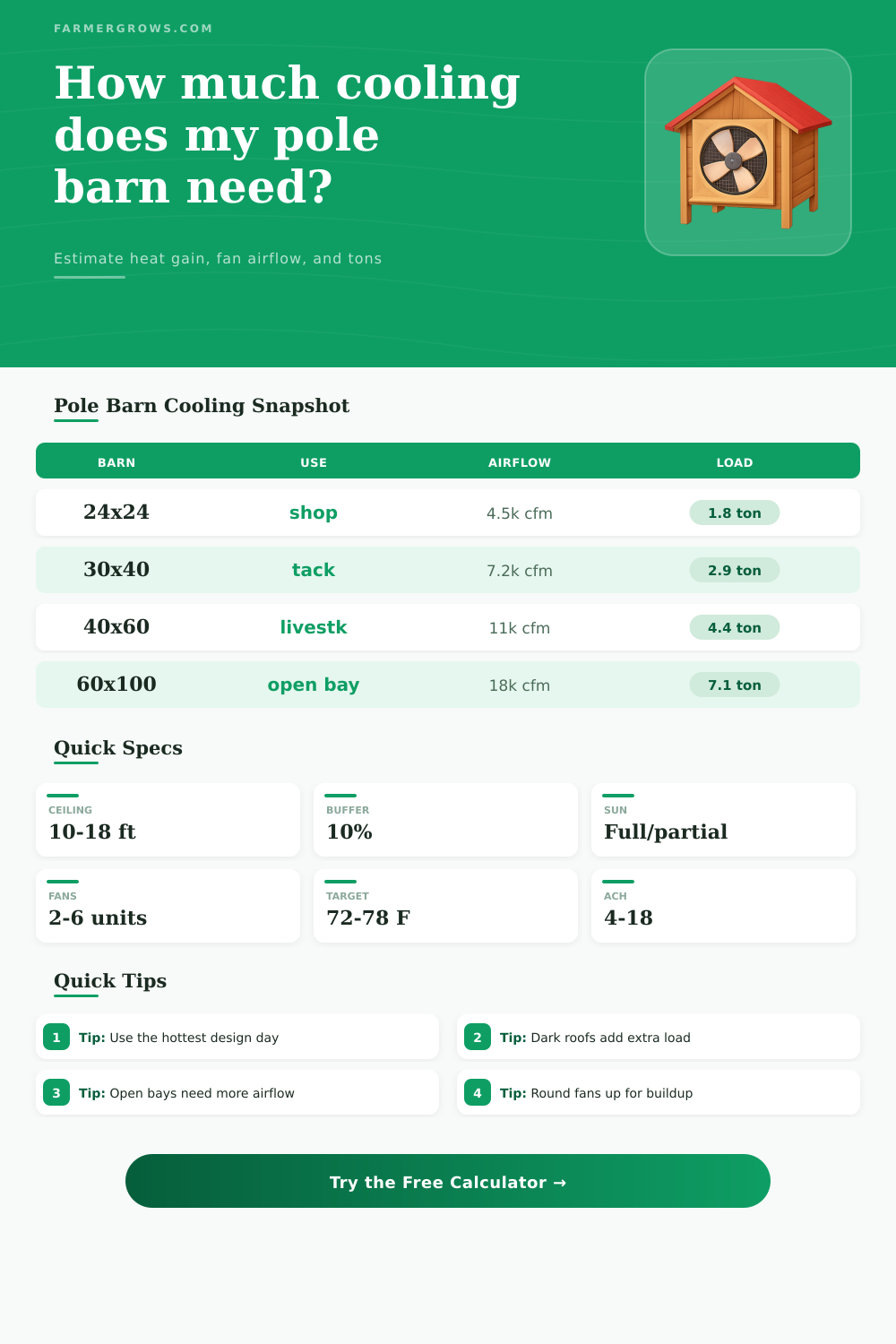
| 24 x 24 | Workshop | 1.8 ton | 1-2 |
| 30 x 40 | Tack room | 2.9 ton | 1-2 |
| 40 x 60 | Livestock | 4.4 ton | 2-3 |
| 60 x 100 | Open bay | 7.1 ton | 3-6 |
Pole barns are often use for workshops or to keep livestock. Pole barns, however, are known to become very hot in hot weather. The metal roof absorbs heat from the sun, and the metal siding allow that heat to leave the pole barn.
Because the interior of the pole barn can become very hot, ventilation is required to allow the hot air to leave the pole barn. Without proper ventilation in the pole barn, the hot air cannot be replaced with cool air, and the heat will build up inside the pole barn to the point where it become difficult to use the pole barn for its intended purposes. The color of the metal roof will impact how much heat the barn absorbs.
How to Keep a Pole Barn Cool and Ventilated
A dark colored metal roof will absorb more heat then a light-colored metal roof. In some cases, using a dark-colored metal roof can increase the amount of heat that enter the pole barn by 15%. Using overhangs or trees to cover the metal roof will reduce the amount of heat that the metal roof absorbs.
Additionally, the height of the walls will influence the amount of air that need to be moved in the pole barn. The taller the walls, the more greater the volume of air in the pole barn. The greater the volume of air, the more air that must be moved to allow for proper ventilation.
The airflow in the pole barn is measured in air changes per hour. Air changes per hour are the amount of times that the air inside the pole barn is replaced each hour. Workshops may require between 4 and 6 air changes per hour.
Livestock shelters, however, may require between 10 and 18 air changes per hour. Livestock shelters require more air changes per hour because animal create body heat. Additionally, most livestock shelters have open sides to the barn so that the animals can exit and enter the shelter.
Other heat sources inside the pole barn include the tools, lights, and welders use inside the pole barn. If these items are not accounted for, the heat that they create will increase the temperature within the pole barn. Pole barns have insulation that determines the amount of heat that move through the walls.
The open-sided barn will have high value of the unit factor (U-values). High U-values indicate that heat will move easy through the poles and barn. Adding sheathing to the barn will reduce the U-values.
Lower U-values mean that the barns insulation is working well to reduce the amount of heat that passes through the poles to the interior. Infiltration is the amount of outside air that enters the pole barn. Even if the pole barn is well insulated, infiltration will increase the temperature within the barn.
The first step in determining the ventilation needs for you pole barn will be to determine the target temperature that you would like to maintain inside the barn. For instance, if the outside temperature is 95 degrees, you might want the temperature inside the pole barn to be between 72 and 78 degrees. The difference between the outdoor and indoor temperature is the temperature delta, or the delta between indoor and outdoor temperature.
The greater the difference in temperatures, the more ventilation that the pole barn will require. Fans move the air within the pole barn. Air movement within the barn will help regulate the indoor temperature within the pole barn.
Different sized pole barns will require a different amount of Cubic Feet per Minute (CFM). Small workshops that are 24 by 24 feet in size might require 4,500 CFM to allow for proper ventilation. Large barns that are used to house livestock and are 40 by 60 feet in size might require 11,000 CFM.
The largest type of pole barns are often open-bay barns that can be 60 by 100 in size and require up to 18,000 CFM for proper ventilation. An exhaust fan needs to be chosen that meets or exceeds the required CFM for that size pole barn. In most instances, it is recommended to provide a 10% buffer in the CFM calculations for the pole barn.
This buffer will ensure that there will be enough ventilation for the barn if the temperature begin to rise, or if the air filters begin to become dusty from the air movement within the pole barn. Fans should be placed high up on the end walls of the barn. The hot air inside of a barn will rise to the top of the barn.
Fans should also be placed low on the sides of the pole barn. By placing fans in these specific locations in the barn, hot air will be drawn out of the barn. If the placement of the fans is incorrect, they will not be able to effective move the air within the barn.
In dry climates, you can install evaporative coolers in the barn to increase the efficiency of the ventilation process by 20 to 30%. One of the mistakes that should of been avoided when building a pole barn is using fans that are too small for the size of the barn. Using fans that are too small for the size of the pole barn will create issues in the barn, such as the tools beginning to warp from the heat, or the interior of the barn may become too hot for the person working in the barn.
To avoid this potential issue, ensure that the ventilation needs for the barn are calculated based off the hottest day of the year, not the average temperature. In addition to calculating the needs of the livestock (if any) or the workshop functions, ensure that you account for the heat that is created by the dark metal roof and the tools in the barn. By calculating these factors, you will ensure that the pole barn will remain a functional space for however you plan to use it.