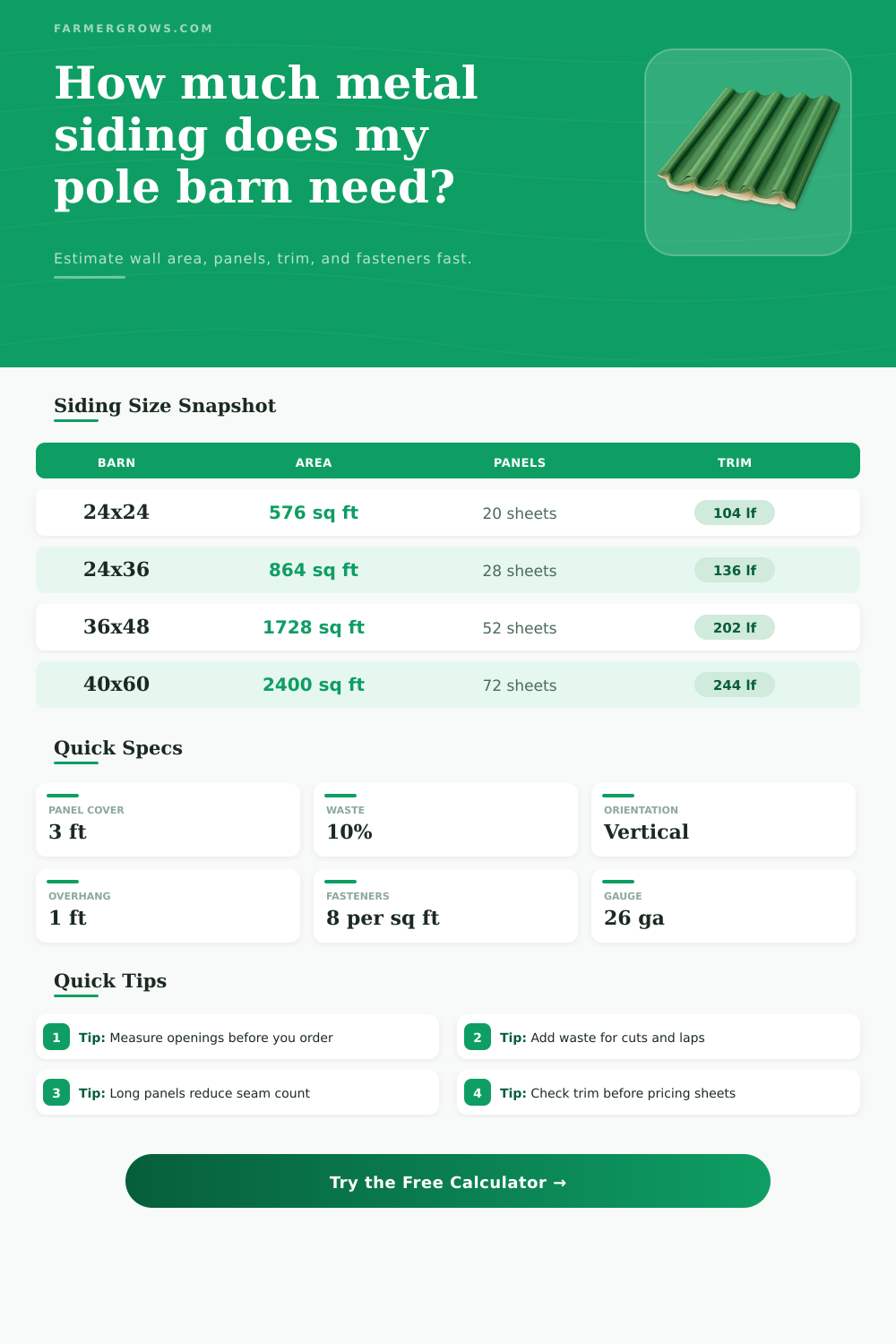
Pole Barn Metal Siding Calculator
Estimate wall area, panel count, trim, and fasteners from a pole barn layout. Switch units, test presets, and see the full breakdown.
Pick a real-world barn shape to seed the calculator. Each preset sets length, width, wall height, pitch, panel cover, panel length, waste, and siding type.
Panel and trim controls
These refine siding area, panel count, trim, and fastener totals. Defaults stay practical for common pole barn builds.
Siding Results
These values update from the selected barn size, wall height, panel size, and siding system.
| Panel system | Wall weight | Roof weight | Notes |
|---|---|---|---|
| 29 ga steel | 0.80 lb/sq ft | 0.80 lb/sq ft | Lightest common shell |
| 26 ga steel | 1.10 lb/sq ft | 1.10 lb/sq ft | Heavier, stiffer panel |
| Board and batten | 2.30 lb/sq ft | 2.30 lb/sq ft | Thicker wood cladding |
| Insulated steel | 1.45 lb/sq ft | 1.45 lb/sq ft | Panel and foam core |
| Post spacing | 24 x 24 | 30 x 40 | 40 x 60 |
|---|---|---|---|
| 6 ft O.C. | 20 posts | 24 posts | 28 posts |
| 8 ft O.C. | 12 posts | 18 posts | 24 posts |
| 10 ft O.C. | 12 posts | 14 posts | 20 posts |
| 12 ft O.C. | 8 posts | 12 posts | 16 posts |
| Roof pitch | Rise / 12 | Slope factor | Use case |
|---|---|---|---|
| 3/12 | 3 in | 1.03 | Low slope shed |
| 4/12 | 4 in | 1.06 | Most barns |
| 5/12 | 5 in | 1.08 | Higher drainage |
| 6/12 | 6 in | 1.12 | Steeper shell |
| Hole size | Depth | Weight / post | Use case |
|---|---|---|---|
| 12 in | 42 in | 0.20 yd3 | Light barn post |
| 12 in | 48 in | 0.23 yd3 | Deeper embed |
| 14 in | 48 in | 0.32 yd3 | Heavier shell |
| 16 in | 54 in | 0.47 yd3 | Large spans |
When building a pole barn, calculating the amount of metal siding require for the barn is a critical aspect of the construction process. Metal siding is a necessary component of pole barn construction. Ordering too little metal siding means you will have to find more metal siding panel during the construction process.
Ordering too much metal siding means you will waste money on metal siding panels that you wont need for the barns construction. Therefore, it is essential to calculate and measure the amount of metal siding that are required before beginning the construction process of the pole barn. Metal siding for pole barns is a common construction option because metal siding is a very durable material and sheds water efficient off the barn structure.
How Much Metal Siding Do You Need for a Pole Barn
The steel panels that are used for metal siding for pole barns is often corrugated or have standing seams such that the metal panels lock together to prevent water from entering the pole barn structure. You can calculate the total area of metal siding panels that are required for a pole barn by multiplying the perimeter of the barn by the height of the barn walls. However, you must also add the area of the gable end of the pole barn to the total area of metal siding panels.
This is because the gable ends have metal siding panels that is attached to the sides of the pole barn. Additionally, you must also subtract the area of the doors and windows of the pole barn from the total area of metal siding panels. This is because there are opening in the walls of the pole barn for these opening components.
Typically, doors and windows account for 10 to 20 percent of the total area of the walls of the pole barn. Including metal siding panels on the doors and windows in these openings will result in order too much metal siding for the structure. A waste factor must be included in the metal siding area calculation.
Metal siding panels do not always fit perfect into the pole barn structure. Some of the metal siding will be wasted during the cutting of the corners of the metal siding panels. A buffer of 10 percent metal siding panels can be included into the area calculation.
However, if the pole barn design is complex or if the individual is relatively new to installing metal siding on pole barn structures, the individual should of include a buffer of 15 to 20 percent metal siding panels into the area calculation. The length of the metal siding panels will impact the installation process. Metal siding panels are available in lengths that include full-height metal panels for barn walls.
Using these metal panels will reduce the number of horizontal seam in the barn structure. Fewer horizontal seams mean that there are fewer points of entry for water to enter the barn structure. Additionally, metal siding panels are available in a variety of shapes and sizes.
Rectangular pole barns are common in agricultural settings because they are often the same width as the equipment that needs to be stored in the barn. Square pole barns are also useful in barn construction as they are efficient in their use of storage space in compact areas. The walls of a pole barn have a height between 10 and 16 feet to provide sufficient clearance for many types of agricultural tractor vehicle.
The slope of the roof of a pole barn will also impact the amount of metal siding panels that are required to cover the structure. Steeper roof pitches will require more metal siding panels to cover the roof structure. Overhangs on the barn walls are often constructed to protect the barn from rain that can fall on the barn walls.
The gauge of the metal siding panels will determine the weight of the metal siding panels. 29-gauge metal siding is thinner than 26-gauge metal siding panels. The 29-gauge metal siding panels are easier to handle when installing them on the pole barn structure.
Additionally, the 29-gauge metal siding panels weigh approximately 0.8 pound per square foot. 26-gauge metal siding panels are thicker than 29-gauge metal siding panels. This thickness of the 26-gauge metal siding panels make them more resistant to dents that may be caused by hail or farm and tractor branches.
The 26-gauge metal siding panels weigh more than 29-gauge metal siding panels, approximately 1.4 pounds per square foot. Additionally, metal siding panels can be even heavier than 26-gauge metal siding panels. For instance, insulated metal panels can weigh up to 2 pounds per square foot.
The weight of the metal siding panels is another consideration in barn construction because the post and the girts of the pole barn will support the metal siding panels. Metal trim is often used on pole barns to seal any gaps between the metal siding panels and the frame of the pole barn. Vertical metal trim is used at the corners of the barn.
Base metal trim is used at the bottom of the barn walls. Eaves metal trim is used on the overhangs of the barn walls. Finally, rake metal trim is used along the slopes of the gable ends of the barn.
Metal fasteners will hold the metal siding panels to the pole barn structure and the metal trim components. Eight metal fasteners are used per sheet of metal siding panels. The spacing of the posts will also impact the amount of metal trim that is needed to construct the barn.
The spacing of the posts will determine the placement of the metal girts that will support the metal siding panels on the barn walls. Different type of pole barns have different metal siding panel considerations. For instance, livestock barns will have large doors in the barn walls that will reduce the amount of metal siding panels that is required for that barn.
Additionally, livestock barns may require thicker metal trim panels for the bases of the barn to protect the flooring from moisture from the ground. Machine sheds that are constructed as pole barns may have an open-sided construction that reduces the amount of metal siding panels that are required to construct those sheds. The shed will only require metal siding panels on the back and end wall of the shed.
However, you must measure the measurements of the doors for these sheds because the metal siding panels for those sheds will be constructed according to the dimension of the shed doors. Additionally, considering the longevity of the metal panels often determines the type of metal siding panels. Metal siding panels that have galvalume coating will prevent rust in the metal siding panels for many year.
Additionally, all metal joinings should be installed to face downhill slopes on the pole barn structure. Another consideration when constructing metal siding panels for pole barns is the placement of the girts. You should install the girts at regular intervals around the pole barn walls, such as every four feet.
Installing the girts at regular intervals will provide the metal siding panels with the necessary support to avoid sagging or waving metal siding panels. Finally, another consideration when installing metal siding panels on pole barn structures is to review the local building code for those barn structures. Local building codes may require specific type of metal fasteners to be used for metal siding panels on pole barns.
Additionally, building codes may also require specific wind rating for metal siding panels on pole barns. The moddern metal siding can be installd based off the design needs. Youll need to recieve the panels early.
It isnt always easy but it is actualy worth it to get the metal siding right.