Pole Barn Footing Calculator
Estimate footing count, hole volume, gravel base, concrete bags, and excavation totals from your barn layout. Switch units, test presets, and compare footing sizes fast.
Pick a real-world barn layout to preload footing spacing, hole depth, bell size, gravel base, and soil assumptions. Each preset is built to give you a practical starting point for planning and permit checks.
Footing Results
Enter your barn dimensions and footing settings to see the full layout check.
| Post size | Hole dia | Bell dia | Typical use |
|---|---|---|---|
| 4x6 | 12 in | 18 in | Light walls |
| 6x6 | 14 in | 24 in | Most barns |
| 6x8 | 16 in | 28 in | Wider bays |
| 8x8 | 18 in | 30 in | Heavy roof |
| Depth | ft³/hole | yd³/hole | 80-lb bags |
|---|---|---|---|
| 36 in | 4.6 | 0.17 | 8 |
| 42 in | 5.3 | 0.20 | 9 |
| 48 in | 6.0 | 0.22 | 10 |
| 60 in | 7.5 | 0.28 | 13 |
| Bag size | Yield | Per yd³ | Notes |
|---|---|---|---|
| 40 lb | 0.30 ft³ | 90 bags | Small patch |
| 60 lb | 0.45 ft³ | 60 bags | Hand pour |
| 80 lb | 0.60 ft³ | 45 bags | Common size |
| Bulk mix | 1 yd³ | 1 truckyard | Fastest fill |
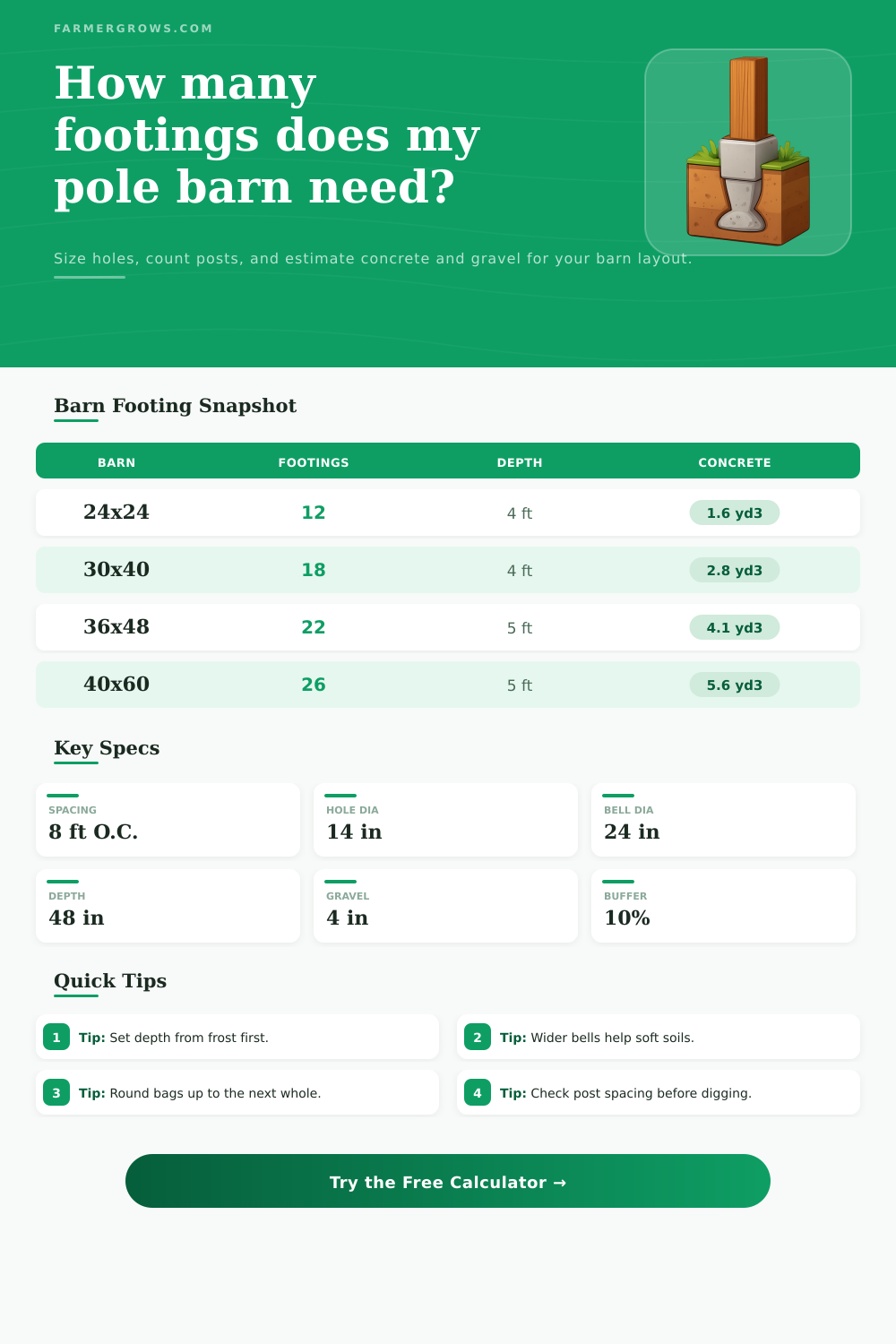
| Barn size | Spacing | Footings | Concrete |
|---|---|---|---|
| 24x24 | 8 ft | 12 | 1.6 yd³ |
| 30x40 | 10 ft | 18 | 2.8 yd³ |
| 36x48 | 8 ft | 22 | 4.1 yd³ |
| 40x60 | 10 ft | 26 | 5.6 yd³ |
Set the hole depth first, then adjust the bell and gravel base. In cold climates, frost line depth usually matters more than the post size alone.
When the soil is weak or wet, a wider bottom can spread the load better. Keep the overage buffer for waste, cleanup, and field adjustments.
When building a pole barn, determining the correct depths and width for the post holes is an essential task. The post holes will ultimately bear the weight of the pole barn. If the depth and width of the post holes isnt adequate for the weight of the pole barn, the pole barn could eventually shift or even tilt.
There are several factors that you must consider when determining the dimensions of the post holes, including the soil type in the area, the frost line in the area, and the weight of the pole barn. The frost line in the area where the barn will be built determines the depth of the post holes. In many cold regions of the country, the frost line is four feet deep or deeper into the ground.
How Deep and Wide to Dig Post Holes for a Pole Barn
In these areas, building the post holes below the frost line prevents the pole from being pushed out of the ground due to the expansion of the soil when it freezes. Even in areas that have a mild climate, digging the post holes below the active soil layer is recommended, as the active soil layer will experience seasonal freezing and thawing. The soil type in the area also play a role in the depth of the post holes.
Areas with wet clay soil will require deeper post holes than areas with firm soil. The size of the buildings posts also plays a role in the size of the post holes. An 8×8 post will require larger post holes than a 4×6 post.
A bell footing is a type of post footing that features a wider base than the upper portion of the footing. To create a bell footing, the worker digs the post hole vertically to the required depth of the footing, and the bottom of the hole is flared to create a wider footing at the bottom of the post than the top of the footing. This type of footing is helpful in situations where the soil is soft, and the footing will need extra stability.
A layer of gravel are placed at the bottom of the bell footing before the concrete is poured into the hole. Four inches of gravel is typically placed into the hole. This gravel layer will help with drainage for the post and keep the poured concrete from becoming dirty due to contact with the soil.
The remaining portion of the hole is filled with concrete to cover the wood post. The total number of footings that are required for the pole barn are calculated based off the shape and the size of the pole barn. You can measure the length of the pole barn and the width of the pole barn.
Each dimension can then be divided by the desired distance between the posts to determine the total number of posts that will be required to construct the barn. The barn will require more posts if it is to be a stiffer frame structure that can resist more lateral movement, or it may require fewer posts if the lumber used to construct the barn are thicker. Determining the amount of concrete that will be needed for the pole barn is a critical task in the construction process.
The volume of each post hole need to be calculated. The volume of each post hole will be multiplied by the total number of posts for the barn to determine the total volume of concrete that will be needed. Since bell footings will be used for each post hole, the volume of each post hole will be greater than if the holes were straight holes dug into the ground.
The volume of the gravel layer will also be calculated to determine the total volume of concrete that will be poured into the holes. Adding ten percent to this total volume is a helpful estimate to account for spills of the concrete or unevenness of the ground. If eighty-pound bags of concrete will be used for the barn, each bag will contain 0.6 cubic feet of concrete.
Drainage for the pole barn will require placing gravel within each post hole. When gravel is not placed within the post hole, water will pond within the post hole. The standing water within the post hole can cause the concrete to degrade over time due to contact with water, or the wood posts can rot.
Finally, prior to the construction of the pole barn, it is necessary for each builder to review the local building codes. In some cases, local building codes will require that an engineer approve the construction plans for the pole barn and it’s post holes. Some of the most common mistakes for pole barn builders are to dig the post holes prior to completing the layout of the barn, not to account for the frost line, digging straight post holes into weak soil instead of using bell footings, and not accounting for the strength of the soil in which the posts will sit.
To avoid these mistakes, it is helpful to test the soil prior to building the barn and consider the dimensions of the post holes that will be dug into the ground. Following the information discussed in this article on constructing post holes for pole barns, if the dimensions of each post hole are carefully planned and each volume of concrete is calculated correctly and gravel is included in each hole, the pole barn will remain stable for many years. You should of considered the soil type too.