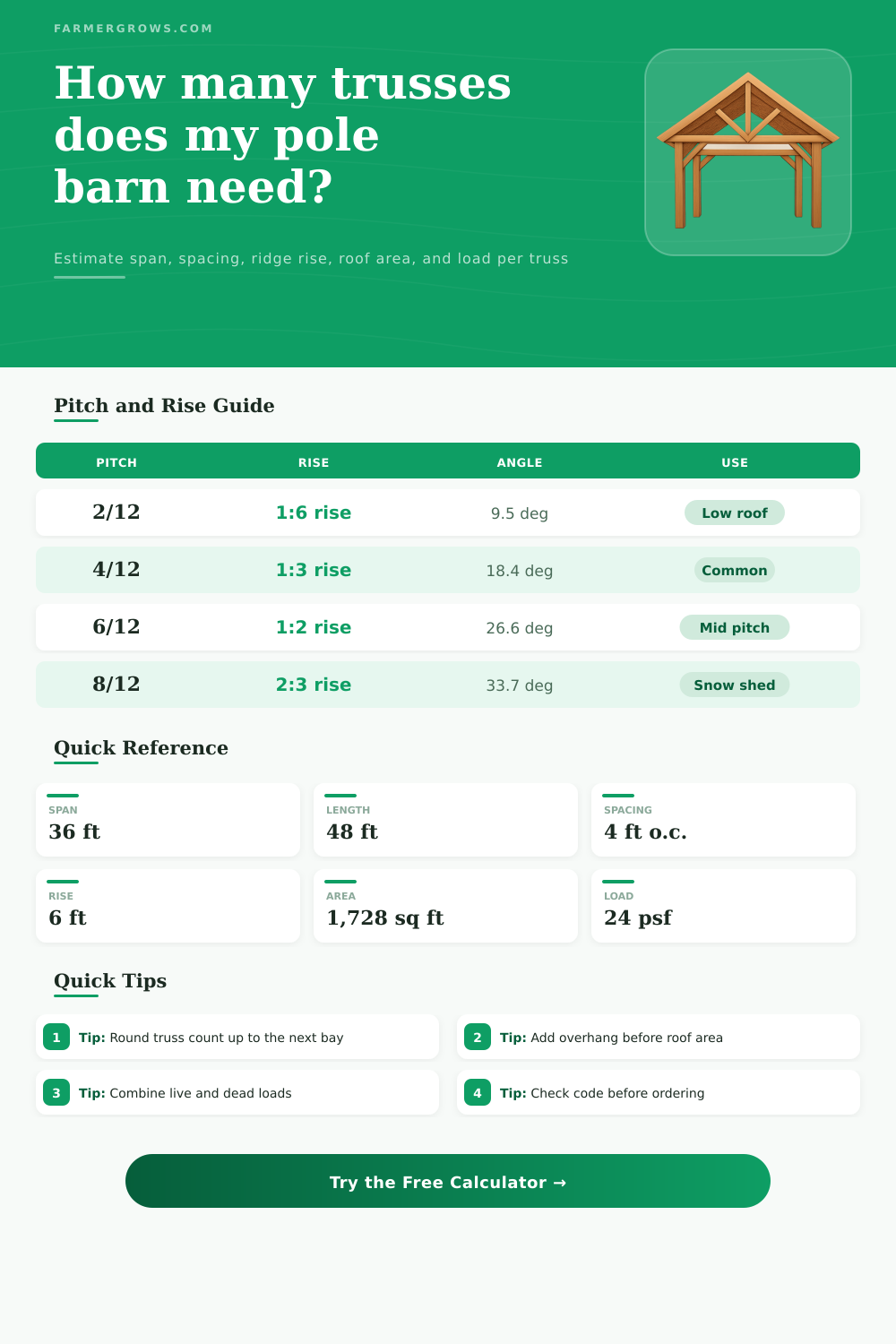
🏗 Pole Barn Truss Calculator
Estimate truss count, peak height, roof area, and design load from a pole barn layout.
| Pitch | Rise per 12 | Slope angle | Common use |
|---|---|---|---|
| 2/12 | 2 in | 9.5 deg | Low roof |
| 4/12 | 4 in | 18.4 deg | Common shed |
| 6/12 | 6 in | 26.6 deg | Mid pitch |
| 8/12 | 8 in | 33.7 deg | Snow shed |
| 10/12 | 10 in | 39.8 deg | Steeper roof |
| 12/12 | 12 in | 45.0 deg | Very steep |
| Spacing | 40 ft bay count | Trusses | Notes |
|---|---|---|---|
| 2 ft o.c. | 20 bays | 21 trusses | High density |
| 4 ft o.c. | 10 bays | 11 trusses | Very common |
| 5 ft o.c. | 8 bays | 9 trusses | Often on wider spans |
| 8 ft o.c. | 5 bays | 6 trusses | Use only where allowed |
| Building | Span | Length | Typical use |
|---|---|---|---|
| 24 x 32 | 24 ft | 32 ft | Small shed |
| 30 x 40 | 30 ft | 40 ft | Workshop |
| 40 x 60 | 40 ft | 60 ft | Equipment barn |
| 50 x 80 | 50 ft | 80 ft | Hay storage |
| 60 x 100 | 60 ft | 100 ft | Large storage hall |
| Assembly | Dead load | Typical use | Note |
|---|---|---|---|
| Bare frame | 2 psf | Simple shell | Allowance only |
| Standing seam metal | 3 psf | Light roof | Common on barns |
| Metal with purlins | 4 psf | Ventilated roof | Popular option |
| Insulated panel | 5 psf | Energy shell | Higher dead load |
| Shingle package | 8 psf | Residential look | Heavier roof |
| Heavy finish | 12 psf | Tile / premium | Check engineered plan |
When building a pole barn, determining the correct amount of trusses to use on the barns roof is essential. The number of truss required for a pole barns roof depends on the barns width, the distance between each truss, and the weight of the roof materials. Trusses are structural frame that will support the roof and transfer the weight of the roof down to the posts that support the pole barn.
Using the incorrect number of trusses for the roof will place too much weight onto the posts and may cause the roof to sag or fail under the weight of the snows and the wind. The span of the barn is the distance between each post. The span will determine the weight that each truss will carry for the pole barn.
How Many Trusses Do You Need for a Pole Barn Roof
For pole barns with a narrow span, such as one under 30 feet in width, you can place the trusses further from each other to save on building material. For pole barns with a wider span, such as one that is 60 feet in span, the trusses has to be closer together or made of heavier trusses to even support the wider span of the barn. The pitch of the roof is the slope of the roof.
Steep pitch, such as 8/12, will allow the snow to easily slide off the roof. However, steep pitches will also increase the height of the pole barn. Shallow pitches, such as 4/12, will create a lower roof but may accumulate snow on the roof.
The dead load is the weight of the roof materials. The live load is the weight of the snow and the wind that land on the roof. You has to calculate the dead load of the roof to ensure that the trusses will be strong enough to support the barn.
Metal roofs have a low dead load. However, roofs with shakes or insulated panels have a higher dead load. Because insulated panels have a higher dead load, they require a beefier trusses for support.
The overhang of the roof will also add to the total area of the roof. Therefore, overhangs will also add to the total weight of the roof that the trusses have to support. The spacing between the trusses is the distance between the center of each truss.
Four feet on center is the standard spacing between each truss. Two feet on center may be required if the pole barn will be located in an area with high wind. Additionally, two feet on center may also be required if the roof will use very heavy roof material.
To calculate the total number of trusses for the barn, divide the total length of the pole barn by the spacing of the trusses. Then, round that number to the next highest whole number. This is to ensure that there is enough trusses to even frame the gables at each end of the barn.
The style of the trusses will change the shape of the roof and the amount of materials that is required to build the pole barn. A Fink truss uses webs to distribute the load of the roof to each truss evenly. Fink trusses are common for pole barns.
A raised heel truss raises the roof to allow space for the roofs insulation. However, the total height of the barn will also increase with the use of raised heel trusses. An attic truss allows space under the peak of the roof for storage.
This is useful for barns that will contain workshops or tools. A few common mistakes should of been avoided when building pole barn trusses. One common mistake is forgetting to use the weight of the purlin and liner panels in the roofs dead load calculation.
Using a lower dead load will result in trusses that cracks under the weight of the roof. Another mistake is using a custom pitch for the roof without checking the length of the rafters that the builder will use on each truss. If the roof has a steep pitch and a wide span, the rafters will be too long for each truss.
Finally, ensure that the posts under the trusses are large enough. Six-by-six posts may work for barns with light roofing materials. However, eight-by-eight posts is necessary for barns that contain heavy roofing materials.
Lastly, each region of the U.S. Have building codes that dictate the number of trusses that must be used on each barn. In the northern regions of the U.S., the snow drift allowances may require more trusses to be built into the corner of the barn. In the coastal regions of the country, the wind uplift that is common may require stronger connections between the trusses.
However, engineered barn drawings will provide the code requirements for your specific location. With the number of trusses determined and the distance between each truss found, you can order the trusses for your pole barn and begin building the structure.