Hydraulic Pump Efficiency Calculator
Measure flow, pressure, shaft power, and displacement to see how efficiently your pump is really working.
| Pressure | 1 gpm | 5 gpm | 10 gpm |
|---|---|---|---|
| 500 psi | 0.29 hp | 1.46 hp | 2.92 hp |
| 1000 psi | 0.58 hp | 2.92 hp | 5.83 hp |
| 2000 psi | 1.17 hp | 5.83 hp | 11.66 hp |
| 3000 psi | 1.75 hp | 8.75 hp | 17.49 hp |
| Displacement | 1000 rpm | 1500 rpm | 2000 rpm |
|---|---|---|---|
| 0.5 in3/rev | 2.16 gpm | 3.25 gpm | 4.33 gpm |
| 1.0 in3/rev | 4.33 gpm | 6.49 gpm | 8.66 gpm |
| 1.5 in3/rev | 6.49 gpm | 9.74 gpm | 12.99 gpm |
| 2.0 in3/rev | 8.66 gpm | 12.99 gpm | 17.32 gpm |
| Pump type | Typical overall | Pressure band | Notes |
|---|---|---|---|
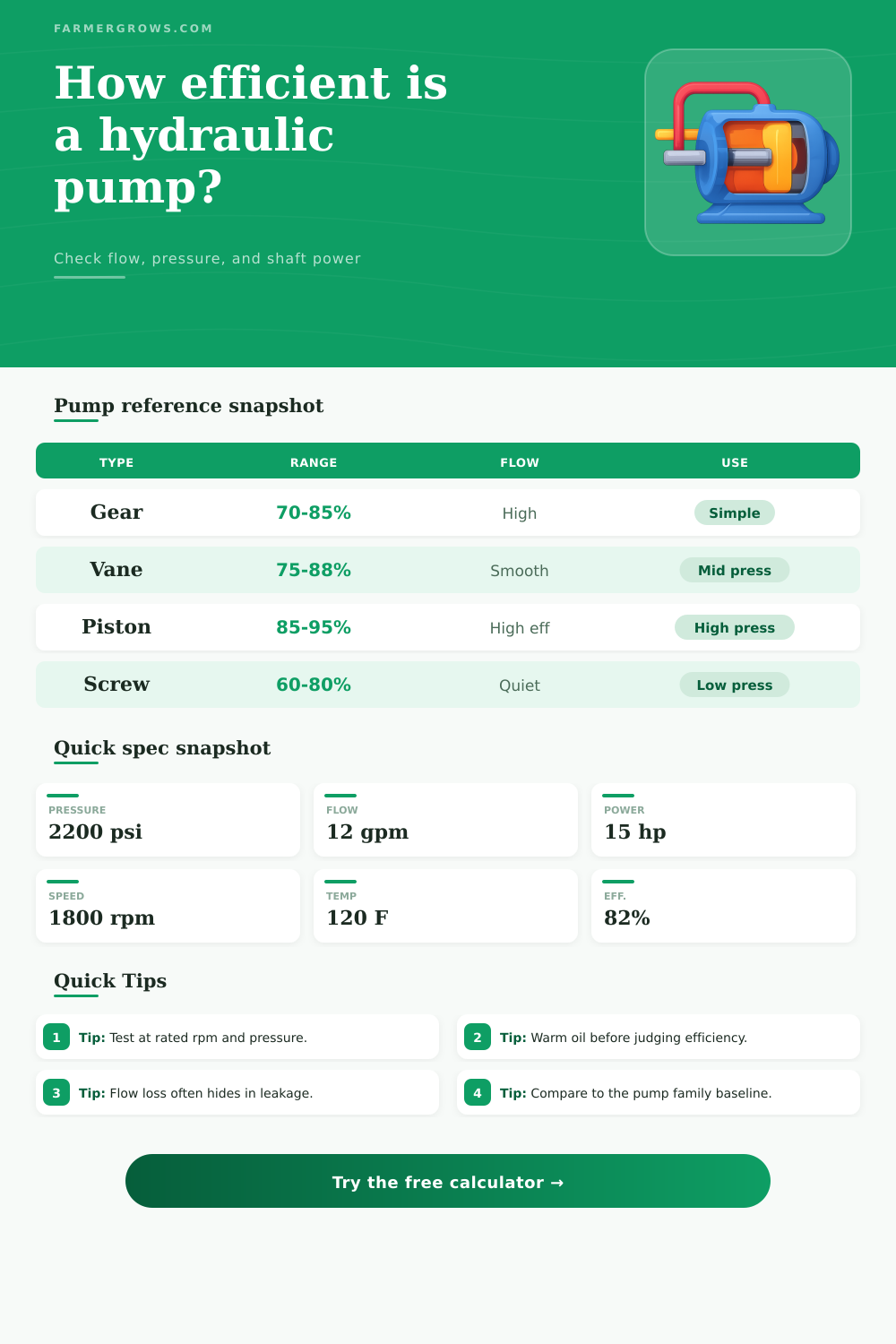
| Gear | 70-85% | 1.5-3k psi | Durable, simple |
| Vane | 75-88% | 1.5-2.5k psi | Smooth, quiet |
| Axial piston | 85-95% | 3-6k psi | Best efficiency |
| Radial piston | 85-92% | 5k+ psi | High pressure |
| Fluid temp | Condition | Factor | Effect |
|---|---|---|---|
| 50 F / 10 C | Cold start | 0.90 | More loss |
| 86 F / 30 C | Cool | 0.97 | Near normal |
| 104 F / 40 C | Ideal range | 1.00 | Best read |
| 140 F / 60 C | Warm | 0.98 | Still good |
Tip: Measure flow at rated speed and pressure so the efficiency reading reflects actual loading.
Tip: Warm the oil first; cold oil can make leakage and power loss look worse than they are.
Hydraulic pump efficiency are a measurement of how effective a hydraulic pump is at converting teh mechanical power of the shaft into hydraulic power. A hydraulic pump isnt able to convert all of the mechanical power to the hydraulic power due to factors like internal leakage and friction within the pump. Internal leakage is the movement of hydraulic fluid past the internal components of the pump, while friction are the loss of power due to the mechanical components of the hydraulic pump.
There are several type of efficiency for a hydraulic pump that should be measured. Volumetric efficiency is a measurement of the ratio of the actual flow produced by a hydraulic pump to the theoretical flow that the pump can produce. Mechanical efficiency is the measurement of the hydraulic power out of the pump divided by the input power.
How to Measure Hydraulic Pump Efficiency
Overall efficiency is calculated by multiplying the volumetric efficiency by the mechanical efficiency. Overall efficiency indicate the true efficiency of the pump while it is under a load. In order to measure the efficiency of a hydraulic pump, several tools is required.
A flow meter will measure the flow out of the pump, a pressure gauge will be used to measure the pressure of the hydraulic fluid, and a torque sensor will measure the input power of the pump. These measurements must all be taken with the hydraulic fluid at it’s operating temperature. Using cold hydraulic fluid will create more internal leakage of the fluid, which will lead to lower volumetric efficiency of the pump.
The efficiency of the pump can change based off the load that the pump creates, the speed at which the pump is running, and the temperature of the hydraulic fluid. Therefore, it is important to be able to measure these factors to gain an understanding of the efficiency of the hydraulic pump. Hydraulic pump efficiencies can differ for each of the different types of pump.
Gear pumps are often used for mobile equipment due to the fact that they are both durable and inexpensive to purchase. Gear pumps have an efficiency of between 70 and 85%. If the pressure is increased for a gear pump, the slippage of hydraulic fluid will increase.
Vane pumps have an efficiency of between 75 and 88%. Vane pumps tend to operate more quiet than gear pumps. Piston pumps have an efficiency of between 85 and 95%.
These pumps are used for high demand in industries like excavators. Screw pumps have an efficiency of between 60 and 80%. These pumps provide very quiet hydraulic fluid movement, and are often used for low pressure lubrication tasks.
The efficiency of a hydraulic pump will change according to the temperature of the hydraulic fluid within the pump. At low temperatures, hydraulic fluid efficiency will be lower because the hydraulic fluid will have a higher viscosity. As the temperature of the hydraulic fluid increases within the pump, the hydraulic fluid will become less viscous, thus increasing the efficiency of the pump.
Therefore, it is critical to maintain a stable temperature of the hydraulic fluid during the efficiency testing of the hydraulic pump. To calculate the hydraulic power of a hydraulic pump, the pressure of the hydraulic fluid is multiplied by the flow create by the fluid, and the resulting number is divided by 1,714 to convert the units to horsepower. To calculate the overall efficiency of the hydraulic pump, the hydraulic power is divided by the input shaft power of the pump.
Flow loss is calculated as the difference between the actual flow of fluid from the pump and the theoretical flow. The theoretical flow can be calculated by multiplying the displacement of the pump by the revolutions per minute of the pump, and dividing the result by 231. Heat load is the difference between the shaft power of the pump and the hydraulic power of the pump.
Any percent of inefficiency in the hydraulic pump will result in the creation of heat that must be released from the reservoir of hydraulic fluid. Certain mistake should be avoided when measuring the efficiency of a hydraulic pump. One mistake is to perform the tests while the hydraulic pump is unladen.
The flow of an unladen hydraulic pump will appear to be high due to the lack of resistance to the fluid movement, but the efficiency will be a false reading. Another mistake would of to forget to measure the shaft power of the hydraulic pump. The efficiency of the hydraulic pump cant be calculated if the shaft power is not measured.
One additional mistake would be to forget the speed of the hydraulic pump. The theoretical flow of the pump is mathematical related to the speed at which the pump is rotating. Finally, it is important to not ignore the heat of the hydraulic fluid.
If the hydraulic pump is inefficient, the temperature of the hydraulic fluid will increase, indicating the need for a larger cooler to prevent the formation of varnish in the fluid.