
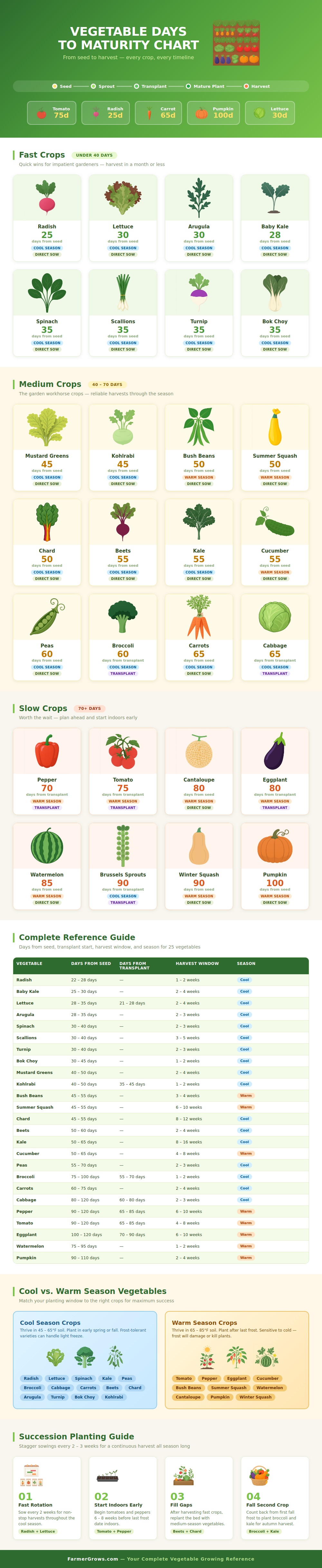
To successfully grow a gardens, it is important to understand the days to maturity for each type of crops. The days to maturity for a crop is equal to an amount of time that passes between the time that you plant the seeds and the time that the crop is mature and ready to be harvested. By understanding the days to maturity for each crop, you are able to successfully plan when to plant the seeds.
Additionally, knowing the days to maturity for each type of crop will ensure that the crops matures and are ready for harvest prior to the change in weather. Most crops can be categorized according to the type of soil that they requires to grow. For instance, there is cool-season crops and warm-season crops.
When to Plant and When to Harvest Your Garden
Cool-season crops include crops like radishes, lettuce, spinach, and Brussels sprouts. These crops can grow in soil that is cooled and can even survive a light frost. Warm-season crops, like tomatoes, peppers, eggplants, and melons require warm soil and warm air to grow.
If you plant warm-season crops into soil that is too cold for these types of plants, the crops will not grow or will dies. Because of this, you should plant warm-season crops only after checking the soil temperature. Beyond soil requirement, crops can also be categorized according to the number of days that it take for the crops to reach maturity.
Fast crops are crops that reach maturity in a short amount of time. Radishes, for instance, take only about twenty-five days to reach maturity and can be planted into cool soil. Radishes will help to utilize the garden space during the early spring.
Medium crops take a moderate period of time to reach maturity. Bush beans and summer squash is two examples of medium crops and take about fifty days to mature. Beets and carrots are also medium crops and take between fifty-five and sixty-five days to mature.
Slow crops, as the name implies, take the longest period of time to reach maturity. Pumpkins are slow crops and take one hundred days to mature. Additionally, pumpkins requires a significant amount of space within the garden.
Another planting strategy is known as succession planting. Succession planting requires that you plant crops of different types at different times within the growing season. Succession planting can be seen in the requirement to plant radishes every two weeks during the cool part of the season, followed by beets or chard that can be planted into the space where radishes was growing.
Succession planting can also be used to plant warm-season crops, such as squash, into the same space after you have harvested fast-growing crops. By planting different types of crops at different times of the season, succession planting helps to increase the amount of food that can be grown within a single growing season. In addition to succession planting, it is critical for gardeners to become aware of the time periods in which the crops are at they’re best for eating.
These time periods are referred to as harvest windows. If radishes is harvested too late, they may become spongy. If summer squash is allowed to grow past its harvest window, it will become more large and tough to eat.
By checking the crops daily, gardeners will be able to ensure that the crops is harvested at the appropriate time period. However, there are some common mistakes made by gardeners who are attempting to establish productive gardens. One mistake is to crowd the plants within the garden.
Crowded plants prevent those plants from receiving the light and air that it need to grow properly. Another mistake is to inconsistently water the plants within the garden. If the roots of the plants grows in irregular ways, this may indicate that the plants are not watered consistent.
A third mistake is to fail to test the soil within the garden prior to planting. The nutrients within the soil is necessary for the growth of the plants, and a soil test will indicate whether or not the soil contain the nutrients that the plants require. Finally, another mistake is to fail to rotate the crop family within the garden.
Each plant family utilizes the nutrients within the soil differently. By rotating the crop families, you can maintain the soil in an optimum state for the plants within the garden.