
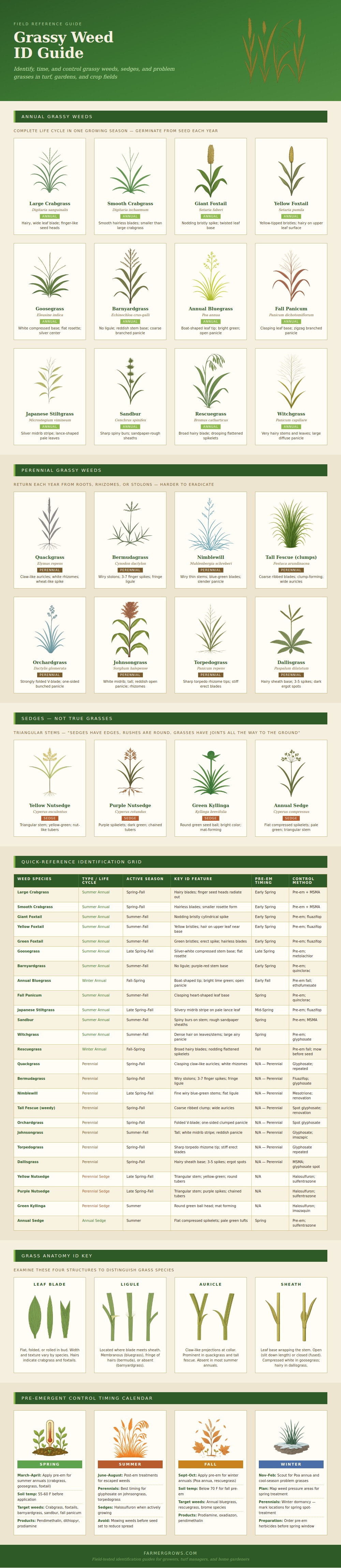
Grassy weeds must be identify because grassy weeds look alot like desirable lawn grass. If you dont correctly identify the grassy weeds in your lawn, you could potentially remove the desirable lawn grass along with the weed. Therefore, you must correctly identify each type of grassy weed to effective treat the lawn with the correct herbicide.
Many type of grassy weeds can be identified by examining the stem of the weeds. True grasses has stems that are round and hollow, and the stems have joints along the plants that go to the ground. Sedges has triangular stems with edges to them.
How to Identify and Treat Grassy Weeds in Your Lawn
Rushes have round stems to them. Therefore, feel the stems of the suspected grassy weeds to determine if they have round stem or triangular stems. If the stems are sedges, they will not respond to herbicide that target true grasses.
Summer annual weeds grow only during the growing season and emerge when the soil temperature reach fifty-five degrees. Crabgrass is one of the most common summer annual weed. Crabgrass can be either large crabgrass or smooth crabgrass.
Large crabgrass has wide blades to its leaves with hairy texture, while smooth crabgrass has sleeker leaf. You can use pre-emergent herbicides such as pendimethalin to prevent crabgrass from establishing root. Foxtails are summer annual weeds with giant foxtails with bristly spike or yellow foxtails with yellow tips to their leaves.
Goosegrass is another type of summer annual weed that grow in compacted soils, especially areas where mower tire travel frequently. Perennial weeds will grow back each year when the area experience the frost in the spring. Quackgrass is a perennial weed with white rhizomes that grows underground, along with the claw like auricles that hold onto the stems of the plants.
Johnsongrass weeds have a white stripe in the middle of the leafs midrib, along with red flower panicle. Torpedograss weed has stiff blades to its leaves, as well as shark-nosed rhizomes that grow underground. Perennial weeds must be treated with glyphosate when they are actively grow in the summer season.
Sedges are weeds that has specific treatments for them. Yellow nutsedge weeds are yellow-green in color and have tubers that is similar to nuts, while purple nutsedge has a darker color with underground network of roots to other sedge weeds. Green kyllinga is a sedge weed with green seed ball that grow in wet areas.
Use the herbicide halosulfuron to treat sedges, as these herbicides is different than herbicides that target grass weeds. You can identify weeds by four different part of the plant. The first part is the leaf blade.
Leaf blades can be flat, folded, or narrow. The second part is the ligule. The ligule is the area where the leaf blade meet the sheath of the plant.
The ligule can be membranous, hairy, or entirely absent. The third part is the auricle. The auricle is the structure on the leaf that may or may not clasp the stem of the plant.
The last part is the sheath. The sheath is the part of the plant that wrap around the stem. Therefore, by examining the leaf blades, the ligules, the auricles, and the sheaths of the weeds, you can identify the type of weeds to the correct classification.
Timing is important when treating the weeds in your lawn. You should apply pre-emergent herbicides to the lawn in March and April when the soil temperature is between fifty-five and sixty degrees to prevent summer annual grass weeds from emerge in the lawn. Perennial weeds should be treated during the summer with glyphosate when the weeds are actively growing.
In the fall, when the soil temperatures drop below seventy degrees, you should treat winter annual grass weeds. Finally, before the weeds form seed heads, you should regularly mow your lawn to prevent the weeds from adding more seed to the soil.