💩 Manure Production Calculator
Estimate daily, monthly, and annual manure output by livestock type and herd size
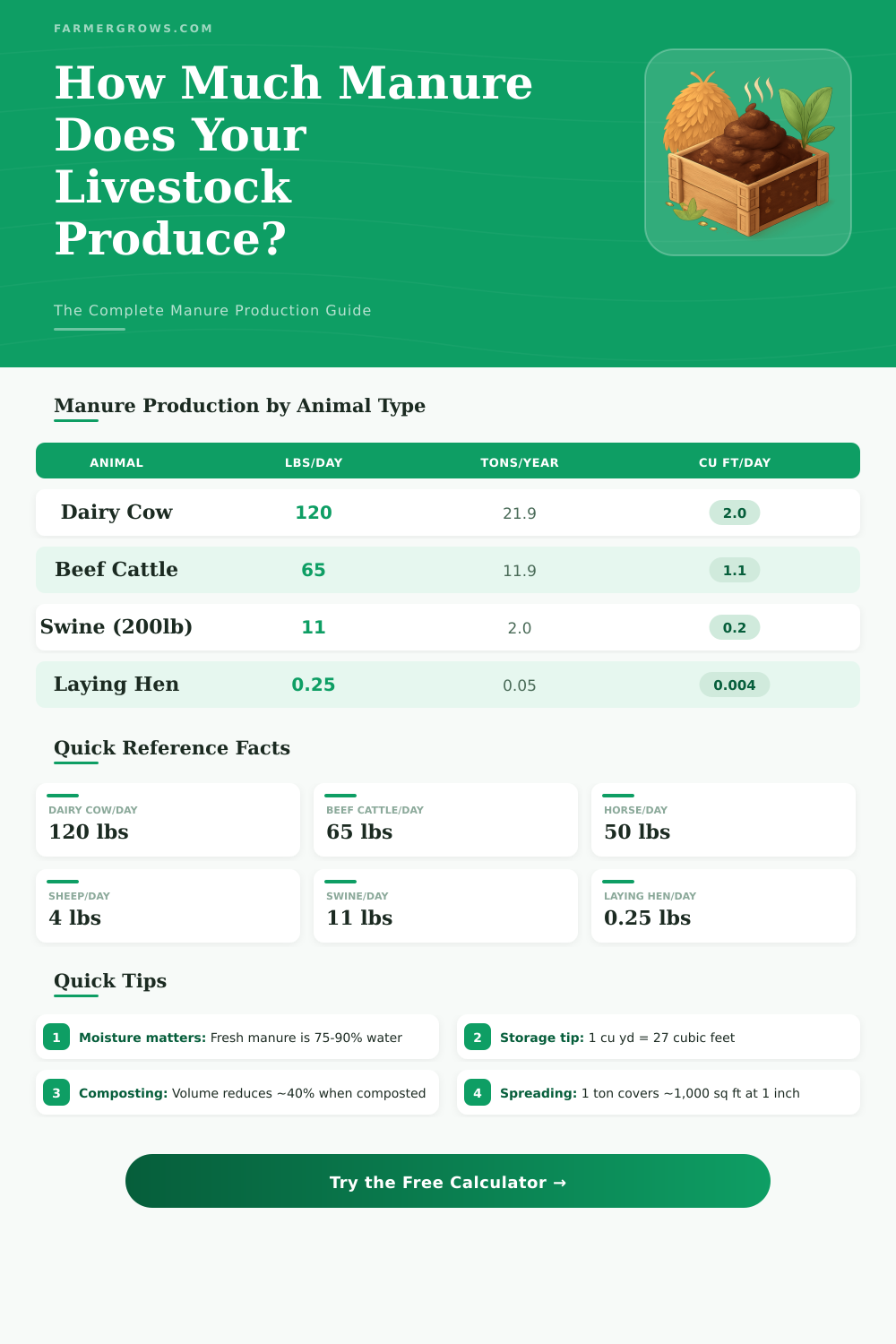
| Animal | Lbs / Day | Tons / Year | Cu Ft / Day | Gallons / Day |
|---|---|---|---|---|
| Dairy Cow (1,400 lb) | 120 | 21.9 | 1.92 | 14.4 |
| Beef Cattle (1,000 lb) | 65 | 11.9 | 1.04 | 7.8 |
| Horse (1,000 lb) | 50 | 9.1 | 0.80 | 6.0 |
| Swine (200 lb market) | 11 | 2.0 | 0.18 | 1.3 |
| Sheep / Lamb (100 lb) | 4 | 0.73 | 0.064 | 0.48 |
| Goat (100 lb) | 3.5 | 0.64 | 0.056 | 0.42 |
| Laying Hen (4 lb) | 0.25 | 0.046 | 0.004 | 0.03 |
| Broiler Chicken (5 lb) | 0.20 | 0.037 | 0.003 | 0.024 |
| Turkey (20 lb) | 0.50 | 0.091 | 0.008 | 0.060 |
| Duck (6 lb) | 0.33 | 0.060 | 0.005 | 0.040 |
| Manure Form | Moisture % | Lbs / Cu Ft | Lbs / Gallon | Volume Factor |
|---|---|---|---|---|
| Liquid / Slurry | 94% | 62 | 8.3 | 1.30x |
| Semi-Solid | 80% | 55 | 7.3 | 1.00x baseline |
| Solid / Dry | 65% | 45 | 6.0 | 0.75x |
| Composted | 40% | 35 | 4.7 | 0.60x |
| Herd (Dairy Cows) | Cu Yds / Month | Cu Meters / Month | Tons / Month | 6-Month Storage (cu yd) |
|---|---|---|---|---|
| 10 cows | 16.0 | 12.2 | 18 | 96 |
| 25 cows | 40.0 | 30.6 | 45 | 240 |
| 50 cows | 80.0 | 61.2 | 90 | 480 |
| 100 cows | 160.0 | 122.4 | 180 | 960 |
| 250 cows | 400.0 | 306.0 | 450 | 2,400 |
| Operation Type | Typical Herd | Daily Production (tons) | Annual Production (tons) |
|---|---|---|---|
| Small Hobby Farm | 5 cows | 0.3 | 109 |
| Small Dairy | 50 cows | 3.0 | 1,095 |
| Mid-Size Dairy | 200 cows | 12.0 | 4,380 |
| Large Dairy | 1,000 cows | 60.0 | 21,900 |
| Small Swine | 100 hogs | 0.55 | 201 |
| Large Poultry | 10,000 hens | 1.25 | 456 |
Manure management is the process of managing and storing the manure from farm animals. Manure management is necesary due to the fact that improper management of manure can cause various environmental problem. If a person manages manure incorrectly, the manure can emit unpleasant odors, cause runoff into streams, result in regulatory fines, and even lead to nutrient overload in the fields.
In order to properly manage manure on a farm, a person must use mathematical calculations in the development of a manure management plan. Such a plan will allow the person to determine the size of the storage lagoons for the manure and the time that the manure should be applied to the field. Livestock on the farm produce manure.
How to Manage Manure on a Farm
The amount of manure that the animals produce is dependent upon the type of animal that is producing the manure. Dairy cows, for instance, can produce more than there body weight in manure every two days. The majority of the manure that dairy cows produce is composed of water and nutrients.
As the number of animals in the herd increases, the volume of manure that is produced increases as well. As well, the moisture levels of the manure can change depending upon the type of system that is used to manage the manure from those animals. If a person understand how the manure from livestock farms flows, the person can correctly size the lagoons in which the manure will be stored, potentially allowing the farm to turn the manure into profit.
The specific type of animal that is present on the farm will dictate the volume of manure that is created. For instance, a large dairy cow will produce more manure than a laying hen. Additionally, the weight of the animal will impact the volume of manure that the animal produces.
A 1,400-pound cow will produce more manure than a 1,000-pound beef steer. Similarly, market-weight swine will produce manure in amounts that are related to the weight of those pigs. Other factors that can impact the amount of manure that the animals on the farm produce include the quality of the feed that is provided to the animals; richer diets can lead to more manure output from the livestock.
Furthermore, the amount of water that the animals consume will have an impact upon the amount of liquid manure that is produced. Using these tools to calculate the amount of manure that will be produced can allow the farm to establish a plan to manage that manure. One of the variables in the management of manure is the moisture levels of the manure.
The moisture levels of the manure change the volume of the manure that is produced. For instance, manure removed from a dairy barn can contain as much as 94% water. In contrast, manure removed from horse stalls may contain more solid material.
If the manure is composted or if solid manure management systems are used, the volume of the manure will decrease. Additionally, other factors that can increase the volume of the manure includes the use of bedding for the manure. Straw or sawdust, for instance, can increase the total bulk of the manure by 5 to 30%.
Therefore, if the farmers incorrectly manage the amount of manure bulk, their calculations for the storage of that manure will be incorrect as well. Another component of manure management is managing the length for which the manure is stored. The length of time that the manure is stored is often dictated by the regulations set forth for the farm.
Most regulations require that farms have a storage capacity for at least six months of manure. This allows for the barns or lagoons to store manure during winter seasons or wet seasons. For instance, if the farms plans for 180 days of storage for beef cattle, it will need to calculate the amount of cubic yards or meters of manure storage that will be needed to manage this manure for the animals.
The weight of the manure will impact the cost of hauling it away from the farm. The volume of the manure will determine the size of the storage tanks. Additionally, if the manure that is stored is liquid, more space will be required for storage than solid manure.
The amount of manure that a farm will produce is dependent upon the different types of animals that live on that farm. For instance, a dairy farm that manages 50 cows will produce approximately three tons of manure each day. However, a dairy farm that manages 200 cows will produce 12 tons of manure each day.
Large dairy farms may require the use of planned lagoons to store their manure in extra space for storms. Additionally, farms that raise chickens will produce large amounts of manure in the litter in which the chickens are managed. A swine operation that manages 100 market weight hogs can produce over 200 tons of manure each year.
Additionally, the manure from these pigs is often a slurry that requires pumps to move the waste from the pens. Many individuals make mistakes in the management of manure from livestock operations. Some individuals may undersize the storage areas for the manure in an attempt to save money on construction costs.
However, if the storage areas are undersized, various problems can occur during periods of heavy rainfall. In addition to these issues, many individuals fail to factor in the bulk of the bedding in which the manure is stored. If they do not account for this bulk in their calculations of the amount of storage space needed for the manure, the farms will find themselves out of storage space.
A method of management includes composting the manure to kill the pathogens and to stabilize the nutrients in that manure. However, people must manage composting areas to provide for adequate air flow in the area to prevent unpleasant odors from those composting areas. Additionally, the rates at which the manure is spread on the fields is important.
If the rates are not managed properly, the nutrients in the manure can be washed away from the fields. Manure contains nutrients that can act as a fertilizer for the crops that are grown on the farm. The nutrients in manure include nitrogen, phosphorus, and potassium.
Each of these nutrients is often cheaper to use from manure than commercial fertilizers. However, using too much of any of the nutrients in manure can create problems for the fields. For instance, using too much phosphorus can create algae blooms within the water sources.
In order to determine the amount of manure to use on the fields, soil tests can be performed to determine how much of each nutrient is needed by the crops. Additionally, the liquid manure can be injected into the soil to minimize nutrient losses from the fields. Alternatively, solid manure is easier to simply broadcast over the fields.
Beyond the considerations of the different types of animals on the farm, there are economic considerations of using manure from livestock farms. For instance, moving manure incurs hauling costs; hauling wet manure costs more per nutrient unit than hauling dry manure compost. Additionally, gardeners that need fertilizer can sell dry manure compost.
A dairy farm that manages 100 cows can produce 21,900 tons of manure every year. This manure can be used to fertilize the crops on the farm or neighboring farms. Small farms that manage five cows will produce 109 tons of manure each year.
However, these small farms may struggle to manage manure without specific manure handling equipment. In addition to the factors related to the animals and the fertilizer content of their manure, there are also regulations and the impact of the climate that impacts manure management. For instance, many states require farms that produce large amounts of manure to create nutrient management plans.
These plans are required to receive permits to manage and store manure. If a farm fails to put in accurate estimates for the amount of manure that will be produced each year, they will encounter difficulties in receiving the permits that are required to manage their farms. The climate in which the farm is established can also impact the type of manure that is produced and how dense the manure is.
For instance, manure will dry at a faster rate in arid climates than in the humid climates. Finally, the seasonal rhythms of the year can impact manure management plans. For instance, if manure is stockpiled in the winter, it will melt in the spring.
Therefore, plans must be made to handle the influx of manure in the springtime; the same for covering the lagoons to reduce the amount of manure odor and runoff from the farm areas. Additionally, aerating the manure can help to speed up the composting process of the manure.