Nozzle Flow Rate Calculator
Calculate nozzle flow from pressure, orifice size, discharge coefficient, and nozzle count. See GPM, L/min, exit velocity, and discharge time in one place.
Nozzle Flow Results
| Nozzle Family | Cd Range | Pressure Range | Typical Use |
|---|---|---|---|
| Fine mist nozzle | 0.55-0.60 | 20-40 PSI | Humidification and cooling |
| Flat fan spray tip | 0.60-0.65 | 20-60 PSI | Field spray booms |
| Hollow cone nozzle | 0.65-0.70 | 30-80 PSI | Orchard and spot spray |
| Full cone nozzle | 0.70-0.76 | 20-70 PSI | Uniform fill and rinse |
| Low-drift nozzle | 0.58-0.64 | 25-70 PSI | Reduced drift applications |
| Irrigation gun | 0.80-0.88 | 50-120 PSI | Long throw irrigation |
| Fire stream nozzle | 0.88-0.95 | 75-150 PSI | Directed stream flow |
| Custom test nozzle | Measure it | Bench test | Calibration and research |
| Orifice | 40 PSI | 60 PSI | 80 PSI | 100 PSI |
|---|---|---|---|---|
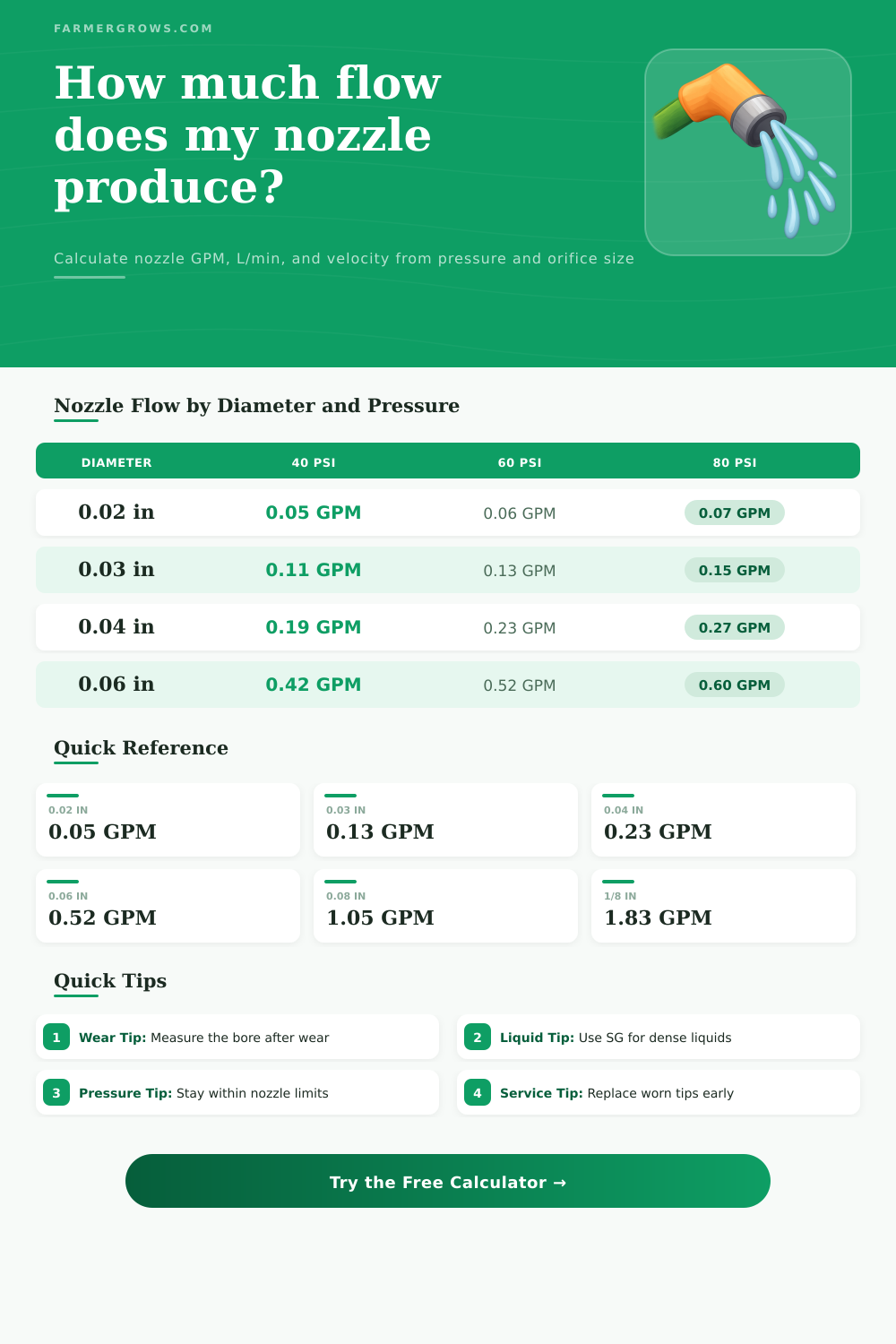
| 0.02 in | 0.05 GPM | 0.06 GPM | 0.07 GPM | 0.07 GPM |
| 0.03 in | 0.11 GPM | 0.13 GPM | 0.15 GPM | 0.17 GPM |
| 0.04 in | 0.19 GPM | 0.23 GPM | 0.27 GPM | 0.30 GPM |
| 0.06 in | 0.42 GPM | 0.52 GPM | 0.60 GPM | 0.67 GPM |
| 0.08 in | 0.75 GPM | 0.92 GPM | 1.05 GPM | 1.18 GPM |
| 0.10 in | 1.17 GPM | 1.43 GPM | 1.66 GPM | 1.85 GPM |
| 1/8 in | 1.83 GPM | 2.24 GPM | 2.59 GPM | 2.89 GPM |
| 3/16 in | 4.12 GPM | 5.04 GPM | 5.81 GPM | 6.51 GPM |
| 1/4 in | 7.31 GPM | 8.96 GPM | 10.35 GPM | 11.56 GPM |
| Application | Nozzle Size | Pressure | Flow / Nozzle | Notes |
|---|---|---|---|---|
| Boom herbicide spray | 0.02-0.03 in | 20-40 PSI | 0.05-0.13 GPM | Good drift control |
| Fertilizer broadcast | 0.03-0.06 in | 30-50 PSI | 0.11-0.42 GPM | Uniform field coverage |
| Orchard misting | 0.04-0.08 in | 50-90 PSI | 0.19-1.05 GPM | Fine droplet pattern |
| Washdown rinse | 0.06-0.10 in | 40-80 PSI | 0.42-1.66 GPM | Fast cleanup flow |
| Irrigation gun | 1/8-1/4 in | 60-120 PSI | 1.83-11.56 GPM | Long throw stream |
| Foam / foaming | 0.03-0.06 in | 30-70 PSI | 0.11-0.60 GPM | Keep air mix stable |
| Fire stream | 1/8-1/4 in | 75-150 PSI | 1.83-11.56 GPM | Use rated hardware |
| Calibration bench | Any size | Any test | Measured flow | Catch-can verification |
| Quantity | Imperial | Metric | Note |
|---|---|---|---|
| Diameter | 1 in | 25.4 mm | Use bore, not tip cap |
| Pressure | 1 PSI | 0.06895 bar | Gauge pressure only |
| Flow | 1 GPM | 3.785 L/min | Liquid volume per minute |
| Velocity | 1 ft/s | 0.3048 m/s | Exit speed from nozzle |
| Volume | 1 gal | 3.785 L | Tank timing input |
| Area | 1 in2 | 645.16 mm2 | Calculated from diameter |
| Density | 1 SG | 1000 kg/m3 | Water at room temp |
| Time | 1 min | 60 s | Used for discharge time |
Nozzle flow rate is the measurement of the volume of liquid that pass through the nozzle opening in one minute. The size of the nozzle opening, the pressure of the liquid, and the nozzle’s discharge coefficient determine the flow rate of the nozzle. An understanding of the flow rate of the nozzle is essential because the flow rate of the nozzle will determine whether the pump can provide enough liquid to the system or whether the pump will fail to meet the demand of the nozzles in the system.
If the flow rate of the nozzle is chosen incorrect for the tasks to be performed, there will be an even spread of the liquid in the field and chemicals or fuel will be wasted. The physical property of the liquid that exits the nozzle and the pressure that is applied to the nozzle affect the flow rate of the nozzle. If the pressure is increased, the velocity of the liquid will increase and the flow rate will also increase.
What Affects Nozzle Flow Rate
The increase in the pressure of the liquid dont, however, result in a linear increase in the flow rate of the nozzle. For instance, if the pressure is doubled, the flow rate will only increase by approximately 41 percent because flow rate is related to the square root of the pressure value. The density of the liquid also impact the flow rate of the nozzle.
If the liquid that is used has a specific gravity of 1.0, such as water, the flow rate will be different than a liquid with a higher specific gravity, such as a fertilizer slurry with a specific gravity of 1.2 will have a slow velocity and lower flow rate. The discharge coefficient of the nozzle is a value that takes into account the shape and efficiency of the nozzle in which the liquid exit. The discharge coefficient is a number between 0.5 and 1.
The higher the number, the more closer to the ideal flow rate the nozzle will be. For example, a nozzle that has a flat-fan shape will have a higher drag on the liquid than a nozzle that is shaped like a fire nozzle. Therefore, the flow rate of the flat fan nozzle will have a lower discharge coefficient, such as 0.62, than the fire nozzle with a discharge coefficient of 0.95.
The discharge coefficient is one of the factors that determine the difference between the actual flow rate of the nozzle and the theoretical flow rate of the nozzle. Wear on the nozzle and changes in the pressure will change the flow rate. The chemical that exit the nozzle may be abrasive and erode the edge of the nozzle.
An eroded nozzle will have an enlarged orifice for the liquid to exit the nozzle which will increase the flow rate of that nozzle by 15 to 30 percent. In this case, the nozzle should of been measured annually to determine if erosion has occurred. Changes in the pressure of the system will affect the flow rate of the nozzles.
For instance, if the tractor that is spraying the field move over ruts in the field, the pressure of the system may drop. This drop in the pressure will lead to a drop in the flow rate of the nozzles. Another consideration in the determination of the flow rate is the number of nozzles in the system.
The flow rate of a single nozzle may be low, but many nozzle will result in a high total demand of the system. For instance, twenty nozzles will have a higher total demand than a single nozzle. The flow rate of the pump must be sufficient to supply the total flow rate of the nozzles.
If the pump is too small for the total demand of the nozzles, the pressure will drop and the flow rate will be lower than the demand of the nozzles. Flow rate can be tested by filling a container of a known volume, such as a five-gallon bucket. By measuring the amount of time it take to fill the five-gallon bucket, you can calculate the flow rate.
If it takes too short of a time to fill the five-gallon bucket with liquid, it indicates that the flow rate of the nozzle is too high, which could be due to a worn nozzle. If it takes too long to fill the five-gallon bucket, it indicates that the flow rate of the nozzle is too low, which could be due to a clogged nozzle or a pump that is too small for the system. Finally, it is also important to consider the component of the system, such as hoses and filters.
The hoses in the system may drop the pressure of the liquid and the filters may restrict the amount of liquid that reach the nozzles in the system.