Knapsack Sprayer Calculator
Estimate finished spray volume, product dose, and refill counts for each backpack job.
📊 Live Mix Results
| Ratio | oz/gal | mL/L | Use |
|---|---|---|---|
| 1:16 | 8 | 63 | Heavy |
| 1:32 | 4 | 31 | Std |
| 1:64 | 2 | 16 | Light |
| 1:128 | 1 | 8 | Fine |
| Rate | Area | Metric | Use |
|---|---|---|---|
| 1 gal | 1000 ft2 | 107 m2 | Light |
| 2 gal | 500 ft2 | 54 m2 | Normal |
| 4 gal | 250 ft2 | 27 m2 | Dense |
| 6 gal | 167 ft2 | 16 m2 | Heavy |
| Bottle | L | fl oz | Batch note |
|---|---|---|---|
| 16 oz | 0.47 L | 16 | Mini |
| 32 oz | 0.95 L | 32 | Std |
| 64 oz | 1.89 L | 64 | Large |
| 1 L | 33.8 oz | 1 | Metric |
| Job | Area | Mix | Note |
|---|---|---|---|
| Lawn | 2500 ft2 | 1:32 | 2 fills |
| Beds | 800 ft2 | 1.5 oz/gal | 1 fill |
| Patio | 1200 ft2 | 2 oz/1000 | 1 fill |
| Orchard | 400 m2 | 20 mL/L | 1-2 fills |
To use a backpack sprayer effectivly, you need to understand how to balance the chemical concentrate, the water, and the backpack sprayer tanks size. A backpack sprayer is used for various task, such as weed control or fertilizing garden beds. However, you must prepare the backpack sprayer correctly to ensure that you dont run out of the liquid before you finish the gardening task or spray too much liquid on the ground.
The first concept to understand when using a backpack sprayer is the concept of coverage. Coverage refer to the amount of liquid that the backpack sprayer will apply to the ground over a specific area. For example, lawns typically require two gallons of liquid per thousand square foot.
How to Prepare and Use a Backpack Sprayer
However, flower beds or fence lines may require more liquid to spray on those vertical surface. If you walk at varying speed when using a backpack sprayer, your coverage will not be even. If you walk too fast, the backpack sprayer will not apply the chemical needed for the plants.
However, if you walk too slow, you may apply too much liquid. Therefore, you should break up the area that you would like to treat into smaller area so that you can maintain even coverage. The label on the chemical that you are using will indicate the proper mixing ratio for the chemical and water.
For example, a ratio of 1:32 indicate that you should mix one part of the chemical with thirty-two part of water. Following the label will ensure that the chemical is at the proper concentration for your plant or gardening task and will ensure that the chemical doesnt damage the grass in your lawn. For tasks like killing moss on patios, you may need a stronger chemical mixture of four ounce of chemical to one gallon of water.
The mixing ratio will tell you how much chemical to add to the backpack sprayers tank. However, the per area dose tell you how much liquid in total that you need to apply to the ground. The size of the backpack sprayer’s tank will determine how many square meters of ground that you can treat before having to refill the tank.
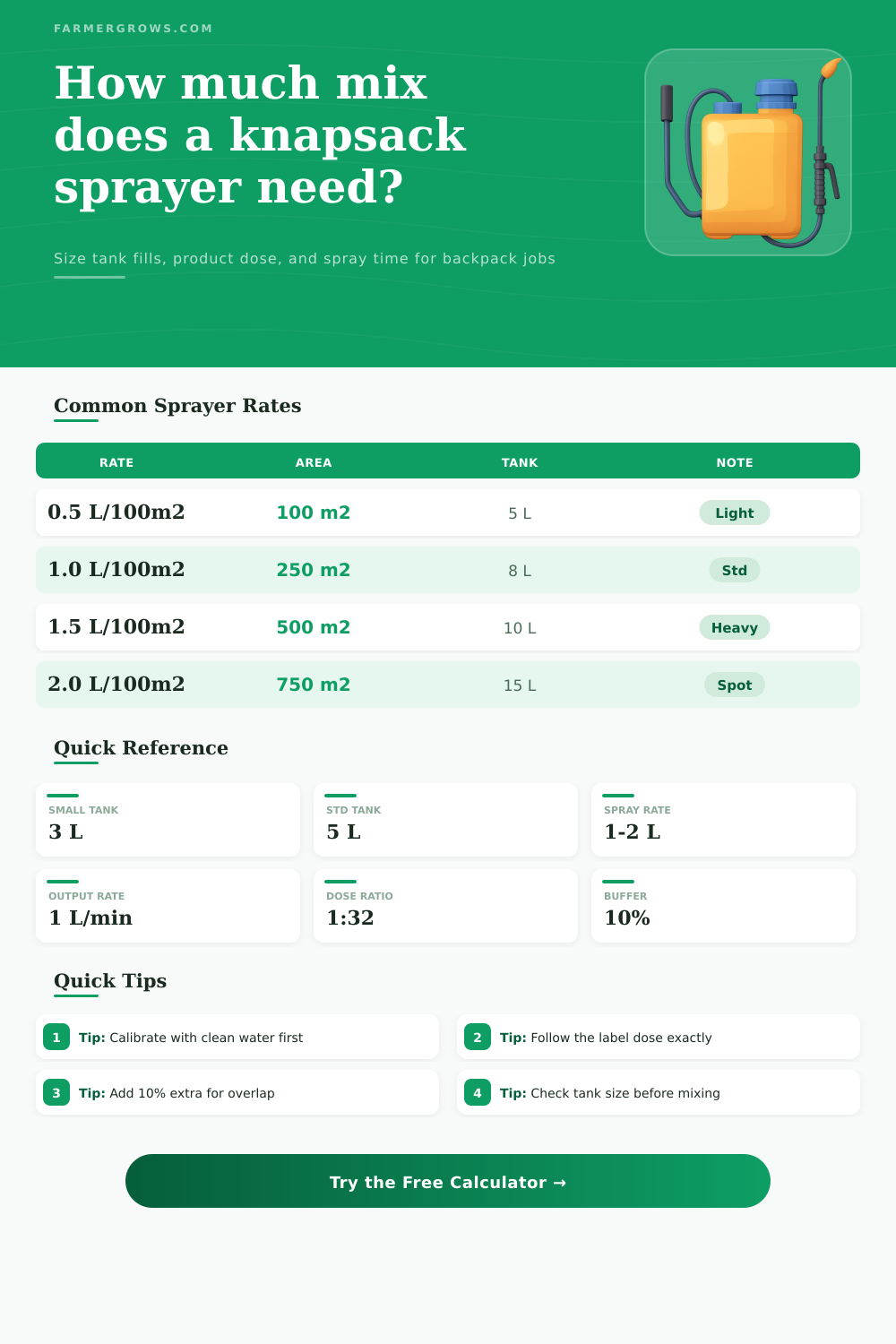
A sixteen-liter backpack sprayer can treat up to two hundred fifty square meter. However, a three-liter backpack sprayer may be better for treating small spot in the garden. You should always allow for ten percent extra volume of liquid in your tank in case you need it for the extra wind drift or because you walked too slow on some area of the garden.
If you dont allow for an extra ten percent of liquid, you may find that you run out of liquid before you finish your gardening task. It is also important to calibrate the backpack sprayer to ensure that it is outputting the proper amount of liquid. To calibrate the backpack sprayer, fill the tank with water, spray a specific area of the ground, and time how long it take for the sprayer to complete the area.
Most backpack sprayer should output approximately four liters of liquid per one hundred square meters of treated area. However, if the backpack sprayer has any clogged or uneven nozzles, this output may change. Testing the backpack sprayer with water will allow you to determine if your backpack sprayer will output the proper amount of liquid when you begin using the chemical concentrate.
Other factor that will affect the use of the backpack sprayer include the impact of the environment in which you will use the sprayer. For example, if there is too much wind in the area that you are spraying, the chemical will drift away from the plants. Additionally, if you are spraying on a slope in the ground, gravity may affect the amount of chemical that land on the plants.
You can also expect different results in dry soil as compared to wet soil. If the weather is wet, you may want to use less chemical to avoid pooling of the chemical on the ground. It is also important to wear the proper safety gear when using a backpack sprayer.
For example, you should wear gloves and eye protection to guard against chemical splash that may damage your skin or eyes. Additionally, if you are using different chemical concentrates, you should rinse the backpack sprayer between each batch of chemical to avoid mixing the two chemicals together. If you do not rinse the backpack sprayer, you may create an ineffective or even harmful chemical that will damage the plants that you are trying to treat with the chemical.
Finally, make sure that you double-check the measurements of the chemical concentrate that you are using. If you use the incorrect unit of measurement, such as imperial gallons versus metric liters, you may create an incorrect chemical concentration.