Conical Silo Volume Calculator
Calculate volume of cone bins, hopper silos, frustum shapes, and compound cylinder + cone structures.
📊 Volume Results
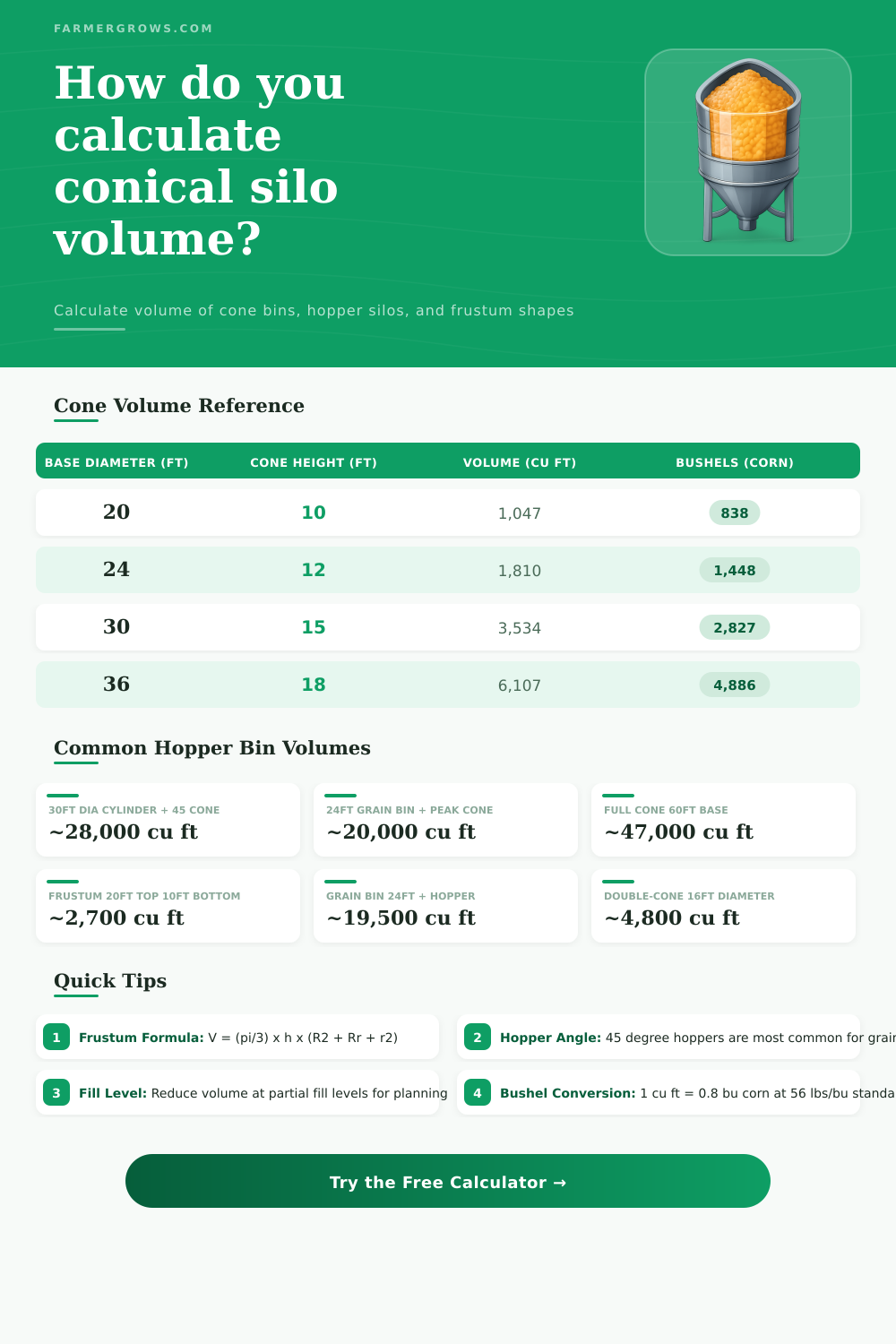
Cone Volume Reference (full cone, tip to base)
| Base Diameter (ft) | Cone Height (ft) | Volume (cu ft) | Bushels Corn |
|---|---|---|---|
| 10 | 5 | 131 | 105 |
| 16 | 8 | 536 | 429 |
| 20 | 10 | 1,047 | 838 |
| 24 | 12 | 1,810 | 1,448 |
| 30 | 15 | 3,534 | 2,827 |
| 36 | 18 | 6,107 | 4,886 |
| 48 | 24 | 14,476 | 11,581 |
| 60 | 30 | 28,274 | 22,619 |
Shape Configuration Comparison
| Configuration | Formula | Best Use | Volume vs Full Cylinder |
|---|---|---|---|
| Full Cone | (π/3) r² h | Pile capacity, outdoor storage | 33% of same-dim cylinder |
| Frustum | (π/3) h (R²+Rr+r²) | Hopper sections, transition pieces | Varies by top/bottom ratio |
| Cylinder + Cone Bottom | πr²h + (π/3)r²h₂ | Hopper bins, grain bins | Cylinder + 33% bonus cone |
| Cylinder + Cone Top | πr²h + (π/3)r²h₂ | Peaked-roof grain bins | Cylinder + 33% bonus cone |
| Full Silo | Both cones + cylinder | Complete silo modeling | Largest total volume |
Common Hopper Angles Reference (for 24 ft diameter bin)
| Angle (degrees) | h/r Ratio | Cone Height (24ft dia) | Cone Volume |
|---|---|---|---|
| 30° | 0.577 | 6.9 ft | 1,046 cu ft |
| 45° | 1.000 | 12.0 ft | 1,810 cu ft |
| 50° | 1.192 | 14.3 ft | 2,156 cu ft |
| 55° | 1.428 | 17.1 ft | 2,582 cu ft |
| 60° | 1.732 | 20.8 ft | 3,136 cu ft |
| 70° | 2.747 | 33.0 ft | 4,972 cu ft |
A hopper bin consist of a cylindrical body and a conical bottom that holds the grain. Farmers must calculate the volume of a hopper bin because the volume will determine how much grain the bin can hold. To calculate the volume of a hopper bin, farmers must understand the dimensions of the cylindrical section and conical section of the bin.
If farmers dont calculate the volume of the bin correctly, there will be either an overflow of grain from the bin or there will be empty space within the bin that is not being utilized to store the grain. A conical silo volume calculator can aid farmers in calculating the volume of different shapes for there grains, such as cones, cylindrical bins with peaked roofs, and silos with hopper bottoms. The conical bottom of the hopper bin is crucial to the functioning of the bin as the angle of the cone will determine the ease with which the grain will exit the hopper bin.
How to Calculate the Volume of a Hopper Bin
Due to the fact that grain does not flow as easy as water, using a flat-bottom bin will result in the grain getting stuck in the bin. Using a conical bottom with a 45-degree angle will allow the grain to exit the bin due to the influence of gravity. Using a steeper angle, such as 60 degrees, will cause the grain to exit the bin more easy; however, it will also increase the height of the bin and reduce the amount of space within the cylindrical section of the bin.
Using a shallow angle of 30 degrees will allow the bin to take up less vertical space. However, the risk of the grain getting clog within the bin will be increased. To calculate the volume of the bin, farmers will need to measure several dimension of the bin.
Farmers will need to measure the diameter of the bin, and this dimension will remain the same along the cylindrical and conical sections of the bin. The height of the bin will also need to be measured, but only if the grains will be filled to the top of the bin. For bins that will not be filled to the top, the height will also be divided into the height of the cylindrical section and the height of the conical section.
The height of the cylindrical portion will be measured to determine how much bulk grain will be stored in the bin. The height of the conical portion of the hopper bin will depend on the angle chosen for the conical portion of the bin. For bins with frustum shape sections, farmers will need to measure both the top radius of the bin and the bottom radius of the bin to calculate how much grain the bin can hold.
Another dimension that will affect the total volume of grain within the bin is the fill level. Hopper bins are not always filled to capacity with the grain that is stored within the bin. There may be delays in the growing or transporting of the grain that will prevent farmers from filling their bins with the necessary amount of grain.
In cases where the bin is not filled to the top of the bin, the volume of the grain within the bin will be less than the total capacity of that bin. The cones of the bin will lose more volume when they are filled to a partial volume than the cylindrical sections will. This is due to the fact that the volume of the cones is more concentrated towards the bottom of the bin.
The density of the grain that is stored in the bin will also play a crucial role in how much of that specific grain can be stored in the bin. For instance, corn silage is denser than soybeans. This means that a given weight of corn silage will take up less space in the bin than the same weight of soybeans.
To calculate the volume of grain that a bin can hold, the density of the specific grain must be used. Using the dimensions of a hopper bin, farmers can calculate the total volume of that bin. For instance, if a bin has a diameter of 30 feet, a height of 20 feet for the cylindrical section, and a 7.5-foot conical section, it will hold 28,000 cubic feet of grain, which is equivalent to 22,000 bushels of corn.
If the conical section of the bin is made steeper, the volume contained within the conical portion will increase. However, the height of the cylindrical portion will decrease. If a peaked roof is added on top of the cylindrical portion of the bin, the height of the bin will increase.
This will add head space and volume to the bin. The full silo consists of a cylindrical portion and two cones. The full silo will hold the most volume.
However, it will require the bin to be taller to accommodate both conical sections. The density of the grain that is to be stored in the bin will also impact the calculations of how much grain can be stored in that bin. The standard density of corn is 56 pounds per bushel.
However, if the corn is wet, it will be denser than dry corn. Due to the fact that wet corn will settle in the bin more, it will take up less space than dry corn within the same bin. In cases where the planner will perform this calculation in the planning of the bin, it is essential to use 56 pounds per bushel as the density of corn.
For other grains, such as barley, the densities will not be the same, and custom densities will have to be used for such calculations. When measuring the dimensions of the hopper bin, there are some mistake that a farmer may make. The most common mistake is choosing the slant height of the conical section instead of the vertical height of the conical section.
Choosing the slant height will result in an incorrect calculation of the volume of the bin. Another mistake that a farmer may make is to ignore the fill level of the bin. If the farmers plan for the bin to be filled with grain, but there is not enough space for the grain within the bin when it is filled to the top, this will cause a problem in the flow of the grain.
The last mistake that a farmer may make is to choose the incorrect hopper angle for the type of grain that will be stored in the bin. For instance, soybeans will require a steeper hopper angle than corn to prevent the soybeans from getting stuck in the bin. You should of checked the angles more carefuly.