Silo Capacity Calculator
Estimate usable storage, tons as-fed, dry matter, and feed days for tower or bunker silos.
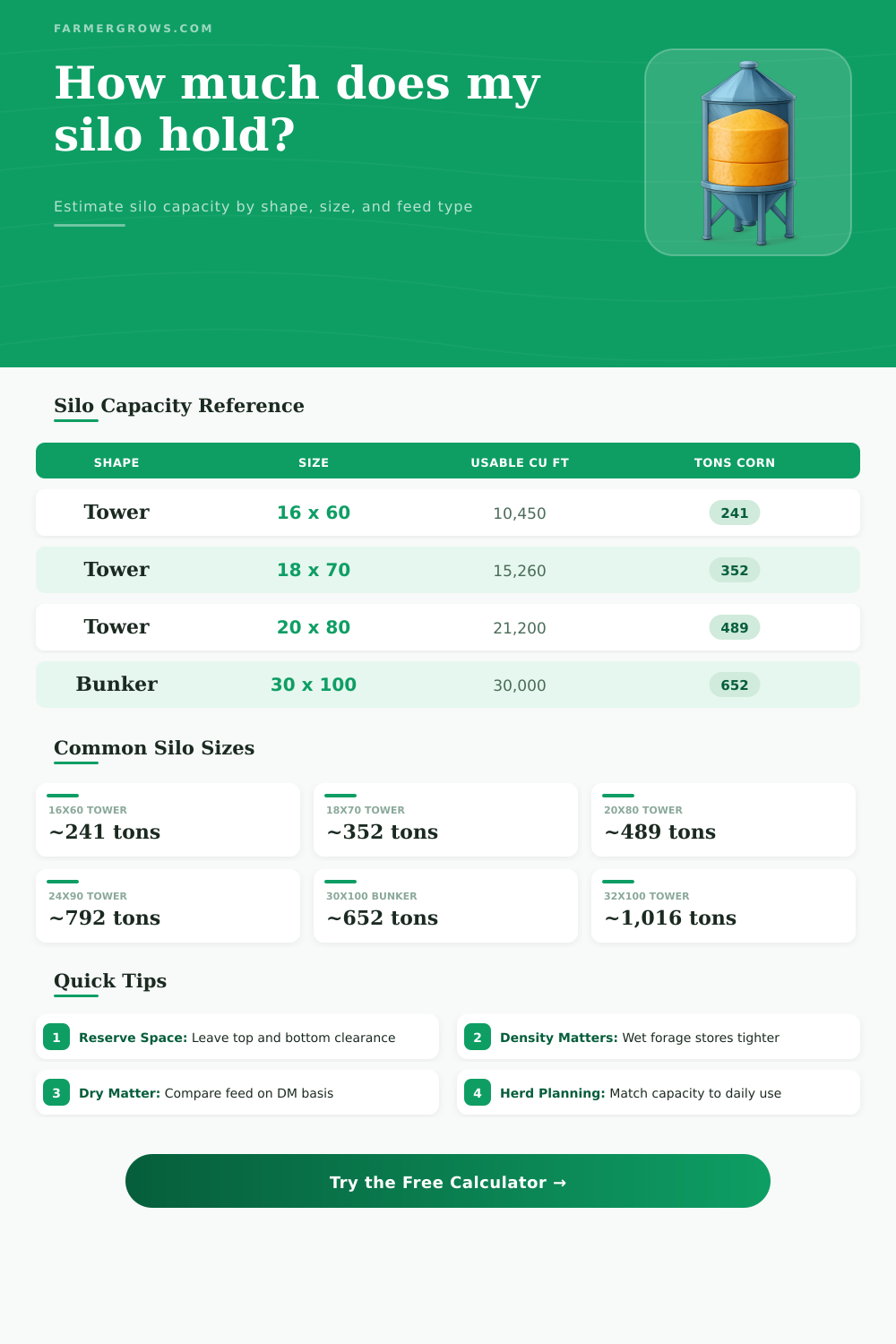
Common Tower Silo Capacities
| Diameter | Height | Usable Cu Ft | Tons Corn |
|---|---|---|---|
| 12 ft | 40 ft | 3,820 | 88 |
| 14 ft | 50 ft | 6,970 | 160 |
| 16 ft | 60 ft | 11,080 | 255 |
| 18 ft | 70 ft | 16,170 | 372 |
| 20 ft | 80 ft | 22,560 | 519 |
| 24 ft | 90 ft | 32,480 | 747 |
| 28 ft | 80 ft | 44,200 | 1,016 |
| 32 ft | 100 ft | 69,200 | 1,593 |
Feed Density Reference
| Feed Type | Density | DM % | Bu/Cu Ft |
|---|---|---|---|
| Corn Silage | 46 | 35% | 0 |
| Haylage | 40 | 50% | 0 |
| Alfalfa Silage | 38 | 55% | 0 |
| BMR Corn Silage | 44 | 35% | 0 |
| High Moisture Corn | 42 | 72% | 0.72 |
| Grain Corn | 45 | 85% | 0.80 |
| Wheat | 50 | 87% | 0.77 |
| Soybeans | 48 | 90% | 0.80 |
Clearance Guide
| Reserve | Typical Range | Best Use | Why It Matters |
|---|---|---|---|
| Top reserve | 2-4 ft | Tower silos | Leaves room for settling |
| Bottom reserve | 4-6 ft | Tower silos | Protects unloader space |
| Top reserve | 0.5-2 ft | Bunker silos | Keeps the fill line neat |
| Bottom reserve | 0-1 ft | Bunker silos | Allows pad drainage |
| Density mode | Auto | Most uses | Fast default calculation |
| Density mode | Custom | Special cases | Use measured values |
Herd Planning Guide
| Herd | Lbs/Day | Tons/Year | Suggested Silo |
|---|---|---|---|
| 50 head | 3,500 | 638 | 16x50 tower x2 |
| 100 head | 7,000 | 1,278 | 20x70 tower |
| 150 head | 10,500 | 1,916 | 24x80 tower |
| 200 head | 14,000 | 2,555 | 24x90 tower |
| 300 head | 21,000 | 3,833 | 28x100 tower |
| 500 head | 35,000 | 6,388 | Multiple towers |
Silo capacities refers to the total amount of feed that a silo can hold. Calculating the capacity correctly are crucial to determining if you have enough feed to last through the winter month. If you do not calculate the capacity of the silo correctly, you run the risk of running out of feed for the herd, which will force you to purchase more feed at a more higher price.
Tower silos are upright cylinders use to store chopped corn or haylage. The diameter of the silo determines the footprints of the silo, while the height of the silo determine its total volume. It is important to leave headspace at the top of the silo for the silage to settle in the silo over time.
How to Figure Silo Capacity and How Long Feed Will Last
Additionally, clearance are required at the bottom of the silo to allow for the unloader to move. If you do not leave the necessary headspace and clearance for these processes, the silage may spoil or the unloader may get jammed. Bunker silos is a rectangular structure that sits on the ground.
The length, width, and height of the bunker silo wall determine the volume of a bunker silo. Bunker silos are covered with plastic and tires to create an airtight seal to prevent the entrance of oxygen into the silo. The farmer must pack the feed tightly in bunker silos to ensure there is no entrance of oxygen into the silo.
Bunker silos require less headspace at the top of the silo then tower silos. The bunk silos also require less space at the bottom because they are often built on sloped pads to allow for drainage of the silo. The density of the feed is another critical factor in calculating how much feed a silo can hold.
Corn silage weigh 46 pounds per cubic foot, while hayage weighs 40 pounds per cubic foot. If the silo is not pack tightly with the feed, the density will be lower. This will result in the silo holding less feed than intended.
Another factor to consider is the dry matter percentage of the feed. This will determine the feed’s nutritional value. Silage will have a lower dry matter percentage than feed such as corn, which have higher nutritional value.
To calculate the number of day of feed you have, you can use herd math. Multiply the number of cows in the herd by the number of pounds of feed each cow will eat in a day. Divide the number of tons of feed you have by the daily consumption of feed by the herd.
The result is the number of days the feed will last in the silo. For instance, a dairy farm that has 100 cows and each cow eat 7,000 pounds of feed per day will need over 1,200 tons of feed per year. Not all feed is the same, so the storage considerations for feed will differ.
Cows easily digest BMR corn silage. It has the same dry matter percentage as corn silage. Grains like wheat and soybean requires different silo considerations.
High-moisture corn is an example of feed that is stored wet in silos but fed to the cows as a drier feed. Each feed product will have a different density and dry matter percentage. Therefore, you must adjust silo calculations according to the various types of feed use in the dairy farm.
The planning of silo storage does not depend on dry months but rather dry spells. For a small farm with approximately 60 cows, a 14-by-50 tower silo will be sufficient. For larger farms, multiple bunker or tower silos will be needed.
Ensure that the bunker silo wall are not taller than 12 to 14 feet since any taller structures may collapse. Finally, auditing the existing silo storage is essential to ensure you have enough feed storage to last the winter. To determine the true capacity of the silo, measure the dimensions of the silo and subtract the amount of headspace and clearance the silo require.
Multiply the volume of the silo by the density of the feed the silo will contain. The total weight of the feed will be the result of this calculation. Adjust the weight according to the dry matter percentage of the feed.
Divide this number by the daily feed demand of the herd to calculate the total number of day the silo will last the cows.