🐐 Goat Hay Calculator
Calculate daily and total hay needs for your goat herd by animal type, production stage, and feeding period.
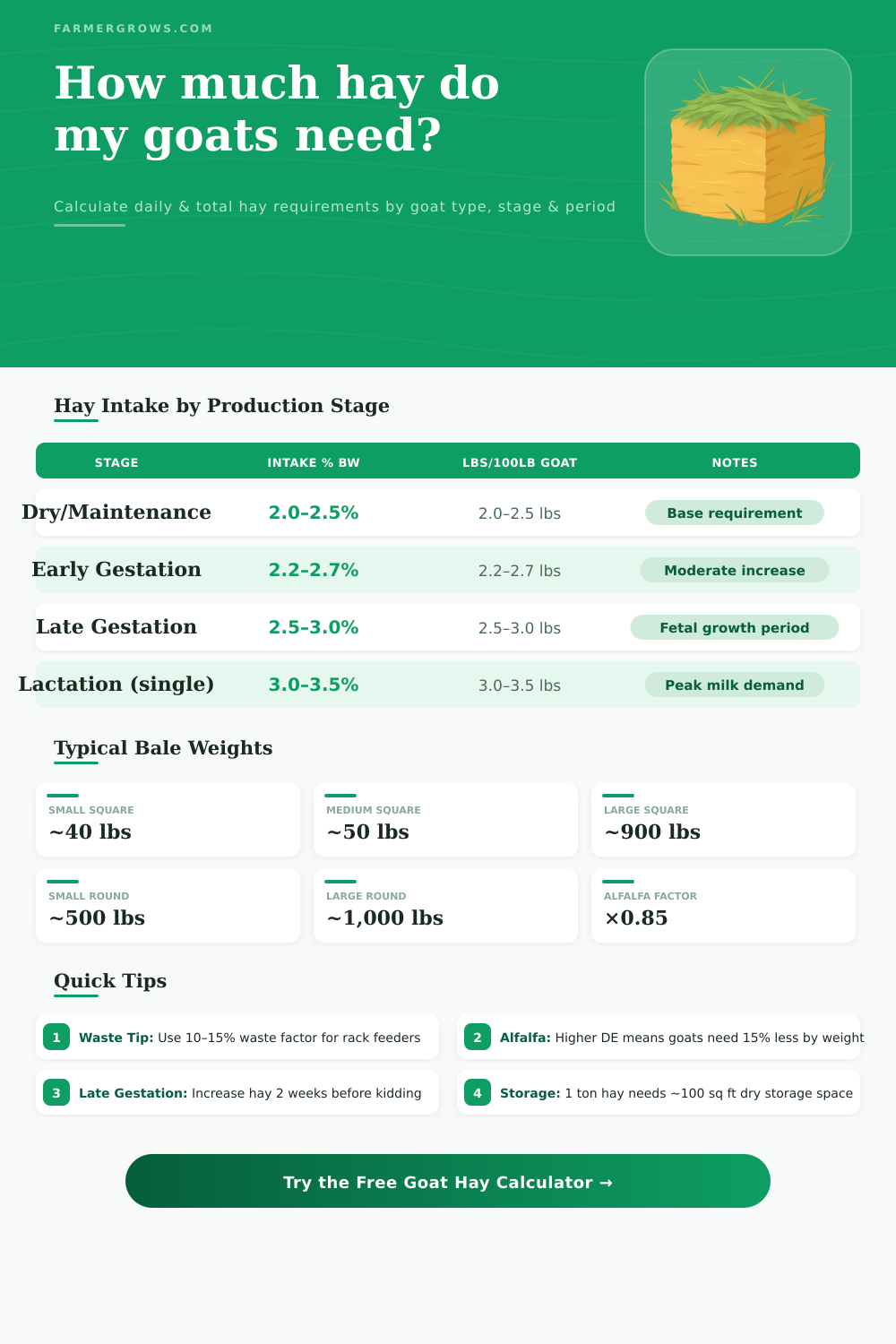
| Stage | Intake % BW | Lbs/100lb Goat | Notes |
|---|---|---|---|
| Dry / Maintenance | 2.0–2.5% | 2.0–2.5 lbs | Base energy requirement |
| Early Gestation | 2.2–2.7% | 2.2–2.7 lbs | Moderate nutrient increase |
| Late Gestation | 2.5–3.0% | 2.5–3.0 lbs | Critical fetal growth |
| Lactation (single) | 3.0–3.5% | 3.0–3.5 lbs | Peak milk production |
| Lactation (twins) | 3.5–4.5% | 3.5–4.5 lbs | Highest demand stage |
| Kids (2–6 mo) | 3.5–4.0% | 3.5–4.0 lbs | Rapid growth phase |
| Hay Type | DE (Mcal/lb) | Crude Protein | Palatability | Notes |
|---|---|---|---|---|
| Grass Hay | 0.85–0.95 | 8–12% | Good | Good maintenance forage |
| Alfalfa Hay | 1.0–1.1 | 16–22% | Excellent | Reduce qty by ~15% |
| Mixed Grass/Alfalfa | 0.92–1.0 | 12–16% | Very Good | Balanced option |
| Browse / Hay Mix | 0.80–0.90 | 9–14% | Good | Goats prefer browse |
| Bale Type | Approx Weight | Storage (sq ft) | Goats Fed/Day* |
|---|---|---|---|
| Small Square | 40 lbs | 6 sq ft | ~13–20 goats |
| Medium Square | 50 lbs | 7 sq ft | ~16–25 goats |
| Large Round | 70–1000 lbs | 25–60 sq ft | ~23–330 goats |
| Large Square | 900–1200 lbs | 32 sq ft | ~300–400 goats |
Hay is the main part of the goat diet. It gives many nutrients to them and goats get minerals for the rest. When the hay is low quality, wet or too stemmy, the goats refuse it and then their health suffers
Daily goats require around 3 to 4 percent of their body weight in grass or legume hay. For a 100-pound goat that means around 2 pounds of hay per day, according to a rough 2 percent calculation from bodyweight. Normal adult goats weighing 150 pounds eat three to six pounds of hay daily, while lactating dairy doe consume even more for the milk.
How Much Hay Do Goats Need and What Kind to Feed Them
Not all goats have same size. Baby dwarf goat does not eat as much as adult buck. Not fed by grain, yearling goats of around 40 pounds match one animal unit.
Every such unit requires approximately 50 pounds of hay daily, if it is of average to good qualtiy.
Common legume hay types for goats include alfalfa, clover, lespedeza and birdsfoot trefoil. Legume hay usually have the highest digestive energy, because the leaves do not change while the plant grows. The stems become hard and fibrous, so the value is highest during young state of the plant.
Fescue hay has 8 to 9 percent crude protein and 55 to 60 percent TDN on dry base, what makes it good food for goat farms.
Goats eat very picky and their digestive systems are complex. Wethers require a different diet than doe. For them quality grass hay works well.
During early or mid pregnancy, timothy or grass hay is enough. At the end of pregnancy you prefer a mix with alfalfa, and during milk, because it has more protein and calcium. Only alfalfa provides enough protein for lactating doe, because milk production require it.
Nubian goats can eat free hay together with goat feed. They also receive alfalfa pellets and black oil sunflower seeds daily. Even so alfalfa and sunflower seeds risk urinary diseases in bucks.
In summer, if goats have natural browse, they almost do not eat hay. Chewing of hay help the rumen and stop bloat. Pellets from hay serve only for supplement and do not replace whole hay or forage.
If goats receive too much grain or tasty fresh food, they refuse their hay.