🐄 Cattle Carcass Weight Calculator
Estimate hot carcass weight, chilled carcass weight, and saleable cuts from live cattle weight
Carcass Weight Results
Calculation Breakdown
Dressing Percentage by Cattle Class
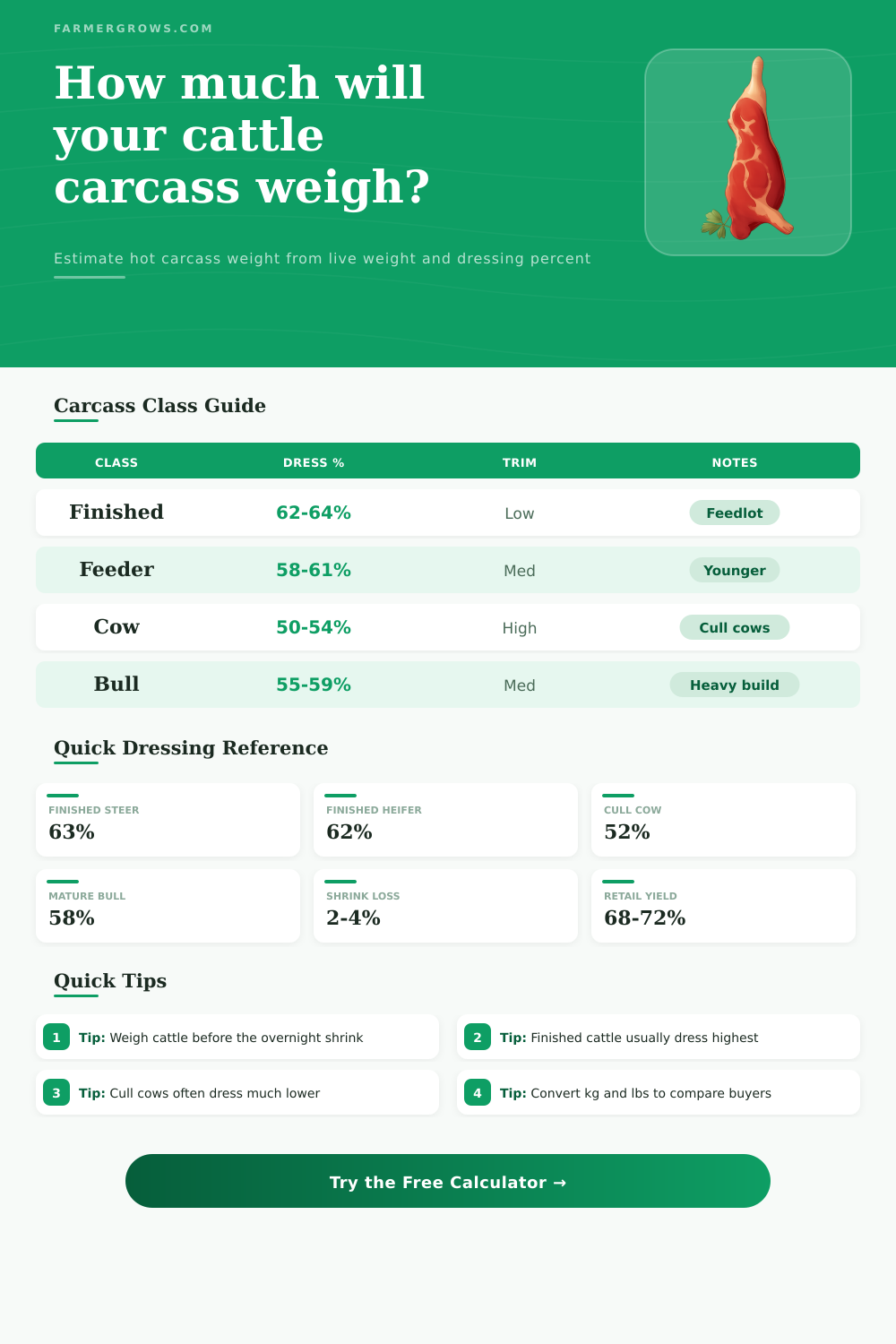
| Class | Typical Dress % | Retail Yield % | Notes |
|---|---|---|---|
| Finished steer | 62% - 64% | 70% - 73% | Feedlot finished, clean hide |
| Finished heifer | 61% - 63% | 69% - 72% | Usually slightly lighter muscling |
| Yearling steer | 58% - 61% | 68% - 71% | Younger cattle, less external fat |
| Grass finished | 56% - 59% | 64% - 68% | Lower finish, leaner trim |
| Dairy beef | 54% - 56% | 63% - 66% | Frame and muscling vary widely |
| Cull cow | 50% - 54% | 60% - 64% | Higher gut fill and lower finish |
| Mature bull | 55% - 59% | 66% - 70% | Heavy muscle, moderate trim |
| Custom | Set manually | 70% default | Use for farm-specific estimate |
Hot Carcass Examples
| Live Weight | Dress % | Hot Carcass | Use Case |
|---|---|---|---|
| 1,100 lb | 60% | 660 lb | Light yearling steer |
| 1,250 lb | 61% | 762 lb | Backgrounded steer |
| 1,350 lb | 63% | 851 lb | Finished steer |
| 1,450 lb | 62% | 899 lb | Finished heifer |
| 1,550 lb | 58% | 899 lb | Grass-finished steer |
| 1,600 lb | 52% | 832 lb | Cull cow |
Cooler Shrink Guide
| Condition | Typical Loss | When it Happens | Practical Note |
|---|---|---|---|
| Fast chill | 0.5% - 1% | Short hanging time | Low moisture loss |
| Normal chill | 1% - 2% | Standard cooler cycle | Most common estimate |
| Extended chill | 2% - 2.5% | Long hanging time | Drying adds weight loss |
| Dry cooler air | 2.5% - 3% | Low humidity | Trimmed carcasses lose more |
| Custom plant | Set manually | Plant-specific basis | Use actual plant data |
Retail Yield Benchmarks
| Class | Typical Retail Yield | Saleable Cuts | Comments |
|---|---|---|---|
| Finished steer | 70% - 73% | High | Good finish and trim balance |
| Finished heifer | 69% - 72% | High | Similar to finished steer |
| Yearling steer | 68% - 71% | Moderate | Less finish, lean carcass |
| Grass finished | 64% - 68% | Moderate | Leaner trim and less backfat |
| Dairy beef | 63% - 66% | Moderate | Variable muscling and fat |
| Cull cow | 60% - 64% | Lower | More bone and trim loss |
| Mature bull | 66% - 70% | Moderate | Heavier muscling helps yield |
The weight of beef body matters for each who raises beef. Hot carcass weight is that of no-cooled body after removal of the head skin and internal organs. The residual meat, fat and bones give the hanging carcass weight
Usually beef cattle have 60 to 64 percent dressing. So 1,000-pound creature gives after slaughtering body of around 630 pounds. Various factors alter the carcas weight however.
How Beef Weight Changes from Live Animal to Meat
1,400-pound steer with half inch of thickness and normal muscle produces 880-pound body. For well fed livestock the hot carcass weight reaches 60 to 64 percent of the alive weight.
Lightweight feeder-livestock reaches only intermediate 50 percent range, while very thick ended cattle surpass 65 percent. In group of genetically alike creatures grow the dressing together with the weight. Beefs have bigger market weight than other species because of differences in type and maturity.
Standard range is 950 to 1,500 pounds, average 1,150 pounds.
Cull-cows are difficult. They range from 40 to 60 percent according to frame size, condition and rumen fill while weighing. Jerseys have 42 to 44 percent of alive weight, while beef breeds 48 to 55 percent.
From 880-pound body comes around 65 percent as boneless trimmed beef, so almost 490 pounds. This is approximately 40 percent of the original alive weight. Fat forms 20 to 22 percent, bones around 15 percent.
Half beef weight of 430 pounds is the hot weight after killing, skinning and gutting. During cooling lost 5 percent because of drip and vaporization.
Carcass weights grew during more than 60 years. Steers average gained in 4 pounds yearly, from 660 pounds in the 1960s until more than 900 pounds currently. Now average steers 960 pounds.
Bigger bodies help offset the drop of butchered cattle.
Strain matters for carcass weight. Cattle who feed all summer fatten quickly and cheaply. Direct sale can well benefit, for instance corn-ended beef cost around 4.50 dollars plus processingfor 750-pound body.