
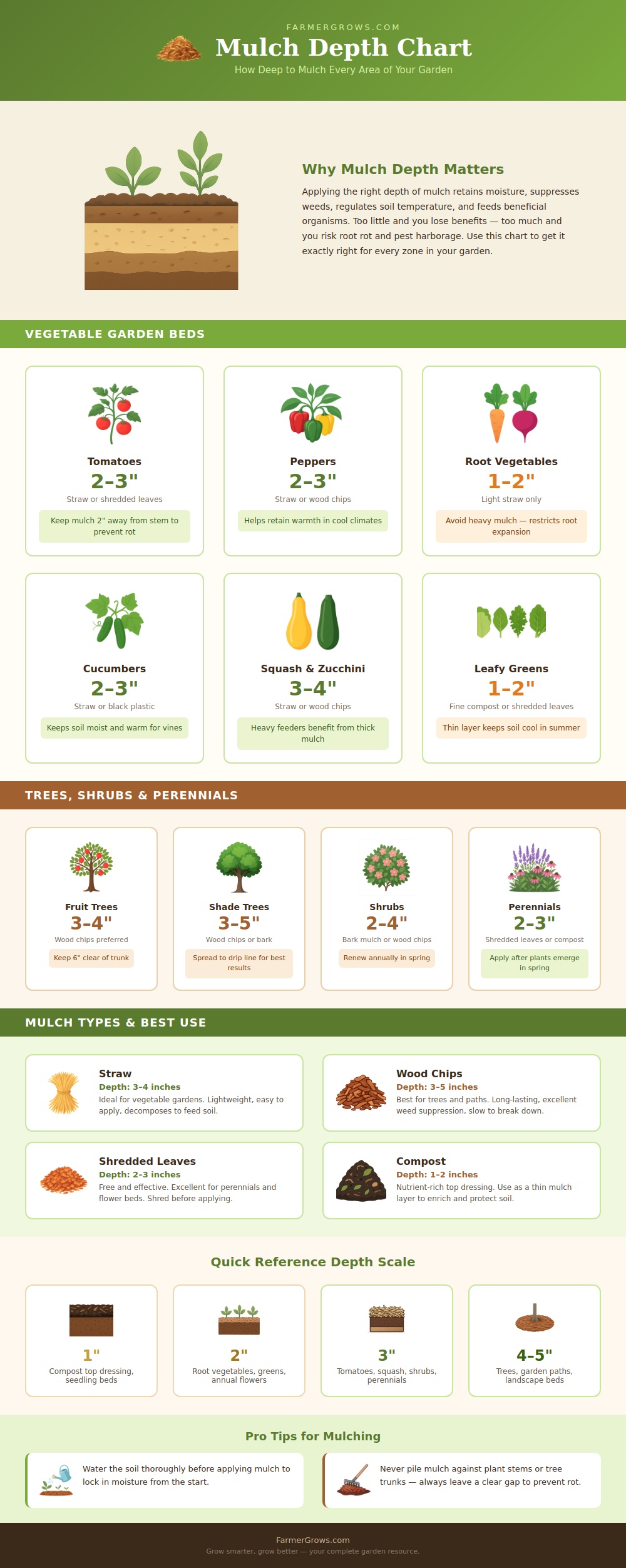
The right depths for mulch uses are really important. Most depends the efficiency of the bed on its depth. Plants and landscaping areas require different depths for good results Too much application can be harmful, but too little does not give the wanted benefits.
For many landscaping cases, depth between 2 and 4 inches works well. Three inches are the best for the most of gardens. That suffices to do its task without problems later.
How Deep to Mulch
2 to 3 inches control weeds and grass, and help the ground not dry too quickly. If the bed is too thin, it does not help. Less than 2-3 inches of organic material, as wood chips or shredded bark, will not keep weeds under control nor protect the ground against dryness.
If you lay more than 4 inches, roots of trees or bushes can rise to get air. For the first application, 3 inches are a good idae. When you repeat it for color each spring, leave it thin and keep 2-3 inches, while the old decompose.
In vegetable gardens, a layer of 1 to 2 inches is better. It ensures good air flow and protects against too much moisture, that could injure vegetables. For perennials, 2 inches suffice, while around annuals and vegetables, 1 inch works.
Too thick a layer stops oxygen from reaching the ground and causes suffocation of roots.
Trees and bushes normally take 4 inches or more mulch, while 2-3 inches work for smaller and tender plants. For trees, do not go past 3-4 inches. Make sure the bed does not touch the trunk.
Hold it at least 3 inches away from the base of the tree. Never push bed directly to bark or stem, because it traps water and causes decay. You occasionally call that volcano mulching.
When you start a new bed or struggle against stubborn weeds, deeper application of 3 or even 4 inches help. The extra depth better suppresses weeds and forms a stronger barrier. Cardboard layers under the bed in fresh areas help even more.
Wood chips on the surface do not strongly consume nitrogen. You can apply bed in 2-4 inches, occasionally to 6 inches, always drawing it away from the base of plants.
When you repeat bed above an old layer, bring the whole depth to 2-2.5 inches. Most organic mulch materials require refill every 1-2 years. Observe decay, mold or color changes.
If it became matted, dump it. Otherwise, fluff it and add new ontop.