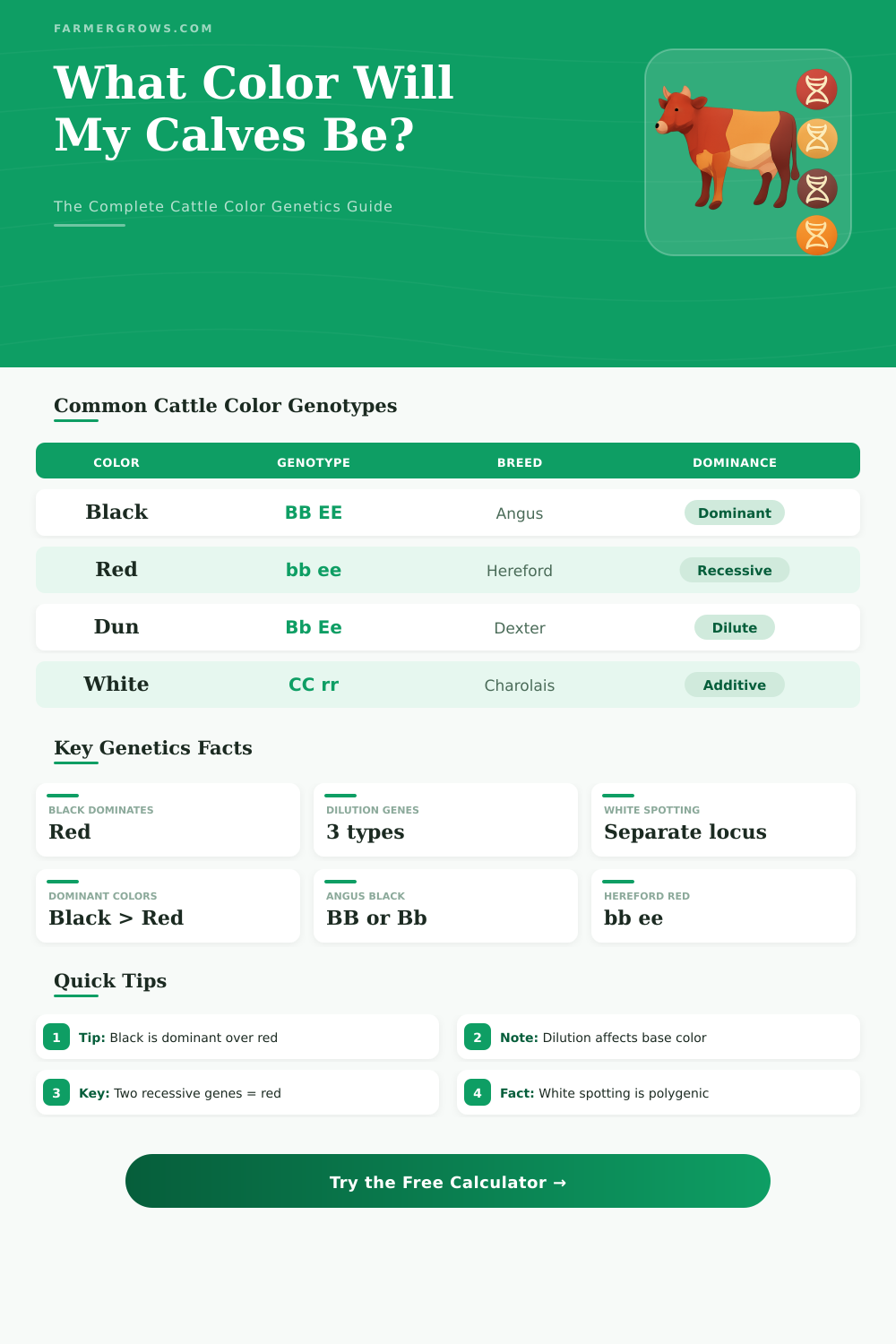
🐄 Cattle Color Genetics Calculator
Predict calf coat color probabilities based on sire & dam genotypes across key color loci
| B Locus | E Locus | Phenotype | Notes |
|---|---|---|---|
| BB or Bb | EE or Ee | Black | Black pigment expressed; B dominant |
| BB or Bb | ee | Red/Brown | ee restricts black pigment to phaeomelanin |
| bb | EE or Ee | Red | No B allele; base red with E present |
| bb | ee | Red/Yellow | Double recessive; clear red or yellow-red |
| BB | EE | Solid Black | Homozygous; breeds true for black |
| Bb | Ee | Black (carrier) | Carries both red alleles; 25% red calves possible |
| Cross Type | Black Offspring % | Red Offspring % | Carrier Status |
|---|---|---|---|
| BB x BB | 100% | 0% | None carry red |
| BB x Bb | 100% | 0% | 50% carry red (Bb) |
| BB x bb | 100% | 0% | All carry red (Bb) |
| Bb x Bb | 75% | 25% | 50% of blacks carry red |
| Bb x bb | 50% | 50% | 50% blacks carry red |
| bb x bb | 0% | 100% | All homozygous red |
| EE x ee | — | — | All Ee (carriers) |
| Ee x Ee | 75% E_ | 25% ee (modified) | 50% carriers |
| Breed | Typical B Locus | Typical E Locus | Dominant Color |
|---|---|---|---|
| Angus (Black) | BB | EE | Black |
| Red Angus | bb | EE | Red |
| Hereford | bb | ee | Red/Yellow-Red |
| Simmental | Bb or bb | Ee or ee | Red or Black |
| Limousin | bb | Ee or ee | Red/Golden |
| Charolais | — | — | White (separate locus) |
| Shorthorn | Varies | Varies | Red, Roan, White |
| Highland | Varies | Varies | Red, Dun, Black, Yellow |
| Dexter | Bb or bb | EE or Ee | Black or Red |
| Belted Galloway | BB or Bb | EE | Black + white belt |
| Base Color | DD (No Dilution) | Dd (One Copy) | dd (Two Copies) |
|---|---|---|---|
| Black (B_ E_) | Black | Dark Dun/Smoky | Dun / Silver-Grey |
| Red (bb or ee) | Red | Light Red / Mealy | Cream / Yellow |
| Dark Brown | Dark Brown | Tan / Fawn | Pale Fawn / Buff |
The color of cattle coats can seem entirely random but indeed exist firm genetic base. Genuinely, in cows are only two basic colors: black and red. Everything else you see is simple change of those two by the activity of other genes.
The gene that determines whether cow has black or red coat is the Melanocortin 1 Receptor; you usually call it MC1R or Extension. It controls the amount of black and red pigment in the skin, that sets the basic color for other genes. The MC1R gene operates the product of enzyme called tyrosinase in the skin cells.
How Cows Get Their Coat Color
That enzyme induces whether appear eumelanin; the black pigment (or phaeomelanin), that is red.
Here the key cause about red coat: it is recessive. Calf requires two copies of the red gene for show red color. The genotype for red is bb, and likewise work horns (they are recessive in hh).
If you breed homozygous black bull (BB) with red cow (bb), all children are born black, but each bears the red gene inwardly. They so are heterozygous for red. Even black and red Angus cows, that seem pure, occassionally bear brown children from nothing, even after generations of selective screening.
Some breeds are set to one look. All Herefords have the typical red body with white face. Charolais always are white.
Red Poll? You never will see anything except red. But other breeds, as Limousin and Simmentals, can be red or black.
Shorthorns appear white, red or roan. Breeds as Longhorns and Beefmasters have more colors with hereditary patterns, that is difficult to predict, including brindle, spotting or stripes.
When cow seems gray, she is basically black, but the diluter gene eases the color. The diluter gene is dominant, so one alone copy suffices for change the base color. Variations in the PMEL17 gene turn black or red in cream or white shades.
All those genes act dose-dependent. One copy does black gray and red pale. Two copies give much more bright result.
In Dexter cattle exists mutation called dun, that acts similarly to chocolate color in dogs. Other mutation creates color alike to palomino in red cows. At Highland cattle the E+ allele appear commonly and is the most recessive from the three alleles in that E locus.
Highland with gene ED/e and del/+ call dun, during silver dun has ED/e with del/del.
Through time many breeds picked against color changes as diluter genes and blaze marks. They now are less common, what simplifies color management in crossbred systems. Even pure black Angus cattle occasionally shows little white mark on the breast or belly.