🌿 Herb Garden Sun Calculator
Find out if your garden light level suits your herb mix — and which herbs will thrive or struggle
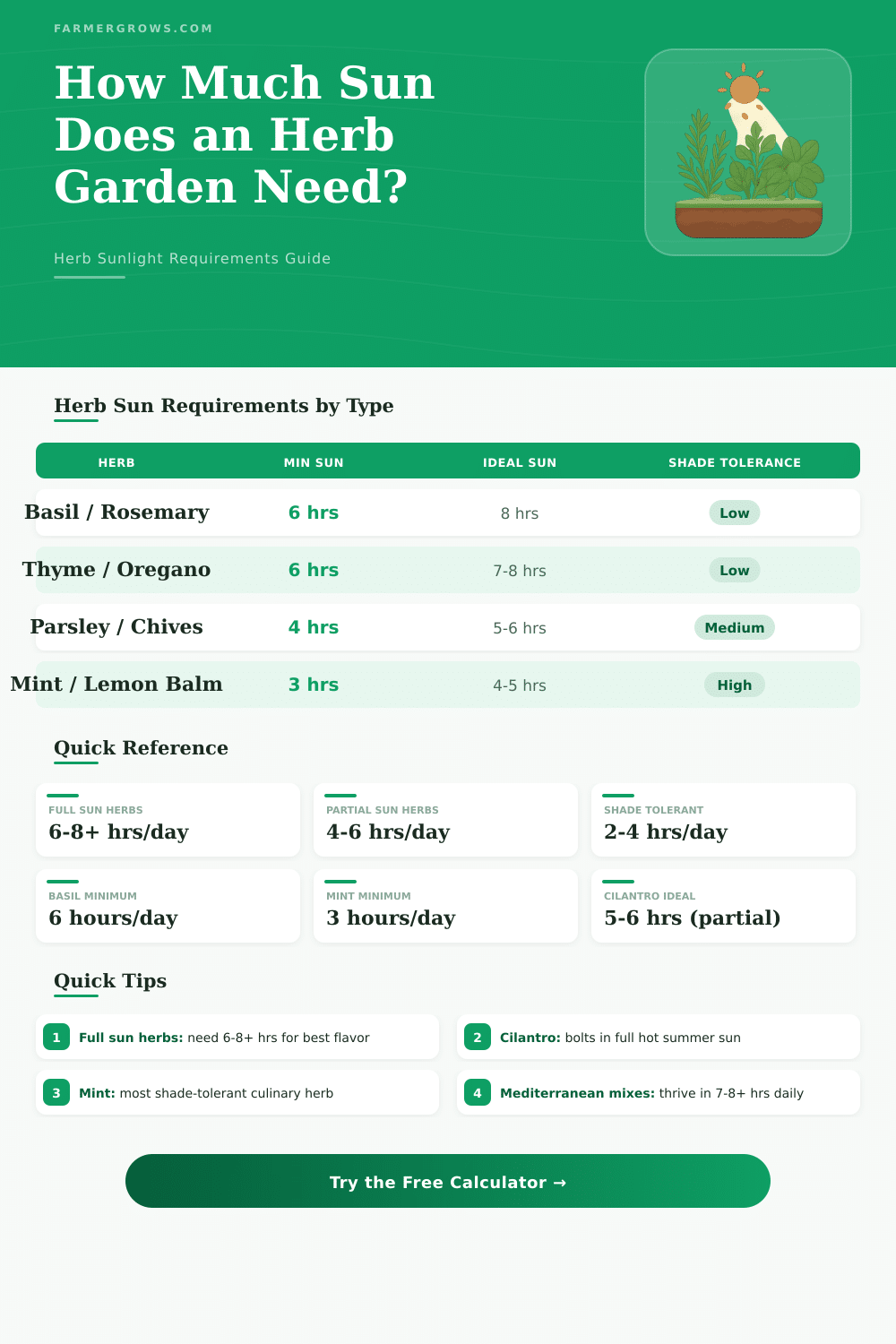
| Herb | Min Sun (hrs) | Ideal Sun (hrs) | Shade Tolerance | Notes |
|---|---|---|---|---|
| Basil | 6 | 8 | Low | Goes bitter and bolts in shade |
| Rosemary | 6 | 8+ | Low | Mediterranean; drought and full-sun loving |
| Thyme | 6 | 7–8 | Low | Full sun; needs well-drained soil |
| Oregano | 6 | 7–8 | Low | Full sun enhances essential oils |
| Lavender | 6 | 8+ | Low | Full sun; very drought tolerant |
| Sage | 6 | 7–8 | Low | Full sun for best flavor |
| Marjoram | 6 | 7–8 | Low | Similar sun needs to oregano |
| Parsley | 4 | 6 | Medium | Tolerates partial shade well |
| Cilantro | 4 | 5–6 | Medium | Bolts quickly in full hot sun |
| Dill | 5 | 6 | Medium | Partial to full sun; bolts in intense heat |
| Chives | 4 | 5–6 | Medium | Tolerates light shade |
| Mint | 3 | 4–6 | High | Spreads aggressively; handles shade well |
| Lemon Balm | 3 | 4–5 | High | Partial shade preferred in hot climates |
| Tarragon (French) | 4 | 5–6 | Medium | Partial sun adequate |
| Lovage | 3 | 4–6 | High | Tolerates shade; tall grower |
| Mix Name | Required Sun | Ideal Sun | Best Location | Suitable Season |
|---|---|---|---|---|
| Full Sun Mediterranean | 6 hrs min | 7–8+ hrs | South-facing outdoor | Spring–Summer |
| Kitchen Herb Classic | 4 hrs min | 5–6 hrs | East-facing garden | Spring–Fall |
| Culinary All-Purpose | 5 hrs min | 6–7 hrs | Raised bed or outdoor | Spring–Summer |
| Shade-Tolerant Mix | 3 hrs min | 4–5 hrs | North-facing or shaded | Spring–Fall |
| Tea Garden | 4 hrs min | 5–6 hrs | Partial sun garden | Spring–Summer |
| Mediterranean Full Sun | 6 hrs min | 8+ hrs | Full sun south-facing | Summer (Zone 8+) |
| Easy Starter Mix | 4 hrs min | 5–6 hrs | Container or raised bed | Spring–Fall |
| Salsa Garden | 5 hrs min | 6–7 hrs | Outdoor or raised bed | Spring–Summer |
| Sun Level | Thriving Herbs | Adequate Herbs | Struggling Herbs |
|---|---|---|---|
| Full Sun (8+ hrs) | Rosemary, Lavender, Basil, Thyme, Oregano | Sage, Marjoram, Dill | Cilantro, Mint (may bolt/stress) |
| Full Sun (6–8 hrs) | Basil, Thyme, Oregano, Sage, Parsley | Cilantro, Dill, Chives | Mint, Lemon Balm (fine but not ideal) |
| Partial Sun (4–6 hrs) | Parsley, Chives, Cilantro, Mint, Tarragon | Dill, Lemon Balm, Lovage | Rosemary, Lavender, Basil |
| Partial Shade (2–4 hrs) | Mint, Lemon Balm, Lovage | Chives, Parsley | Basil, Thyme, Oregano, Rosemary, Sage |
| Full Shade (<2 hrs) | None reliably | Mint (marginal) | All culinary herbs suffer |
The most of grasses like the sunshine. Here the main rule for growing them well. Almost all grasses need at least six hours of full sun daily.
Common species like basil rosemary dill and thyme truly need so much light to benefit. Some of them can manage with less, even so four hours of sunshine daily at least is needed so that the most grow well.
How much sun do herbs need
Sunshine is what forces the grasses create the oils, that give them their special smells and tastes. Those full hours of light daily ensure, that grasses have that typical smell and taste. Because of that, limiting the light results in grasses with less rich taste overall.
Many grasses, that like full sun, come from the Mediterranean. They come from the warm and dry region around that sea, so they adapt easily to similar places. Woody grasses, for instance rosemary and thyme, like more light and drier soil than the more leafy species.
Basil, on the other hand, needs more water and benefits form a bit of shade in the afternoon. Lemongrass is another grass, that likes sun and heat. For more strong taste, the West Indian type of lemongrass works well.
Even so not every grass wants a lot of sun. Mint favours partial shade instead of full sunshine. Mint, that receives too much light, simply does knot benefit.
Hence it forms dense cover on the soil around trees. Coriander is another grass, that handles less light and grows well in cold months.
Some grasses can grow in full sun in north regions, but they need protection against the strong light in south areas during the summer. The side of the garden matters a lot. Spots, that face south, usually give the most sunshine, unless high buildings or forests block from that side.
West or south window in the roof works well for grasses inside also.
Growing grasses inside the house is a bit hard. When sun rays pass through window, that is not truly direct sunshine. Because of that, many grasses hardly adapt to indoor conditions.
Grasses beside windows not always get enough light for good growth. When a sunny window lacks, one can lay the grasses in 15 to 30 centimetres of two 40-watt white fluorescent lamps during 14 to 16 hours daily, what will help. The phrase “full sun” means around eight hours of direct light, and in places with 16 hours of sun it can become too much.
Good plan is adapt to the options of the available garden space and choose grasses, that match with those conditions. Some grasses like shade, others need bright sun, and the most falls somewhere between. Grasses adapt quite a lot to different levels of light, so trying is worthit.
The biggest problem because of lack of sun is, that grasses become long and slim.