☕ Coffee Grounds for Hydrangea Calculator
Calculate the right amount of coffee grounds for your hydrangeas based on method, plant size, and growing goals
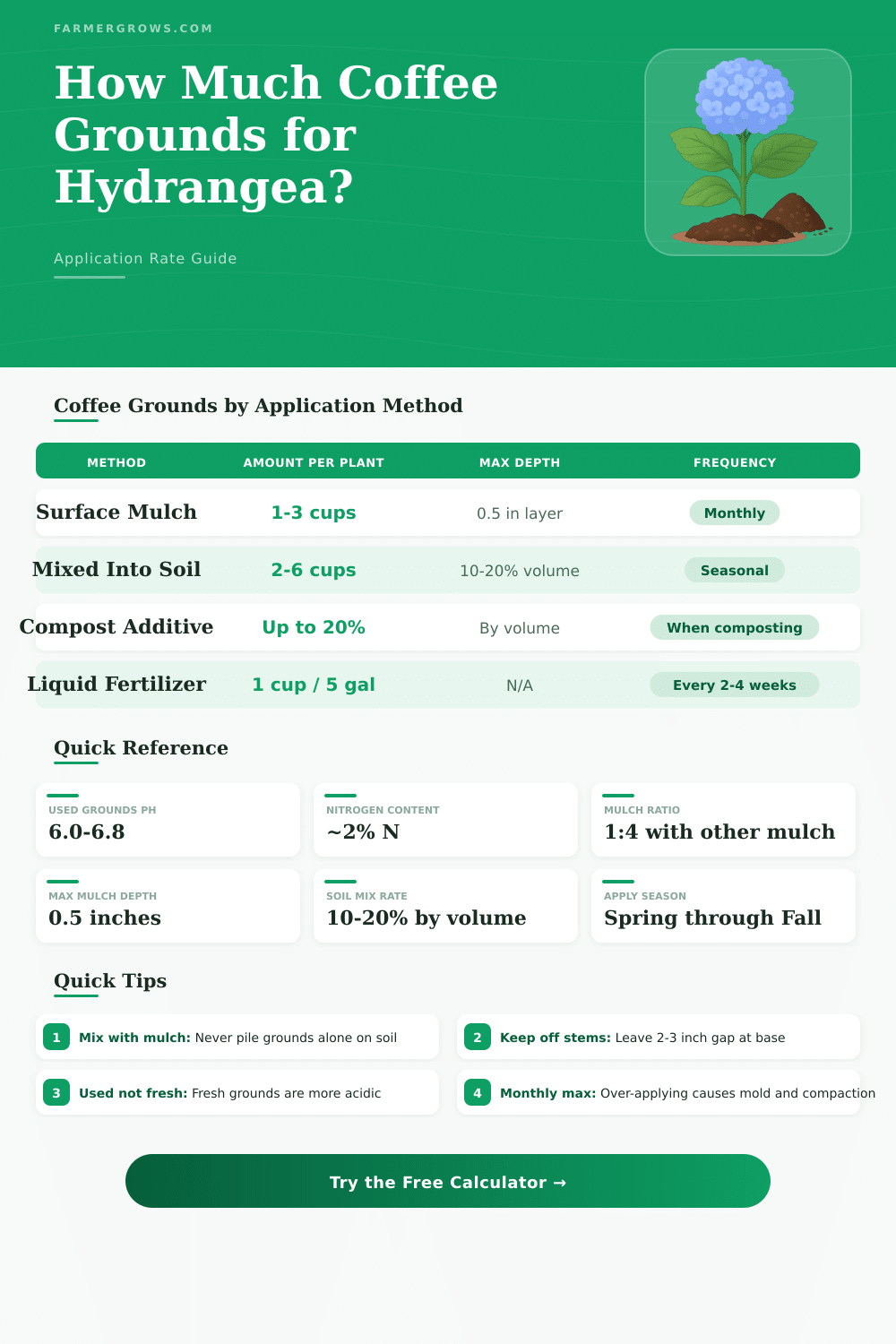
| Method | Amount Per Plant | Best For | Key Consideration |
|---|---|---|---|
| Surface Mulch | 1–3 cups, 0.5 in max | Moisture retention | Mix 1:4 with other mulch |
| Mixed Into Soil | 2–6 cups, 10–20% vol | Long-term amendment | Blend thoroughly with soil |
| Compost Additive | Up to 20% of pile | Balanced nutrition | Best overall approach |
| Liquid Fertilizer | 1 cup per 5 gal water | Quick nitrogen feed | Strain before applying |
| Nutrient | Content | Role for Hydrangeas | Release Speed |
|---|---|---|---|
| Nitrogen (N) | ~2.0% | Leaf and stem growth | Slow release |
| Phosphorus (P) | ~0.3% | Root and bloom support | Slow release |
| Potassium (K) | ~0.3% | Overall plant health | Slow release |
| C:N Ratio | ~20:1 | Good composting balance | N/A |
| Ground Type | Actual pH | Acidity Level | Effect on Soil |
|---|---|---|---|
| Used (brewed) grounds | 6.0–6.8 | Slightly acidic to neutral | Minimal pH change alone |
| Fresh (unbrewed) grounds | 4.5–5.5 | Moderately acidic | Can lower pH over time |
| Espresso grounds | 5.5–6.5 | Mildly acidic | Slight acidifying effect |
| Decaf grounds | 5.5–6.5 | Mildly acidic | Similar to regular used |
| Season | Application | Amount | Notes |
|---|---|---|---|
| Early Spring | Soil amendment at base | Full rate | Mix into top 2–3 inches of soil |
| Late Spring | Mulch layer refresh | Half rate | After last frost, mix with bark mulch |
| Summer | Monthly light top-dress | Half rate | Keep away from stems, water in |
| Fall | Compost incorporation | Full rate | Add to compost pile for spring use |
| Winter | None | 0 | Plant is dormant, skip application |
Coffee Grounds can change the color of Hydrangea flowers. That happens because they add extra acid to the ground. In chemical terms, that extra acid helps the plant absorb aluminium, that naturally exists in the soil.
The results are more blue or silver shades of flowers. When the pH of the soil is 5.5 or lower, it helps the blue color because low pH allows the plant to take more aluminium.
How Coffee Grounds Change Hydrangea Flower Color
Putting used Coffee Grounds around the roots of Hydrangea can make the flowers turn blue after some weeks. Mixing Coffee Grounds in the ground will shift Hydrangea to a brave blue tone. If one does that regularly during several months before the flowering, the bush will burst with the most strong blue flowers.
One key point is that Coffee Grounds also can produce different shades on Hydrangea, from light blue and pink to deep purple. For pink flowers, the pH should be close to neutral or alkaline, around 6.5 or more.
There is a bit of debate about the real strength of that effect. Used Coffee Grounds do not always change the pH of the soil so much that it fully changes the color of Hydrangea flowers. Maybe a small change happens, but like all changes to the soil, it takes time to reach the plant’s system.
Most of the acid goes during teh process of brewing the coffee. So, if the soil now is alkaline with pink flowers, only Coffee Grounds maybe will not be enough to reach blue color.
Even so, in alkaline soil, Coffee Grounds can change the pH fairly around the roots of the plant, even if it does not affect the whole soil layer. A Hydrangea that already had pale violet shade became a nice deep blew after Coffee Grounds were laid around the base daily for some weeks.
One should never put fresh Coffee Grounds directly on the roots of plants. They can be too acidic and burn tender roots. Coffee Grounds are quite acidic, so plants that like acid, like blueberry, azalea and Hydrangea, benefit from them.
But one should not use them around plants that prefer alkaline soil, like lavender or rosemary.
Besides the color, Coffee Grounds fill the ground with nutrients that feed it and help hold moisture. They also push away slugs that commonly attack the leaves and flowers of Hydrangea. They can also attract earthworms, which is good for the health of the soil.
It does not have to be only Coffee Grounds. Stuff like aluminum sulphate can give a similar result. But coffee is a natural and free option.
The secret is to use it often and make sure that the soil stays rich and damp. All Hydrangea flowers will react to more acid, butwith steady effort.