☀️ Garden Sunlight Calculator
Measure daily sun hours for any garden area & find your sunlight zone
| Latitude | Summer (Jun) | Spring/Fall (Mar/Sep) | Winter (Dec) |
|---|---|---|---|
| 25°N (S. Florida) | 13.5 hrs | 12.1 hrs | 10.7 hrs |
| 30°N (Texas) | 14.1 hrs | 12.1 hrs | 10.1 hrs |
| 35°N (Tennessee) | 14.8 hrs | 12.1 hrs | 9.5 hrs |
| 40°N (New York) | 15.3 hrs | 12.2 hrs | 9.1 hrs |
| 45°N (Oregon) | 16.0 hrs | 12.2 hrs | 8.5 hrs |
| 50°N (Canada) | 16.8 hrs | 12.2 hrs | 7.7 hrs |
| 55°N (Scotland) | 17.8 hrs | 12.3 hrs | 6.8 hrs |
| Orientation | % of Max Sun | Best Use | Suitable Zones |
|---|---|---|---|
| South-Facing | 100% | Vegetables, Fruit | Full Sun |
| Southeast-Facing | 88% | Herbs, Annuals | Full – Part Sun |
| Southwest-Facing | 85% | Ornamentals, Herbs | Full – Part Sun |
| East-Facing | 65% | Leafy Greens, Salvia | Part Sun |
| West-Facing | 60% | Tolerant perennials | Part Sun – Part Shade |
| North-Facing | 30% | Ferns, Hostas, Moss | Part Shade – Full Shade |
| Cloud Cover | Light Transmission | Usable Factor | Impact on Plants |
|---|---|---|---|
| Clear (0–20%) | 95–100% | 1.00 | Full photosynthesis |
| Mostly Clear (20–40%) | 80–95% | 0.88 | Minimal reduction |
| Partly Cloudy (40–60%) | 60–80% | 0.70 | Moderate reduction |
| Mostly Cloudy (60–80%) | 35–60% | 0.48 | Significant reduction |
| Overcast (80–100%) | 10–35% | 0.22 | Major reduction |
| Plant Type | Min. Daily Sun | Ideal Zone | Examples |
|---|---|---|---|
| Fruiting Vegetables | 8 hrs | Full Sun | Tomato, Pepper, Squash |
| Root Vegetables | 6 hrs | Full Sun | Carrot, Beet, Parsnip |
| Leafy Greens | 4 hrs | Part Sun | Lettuce, Spinach, Kale |
| Herbs (Mediterranean) | 6 hrs | Full Sun | Basil, Rosemary, Thyme |
| Herbs (Woodland) | 3 hrs | Part Shade | Mint, Chives, Parsley |
| Roses | 6 hrs | Full Sun | All rose varieties |
| Shade Perennials | 2 hrs | Part–Full Shade | Hosta, Astilbe, Fern |
| Fruit Trees | 6–8 hrs | Full Sun | Apple, Cherry, Plum |
| Lawn / Turf | 4 hrs | Part Sun | Fescue, Bluegrass |
| Ground Covers | 1–3 hrs | Full Shade | Ivy, Pachysandra, Moss |
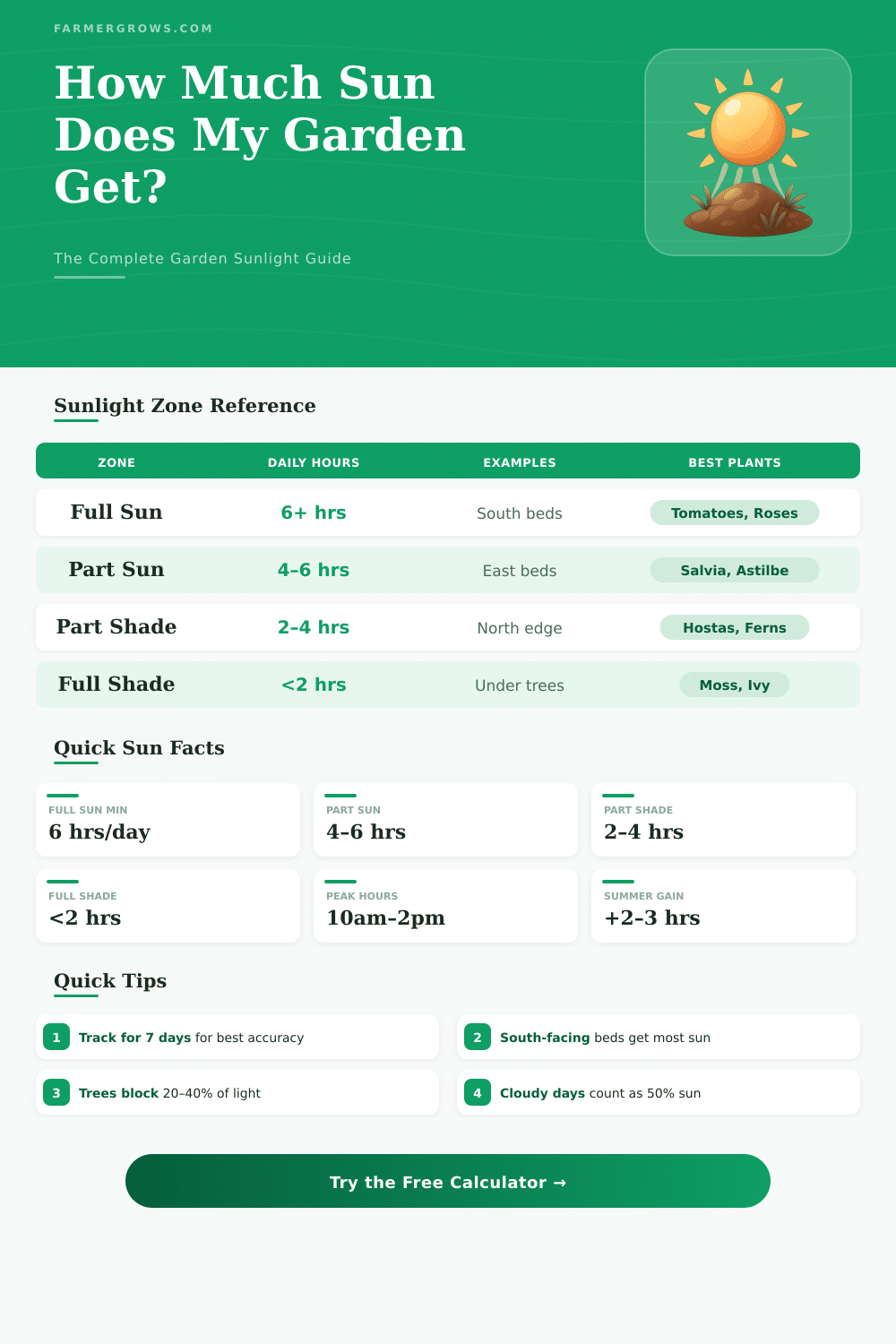
When you prepare your garden, the garden sunlight should be the first thing in your thoughts. Full sun mostly wants to say that the plants receive at least six hours or more direct light daily, and that light does not necessarily must come at once. It can come spread during the whole day, when the sun reaches the right position.
Most labels for plants and catalogues give almost the same explanation: between six and eight hours of direct sun or even more daily.
How Much Sun Does Your Garden Get?
Here the main point even so, not all garden sunlight matches to another. The morning light is soft and covers the whole range, what makes it ideal for young plants and grasses, for giving them a strong start. After midday the light becomes stronger and more powerful, what exactly works for fruiting vegetables.
Tomatoes, melons and peppers all require full garden sunlight. Seven or eight hours of light help to keep the leaves dry, what reduces diseases. Beans follow the same rule, they want at least six to eight hours daily and truly seem healthiest at the beginning of the year.
The sun reaches its maximum force between the tenth in the morning and the afternoon period. Four hours of direct midday or afternoon light, especially if it hits against a south wall, commonly work for many plants. Add some marked morning or evening sun to that?
That is even more great.
Many gardens suffer because of lack of light from near trees. The wise step is choose plants, that grow well in less bright situations. Plants for shade usually have thin leaves with big areas to catch all available light.
Full shade wants to say less than three hours of direct sun, while part-shade plants require between four and six hours. Even salad greens will grow in little light, although more hours certainly give thicker plants and more leaves to pick.
For checking your garden sunlight does not need to bee difficult. The camera of your phone can help a lot here. Do photos with time marks, and you will have good info for free.
The compass app helps to follow, in what direction different parts of the garden twist, so you can plan, how much sun truly reaches every area. The best time for mapping everything outside is winter, because shades then are longer, what shows exactly, where your growing limits sit during the cold months.
The place, where you lay every plant, has big influence. Plants, that need sun, deserve the most sunny places, that you have, while those, that like shade, can stay in the colder corners. You even can grow cucumbers and squash upward to catch more light.
When I am not sure about the needs of plants, start with around four hours of morning sun and slowly grow to six hours works well. More flower buds showing up show, that the plant happy is with its position.
Bringing indoor plants outside needs attention, because sudden UV-exposure can shock them. A greenhouse filters the strong light well, but if you do not have one, getting the plants used step after step to more strong sun helps. For gardens, that almost do not receive direct sun, grow lights can fill the gap.
Here a funny effect: the yellow-green leaves fake the look of light in dark places, because our eyes seegarden sunlight as having that yellowish shade.