🧪 Liquid Fertilizer Blend Calculator
Calculate exact mix volumes, NPK totals, and application rates for any tank size
⚡ Quick Presets
⚙️ Calculator Settings
🧴 Fertilizer Components (up to 3)
✅ Blend Results
📊 Fertilizer NPK & Density Reference
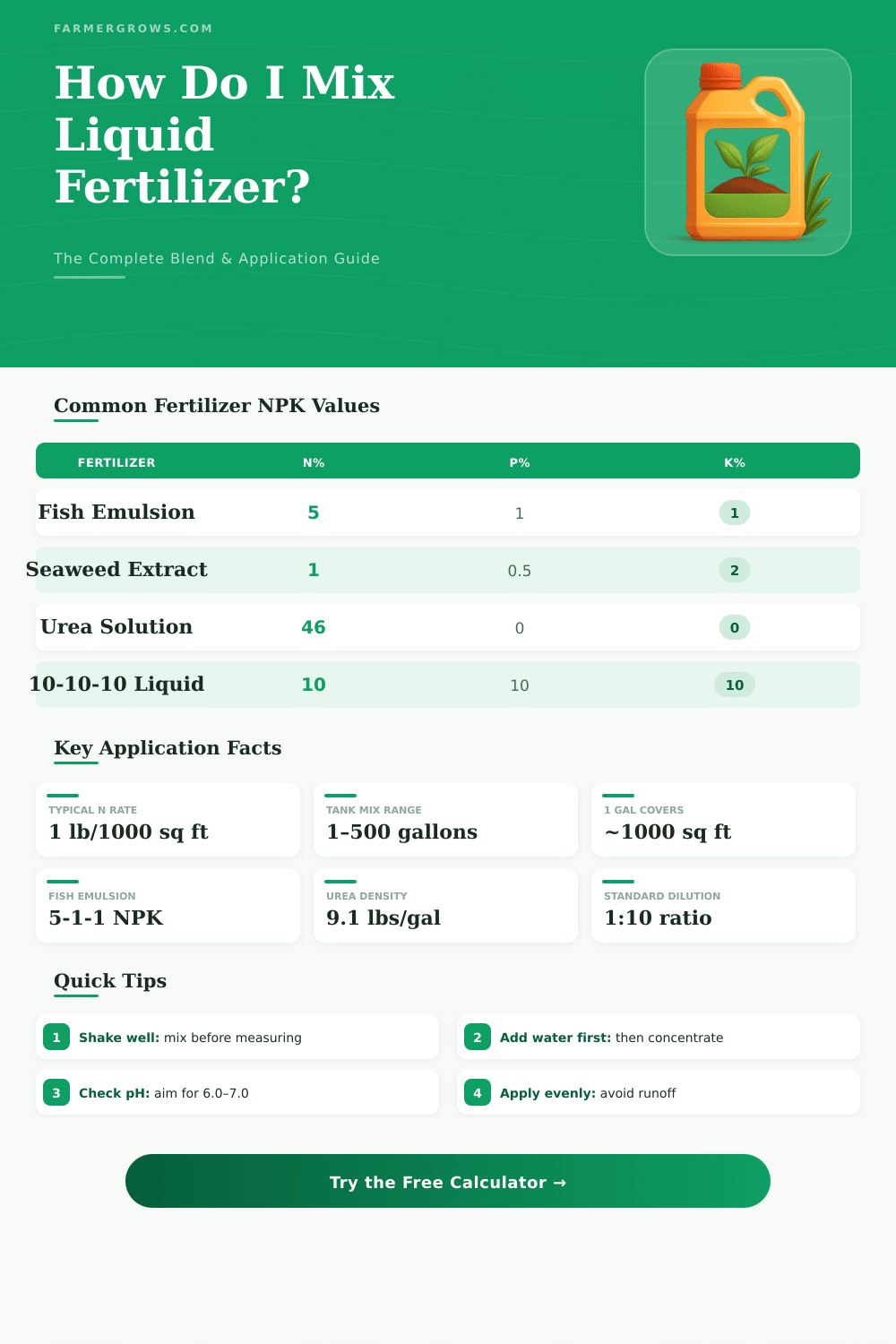
📋 Fertilizer Density & NPK Table
| Fertilizer | N% | P% | K% | Density (lbs/gal) | Density (kg/L) |
|---|---|---|---|---|---|
| Fish Emulsion 5-1-1 | 5.0 | 1.0 | 1.0 | 8.70 | 1.04 |
| Seaweed Extract 1-0.5-2 | 1.0 | 0.5 | 2.0 | 8.45 | 1.01 |
| Urea Solution 28% (UAN) | 28.0 | 0.0 | 0.0 | 10.10 | 1.21 |
| Liquid 10-10-10 | 10.0 | 10.0 | 10.0 | 11.00 | 1.32 |
| CAN-17 Calcium Nitrate | 17.0 | 0.0 | 0.0 | 11.30 | 1.35 |
| MKP 0-52-34 | 0.0 | 52.0 | 34.0 | 9.60 | 1.15 |
| Liquid KTS 0-0-25 | 0.0 | 0.0 | 25.0 | 10.70 | 1.28 |
💧 Application Rate Reference (per 1,000 sq ft)
| Crop / Use | N Target (lbs) | Carrier Water (gal) | Carrier Water (L) |
|---|---|---|---|
| Cool-Season Lawn | 0.5 – 1.0 | 22 – 44 | 83 – 167 |
| Warm-Season Lawn | 0.75 – 1.5 | 22 – 44 | 83 – 167 |
| Vegetable Garden | 0.25 – 0.75 | 10 – 22 | 38 – 83 |
| Foliar Spray | 0.1 – 0.25 | 5 – 10 | 19 – 38 |
| Trees & Shrubs | 0.5 – 1.0 | 20 – 50 | 76 – 189 |
| Hydroponics (per cycle) | 0.1 – 0.3 | Full reservoir | Full reservoir |
🧮 oz to mL & Volume Conversion
| Fluid oz | mL | Tablespoons | Cups |
|---|---|---|---|
| 0.5 fl oz | 14.8 mL | 1 Tbsp | 1/16 cup |
| 1 fl oz | 29.6 mL | 2 Tbsp | 1/8 cup |
| 2 fl oz | 59.1 mL | 4 Tbsp | 1/4 cup |
| 4 fl oz | 118.3 mL | 8 Tbsp | 1/2 cup |
| 8 fl oz | 236.6 mL | 16 Tbsp | 1 cup |
| 16 fl oz | 473.2 mL | 32 Tbsp | 2 cups |
| 128 fl oz | 3,785 mL | 256 Tbsp | 1 gallon |
Liquid fertilizer blend is simply made up of various raw materials for nutrients, that one combines to reach certain nutritious targets. Content of N, P₂O₅ and K₂O in one bag of fertilizer comes from a small group of basic materials for fertilizers. That can be one single basic element or a mix from several such materials, that one mixes together.
One gets mixed formulas by means of simple physical blending of different raw fertilizers, without any chemical reaction between them.
What is a Liquid Fertilizer Blend?
Commonly used basic fertilizers for blending are urea with 46% of nitrogen DAP with 18% of nitrogen and 46% of phosphorus, MAP with 11% of nitrogen and 52% of phosphorus, and potash with 60% of potassium. They combine in different amounts to reach various nutritious targets according to need. By means of only some raw elements can Liquid fertilizer blend producers create a wide kind of nutritious recipes, that match special needs of crops or solve separate gaps in the soil.
Not all fertilizers have the same makeup. The most common have the known NPK-rating, that shows nitrogen, phosphorus and potassium. Also, some include extra nutrients like calcium, magnesium and iron.
For instance, one all-purpose main mixes carry all common nutrients in 2-2-2 NPK-ratio, together with extras like calcium, magnesium and sulphur. It works for fruot trees, vegetables, decorative plants, pinks and flowers.
Ready Liquid fertilizer blend saves time and effort for gardeners, because they offer ingredients already combined in right amounts for general usage home or in garden. There also exist mixes meant for special plants. One particular Liquid fertilizer blend carefully prepares for exotic plants like palms, hibiscus, ferns and tropical species, promising richer natural flowering.
This mix gives balanced nutrients, that release slowly, without danger to burn the plants. It helps to also improve the flow of water and prepare the ground four strong root growth. There also exist high-efficiency liquids, that store man-made NPK together with carbon, fulvic acid and iron, to push fast growth and nicer colour through all landscape types.
In the farming sector, local blending involves storing materials like urea, phosphorus, potash and sulphate of ammonium in separate bins. Some farmers use special mixing trucks or horizontal loaders as blenders. The main difference in farming fertilizers is the powder, because outside-grade elements with dirty, but not dangerous extras are used to lower costs.
Farmers search lower prices, so they include such outside-grade parts in their mixes. Do the savings make it worth it, truly depends on the place and local competition. As long as farmers know the analytical percentage, one canmix with any fertilizer, whether organic, mineral or man-made.