🌱 Compost Calculator
Calculate exactly how much compost you need by area, depth & material type
lbs / yd³
lbs / yd³
lbs / yd³
lbs / yd³
lbs / yd³
lbs / yd³
lbs / yd³
lbs / yd³
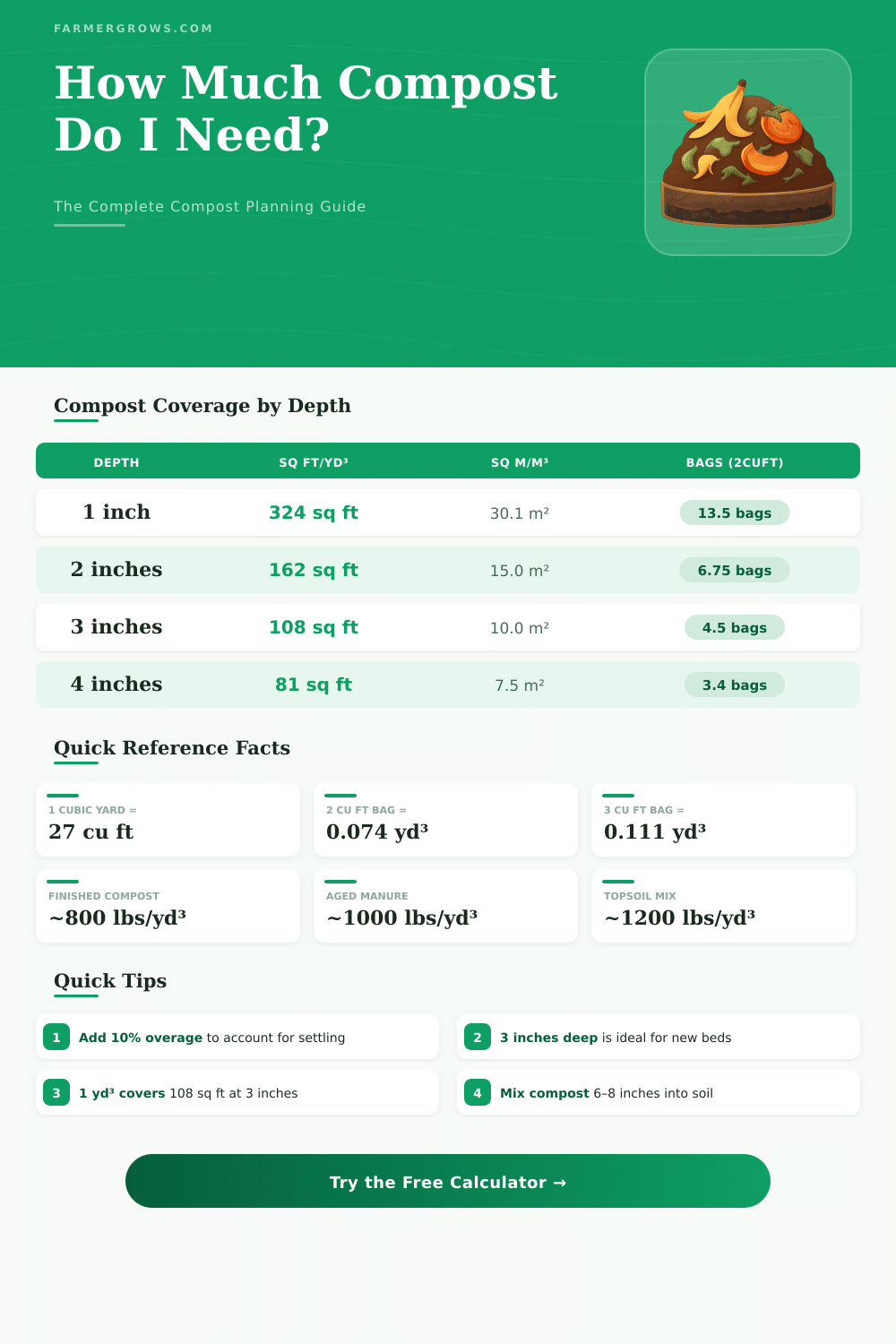
| Depth | Sq Ft per Yd³ | Sq M per M³ | Bags (2 cu ft) per Yd³ | Bags (3 cu ft) per Yd³ |
|---|---|---|---|---|
| 1 inch (2.5 cm) | 324 sq ft | 30.1 m² | 13.5 bags | 9 bags |
| 2 inches (5 cm) | 162 sq ft | 15.1 m² | 6.75 bags | 4.5 bags |
| 3 inches (7.5 cm) | 108 sq ft | 10.0 m² | 4.5 bags | 3 bags |
| 4 inches (10 cm) | 81 sq ft | 7.5 m² | 3.4 bags | 2.25 bags |
| 6 inches (15 cm) | 54 sq ft | 5.0 m² | 2.25 bags | 1.5 bags |
| Bag Size | Volume per Bag | Bags per Cubic Yard | Coverage at 3 in | Coverage at 2 in |
|---|---|---|---|---|
| 1 cu ft bag | 1 cu ft / 0.028 m³ | 27 bags | 4 sq ft | 6 sq ft |
| 2 cu ft bag | 2 cu ft / 0.057 m³ | 13.5 bags | 8 sq ft | 12 sq ft |
| 3 cu ft bag | 3 cu ft / 0.085 m³ | 9 bags | 12 sq ft | 18 sq ft |
| 1 cubic yard bulk | 27 cu ft / 0.765 m³ | — | 108 sq ft | 162 sq ft |
| Project | Area (sq ft) | Cubic Yards @ 3 in | Bags Needed (2 cu ft) |
|---|---|---|---|
| Small Raised Bed 4x8 | 32 sq ft | 0.30 yd³ | 4 bags |
| Standard Raised Bed 4x16 | 64 sq ft | 0.59 yd³ | 8 bags |
| Garden Bed 10x20 | 200 sq ft | 1.85 yd³ | 25 bags |
| Tree Ring 6 ft dia | 28 sq ft | 0.26 yd³ | 4 bags |
| Veggie Plot 12x12 | 144 sq ft | 1.33 yd³ | 18 bags |
| Lawn Top-Dress 20x20 | 400 sq ft | 3.70 yd³ | 50 bags |
| Flower Bed 8x25 | 200 sq ft | 1.85 yd³ | 25 bags |
| Large Yard 50x50 | 2,500 sq ft | 23.15 yd³ | 313 bags |
Compost is that black, crumbly stuff that looks like rich soil. It forms naturally when organic materials, leaves, grasses, food scraps and other waste, break down over time. Look at it as the natural machine for recycling.
Gardens and landscapes really benefit from it, because it strengthens the soil environment and also helps the structure of the soil, its chemistry and biological processes. Most enjoy that old materials that normally would go to the bucket or landfill now become something really useful.
What Compost Is and How to Make It
The secret happens through an aerobic process, which simply means that oxygen is not lacking. Tiny organisms do the main work of the breakdown. They start with the simplest materials later slowly move to the tougher parts, as the piles grow.
Here the funny part: all that tiny organism activity makes heat. The temperature in a Compost pile can quickly rise, which then boosts the whole process.
To start composting, you need only three main elements: oxygen, moisture and good balance between carbon and nitrogen in your organic waste. Green stuff, like veggie scraps, coffee grounds and grasses, add nitrogen to the mix. On the other hand, brown materials; cardboard, paper, leaves, wood chips, deliver the carbon.
If you mix it well, especially if you lay enough brown stuff, that stops your pile from becoming a bad scented chaos.
To set up a Compost system, you don’t need complex setups. Store bought plastic bins give closed, ventilated solutions. Want something more rustic?
Four pallets bound together form surprisingly strong bins. Spinning drums are a good option, if you like to turn them. There are also cedar versions, some bins are made from steel resistant cedar and offer much space for kitchen scraps and garden waste.
Even an old tire with drain holes below works well. On the cheap side, simple wire net around you’re shed does the task.
So, finished Compost consists mostly of broken down or half broken plant parts and common materials, sometimes mixed with a bit of soil. If you add it in a garden or landscape, it improves both the soil structure and the nutrients. Adding Compost wakes the tiny soil creatures to activity and growth.
It also helps to keep water in the soil and can clearly improve the airflow of the ground.
Using unfinished Compost is tempting, but it carries risk. While leaves and other materials still break down, they steal nitrogen from your plants, instead of feeding them. A Compost pile that keeps breaking down shrinks much faster than common organic material left alone which usually takes a year or two to fully break down.
Composting helps from several angles, environmental, economic and social. It keeps food scraps, garden trimmings, wood and manure out of landfills. It is a natural, lasting way to clean up waste and a really clearway to care about kitchen and garden waste responsibly.