🌿 Weed Killer Calculator
Calculate exactly how much weed killer you need for any lawn, garden, or outdoor area
✅ Your Weed Killer Results
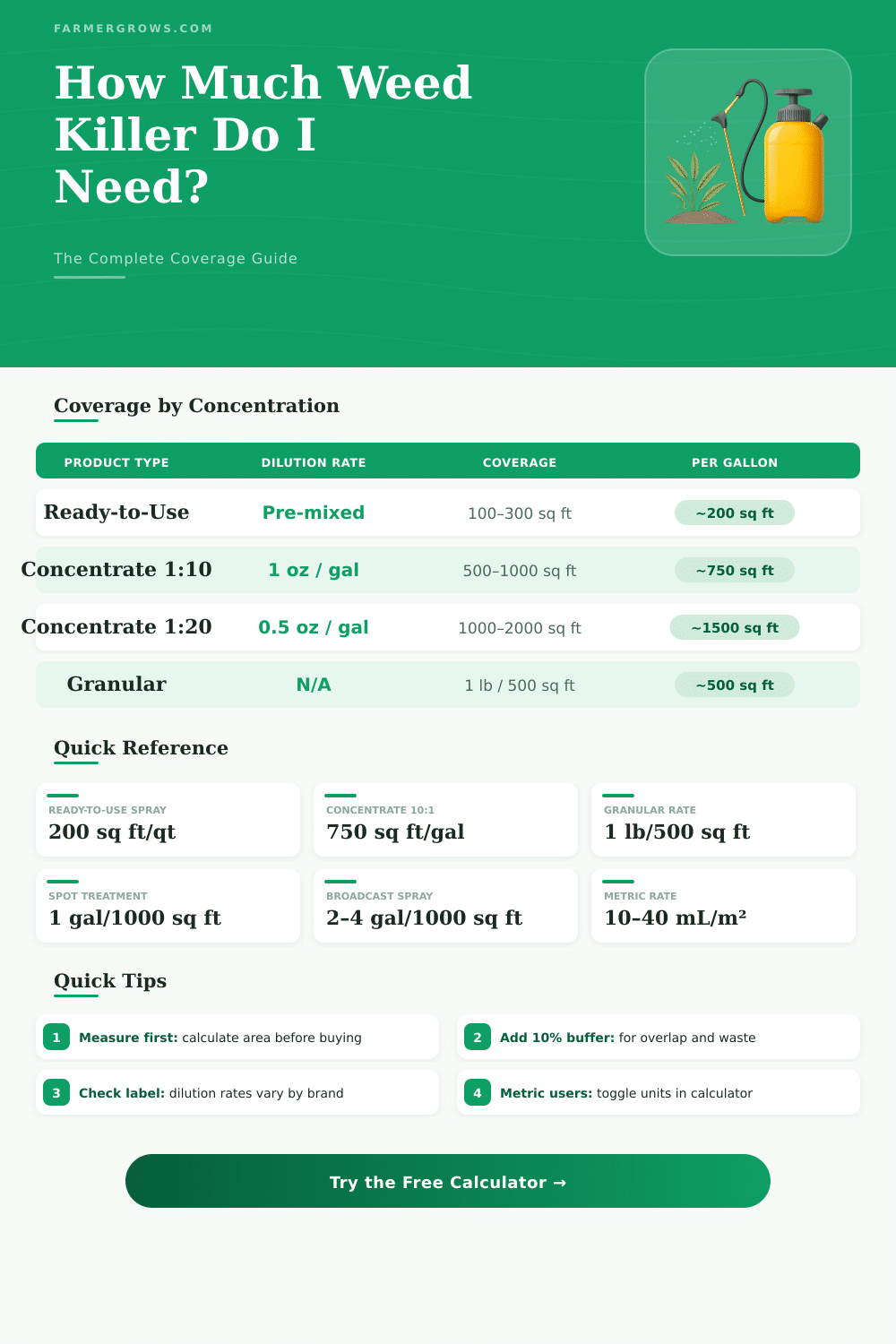
| Product Type | Light Rate | Standard Rate | Heavy Rate | Metric (mL/m²) |
|---|---|---|---|---|
| Ready-to-Use Spray | 1 qt / 300 sq ft | 1 qt / 200 sq ft | 1 qt / 100 sq ft | 15–45 mL/m² |
| Concentrate 10:1 | 1 gal / 1,000 sq ft | 1 gal / 750 sq ft | 1 gal / 500 sq ft | 4–8 mL/m² |
| Concentrate 20:1 | 1 gal / 2,000 sq ft | 1 gal / 1,500 sq ft | 1 gal / 1,000 sq ft | 2–4 mL/m² |
| Concentrate 30:1 | 1 gal / 3,000 sq ft | 1 gal / 2,500 sq ft | 1 gal / 1,800 sq ft | 1–2 mL/m² |
| Granular | 1 lb / 700 sq ft | 1 lb / 500 sq ft | 1 lb / 350 sq ft | 14–28 g/m² |
| Spot Treatment Gel | 1 fl oz / 60 sq ft | 1 fl oz / 50 sq ft | 1 fl oz / 35 sq ft | 30–80 mL/m² |
| Systemic Herbicide | 1 gal / 1,500 sq ft | 1 gal / 1,000 sq ft | 1 gal / 700 sq ft | 3–6 mL/m² |
| Pre-Emergent | 1 lb / 1,200 sq ft | 1 lb / 1,000 sq ft | 1 lb / 800 sq ft | 8–12 g/m² |
| Area (sq ft) | Area (m²) | Ready-to-Use (qt) | Conc. 10:1 (gal) | Granular (lbs) |
|---|---|---|---|---|
| 100 sq ft | 9.3 m² | 0.5 qt | 0.13 gal | 0.2 lb |
| 250 sq ft | 23.2 m² | 1.25 qt | 0.33 gal | 0.5 lb |
| 500 sq ft | 46.5 m² | 2.5 qt | 0.67 gal | 1 lb |
| 1,000 sq ft | 92.9 m² | 5 qt | 1.33 gal | 2 lb |
| 2,000 sq ft | 185.8 m² | 10 qt | 2.67 gal | 4 lb |
| 5,000 sq ft | 464.5 m² | 25 qt | 6.67 gal | 10 lb |
| 10,000 sq ft | 929 m² | 50 qt | 13.3 gal | 20 lb |
| 43,560 sq ft (1 ac) | 4,047 m² | 218 qt | 58 gal | 87 lb |
| Container Size | Volume (fl oz) | Ready-to-Use Coverage | Fills (1-gal sprayer) |
|---|---|---|---|
| 32 fl oz bottle (1 qt) | 32 fl oz | ~200 sq ft | 0.25 fills |
| 1-gallon jug | 128 fl oz | ~800 sq ft | 1 fill |
| 2.5-gallon container | 320 fl oz | ~2,000 sq ft | 2.5 fills |
| 5-gallon pail | 640 fl oz | ~4,000 sq ft | 5 fills |
| Concentrate 32 fl oz (10:1) | 32 fl oz | ~3,000 sq ft | N/A |
| Concentrate 1 gal (20:1) | 128 fl oz | ~24,000 sq ft | N/A |
| Project | Approx. Area | Ready-to-Use Needed | Conc. 10:1 Needed |
|---|---|---|---|
| Small Garden Bed | 100 sq ft | 0.5 qt | ~3 fl oz |
| Typical Driveway Edge | 200 sq ft | 1 qt | ~6 fl oz |
| Average Front Lawn | 1,500 sq ft | 7.5 qt | 2 qt |
| Average Back Lawn | 3,000 sq ft | 15 qt | 1 gal |
| Half-acre lot | 21,780 sq ft | 109 qt | 7.3 gal |
| 1-acre field | 43,560 sq ft | 218 qt | 14.5 gal |
Find the right amount of weed killer can make a difference for removing unwanted grasses. If you apply too little, those plant invaders simply will laugh at your efforts. Too much usage faces you with possible harm to the soil or plants.
It matters to choose the right mix for your particular grasses, understand the problem and estimate the real area of your farm in square metres.
How to Choose and Use Weed Killer Safely
Using typical focused weed killer for lawn, you mix around 0.75 to 1.5 liquid ounces in one gallon of water. That covers about 1 000 square feet. There is another kind, that requires 5 liquid ounces per gallon, but it only reaches 300 square feet.
The range is big depending on the chosen brand, so reading the label is a needed step.
A 16-ounce bottle of Roundup concentrate? It extends from 2.6 to 5 gallons of mixed output, covering between 800 and 1 500 square feet depending on the conditions. On the other hand, one gallon of weed killer against broadleaf plants can address up to 3.5 acres.
Here you see how strongly the impact ranges betwen different products.
Selective weed killer attacks only certain kinds of unwanted grasses, protecting your lawn or crops. Non-selective types are the opposite, they destroy almost everything green. Some mixes for lawn remove more than 250 common broadleaf grasses down to the roots, like dandelion, clover, and spurge.
Others work against more than 200 species, including broadleaf and grasses like crabgrass and foxtail.
Estimating the dose well is key so that the weed killer does its task. Selective mixes work, but you must reach the precise amount and check whether it targets you’re particular grasses. Here is the catch: some chemicals do not affect seeds.
So, new shoots appear soon after the killing of the older group. So, regular fresh spraying all two weeks and keeping that up for some years genuinely helps.
The mode of application also matters. There are spray bottles, cans with wands, mixed sprayers for concentrates, tube tins and spreaders for granules. The time of repeat application depends on the year, the targeted species and the first use.
On a windy day, you can spray close to other plants, if you watch out for drift. A little amount on a tree will not remove a strong tree or shrub… Wood does not absorb that well anyway.
The safety depends mostly on the used amount and the exposure. Big doses repeated over time cause real problems. The home usage of weed killer is much less than on farms and the risk to water stays small in comparison.
Keep people and animals away from treated areas until everythingdries fully.
Weed killer like Grazon needs time to break down, it has quite a long half-life before the residues disappear.