🟢 Vermiculite Calculator
Calculate exactly how much vermiculite you need by area, depth & grade
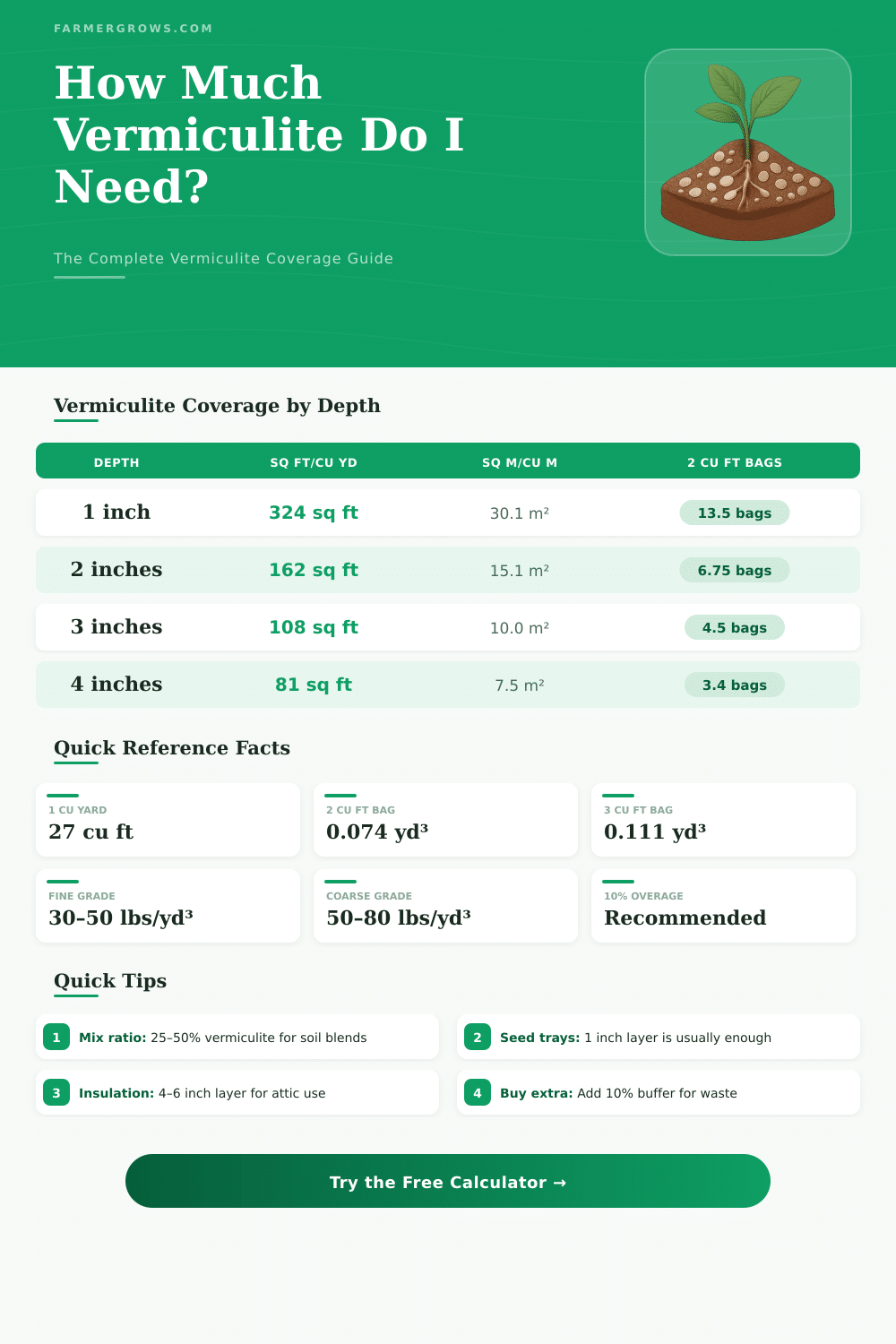
| Depth (in) | Depth (cm) | Sq Ft per Cu Yd | Sq M per Cu M | Cu Ft per 100 Sq Ft |
|---|---|---|---|---|
| 1 inch | 2.5 cm | 324 sq ft | 30.1 m² | 8.3 cu ft |
| 2 inches | 5.1 cm | 162 sq ft | 15.1 m² | 16.7 cu ft |
| 3 inches | 7.6 cm | 108 sq ft | 10.0 m² | 25.0 cu ft |
| 4 inches | 10.2 cm | 81 sq ft | 7.5 m² | 33.3 cu ft |
| 6 inches | 15.2 cm | 54 sq ft | 5.0 m² | 50.0 cu ft |
| Bag Size | Volume (cu ft) | Bags per Cu Yd | Coverage at 3 in | Coverage at 2 in |
|---|---|---|---|---|
| 2 cu ft bag | 2.0 cu ft | 13.5 bags | 8 sq ft | 12 sq ft |
| 3 cu ft bag | 3.0 cu ft | 9.0 bags | 12 sq ft | 18 sq ft |
| 4 cu ft bag | 4.0 cu ft | 6.75 bags | 16 sq ft | 24 sq ft |
| 8 qt bag | 0.27 cu ft | 99.5 bags | 1.1 sq ft | 1.6 sq ft |
| Bulk 1 cu yd | 27.0 cu ft | 1.0 unit | 108 sq ft | 162 sq ft |
| Project | Area | Cu Yds at 3 in | Bags (2 cu ft) |
|---|---|---|---|
| Seed tray area 4x4 | 16 sq ft | 0.15 yd³ | 2 bags |
| Propagation bench 4x8 | 32 sq ft | 0.30 yd³ | 4 bags |
| Small raised bed 4x8 | 32 sq ft | 0.30 yd³ | 4 bags |
| Garden bed 10x10 | 100 sq ft | 0.93 yd³ | 13 bags |
| Garden bed 10x20 | 200 sq ft | 1.85 yd³ | 25 bags |
| Greenhouse floor 20x30 | 600 sq ft | 5.56 yd³ | 75 bags |
| Attic insulation 20x20 | 400 sq ft | 7.41 yd³ (at 6 in) | 100 bags |
Vermiculite is a practical material that helps to improve the ground in gardens and for plants in jars. It works by keeping water and air, both needed for plants, so that they can grow well. In mixed soil, Vermiculite keeps the ground lightweight and allows roots to spread freely.
Sandy areas benefit especially because Vermiculite helps them hold water and air, that otherwise flows too quickly.
Using Vermiculite for Plants
It is possible to consider one of the main benefits of Vermiculite its skill to hold moisture. It is like a sponge, that absorbs water and later releases it slowly, according to the need of roots of plants. That makes it an excellent option for plants that like moist conditions.
Tropical plants and jar plants, that love moisture, grow very well with Vermiculite in their ground mix.
Vermiculite is also lightweight, what is very important for plants in jars and hanging baskets. Sand can serve a similar task in some cases, but it adds weight and does not hold water as well. Hence Vermiculite works more well as a replacement for sand in potting soil especially when weight matters.
For starting seeds, Vermiculite truly is useful. Seeds and young plants require steady moisture to sprout and properly establish. Mixes for seed starting commonly carry Vermiculite especially because of that reason.
It also helps to boost fast root growth in cuttings. Rather, older plants with growing root systems commonly fare more well with more lightweight, aired soil, that stops buildup of water. Here perlite comes useful.
Vermiculite itself does not add nutrients; it stays pure. Nutrients must be added separate. Even so, it helps with the even spread of extra fertilizer, what is a big bonus.
It is clean, so nutrients must be added to the growing mix during usage of it.
There are some downsides. Vermiculite can stay too damp, if one uses too much, and bacteria or fungus can spread in those wet surroundings. It commonly costs a lot and is hardly available.
After around three years in garden beds, it breaks down and needs replacing again. The medium grade breaks down more quickly then the rough grade.
General advice for potting mixes is to use around one quarter to one half of Vermiculite in the whole, according to the moisture need of every plant. For average house plants, ten to thirty percent of the volume works well. For pots with tropical or moisture-loving plants, one can go to twenty to forty percent.
It also mixes in compost recipes with coconut fibers or peat to create good growing conditions. Some gardeners entirely skip Vermiculite and simply mix peat with compost, andthat also can well work.