🌳 Tree Spacing Calculator
Calculate how many trees fit in your area & find ideal spacing distances
| Spacing (ft) | Square Pattern | Triangular Pattern | Spacing (m) |
|---|---|---|---|
| 4 ft | 2,722 trees/acre | 3,143 trees/acre | 1.2 m |
| 6 ft | 1,210 trees/acre | 1,397 trees/acre | 1.8 m |
| 8 ft | 680 trees/acre | 786 trees/acre | 2.4 m |
| 10 ft | 435 trees/acre | 503 trees/acre | 3.0 m |
| 12 ft | 302 trees/acre | 349 trees/acre | 3.7 m |
| 15 ft | 194 trees/acre | 224 trees/acre | 4.6 m |
| 20 ft | 109 trees/acre | 126 trees/acre | 6.1 m |
| 25 ft | 70 trees/acre | 81 trees/acre | 7.6 m |
| 30 ft | 48 trees/acre | 56 trees/acre | 9.1 m |
| 40 ft | 27 trees/acre | 32 trees/acre | 12.2 m |
| Pattern | Efficiency vs Square | Best Use | Row Offset |
|---|---|---|---|
| Square Grid | Baseline (1.00x) | Orchards, formal gardens | 0% |
| Triangular / Staggered | +15.5% more trees | Windbreaks, woodlots | 50% of spacing |
| Single Row | Linear only | Driveways, borders | N/A |
| Hedge / Dense Row | Highest density | Privacy screens | Half spacing |
| Project | Area | Spacing Used | Trees Needed |
|---|---|---|---|
| Small Backyard | 20 x 20 ft | 10 ft square | 4 trees |
| Orchard Row (small) | 50 x 30 ft | 15 ft x 20 ft | 6 trees |
| Windbreak (100 ft) | 100 x 10 ft | 8 ft row | 13 trees |
| Privacy Screen (60 ft) | 60 x 6 ft | 5 ft hedge | 13 trees |
| Large Yard | 150 x 50 ft | 25 ft square | 12 trees |
| 1-Acre Woodlot | 208 x 208 ft | 10 ft triangular | ~503 trees |
As one plants trees outside, that really changes everything, honestly, more than one usually thinks. The spaces between every tree affect everything: how they grow, whether they get enough light and ultimately how much money the land will give later. If you plant them too close at first you will be forced to work with the results for decades.
The most basic way to space trees is based on the size of their full crowns. One commonly sees distances of 50 to 60 feet, which allows every tree to spread fully in a natural form. Here is a simple method: take the full spread of your tree and divide it by two.
How to Space Trees
For instance, the Red Maple spreads between 25 and 45 feet when it fully grows. Divided by two, that gives 12.5 to 22.5 feet as smallest space between them.
When you plant two same trees side by side, each with a 10-foot full spread, space them at 10 feet minimum, because the branches will fight about light above. If you extend it to 15 feet, every tree has around 7.5 feet of breathing room before the crowns will touch one another. Add only a few extra feet, say to 17, and you get comfrotable reserve.
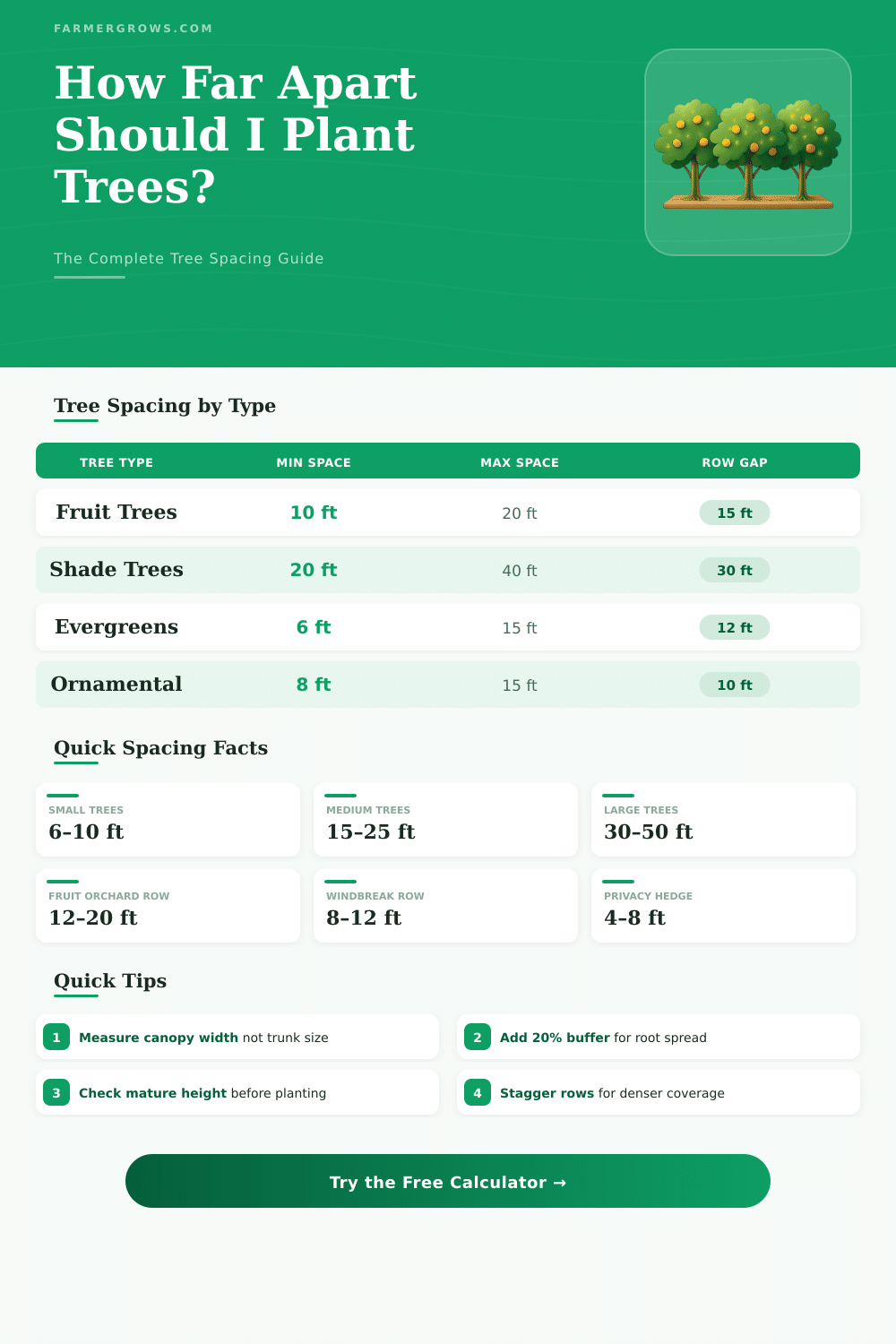
If you do not have exact data about your species, use this general guide, that saves the situation. Little trees work well at 12 to 15 feet apart, medium ones favour 20 to 30 feet and big ones need at least 30 to 40 feet or even more. Norwegian Spruce is a good example: it wants 15 to 25 feet for wind protection, but 20 too 30 feet for park planting.
What is the ideal for productive, long-lasting trees? Arrange them so that the edges of their crowns barely touch one another at full growth. Even smarter is to space them at fifty percent more than that, so that sunshine filters well through the leaves.
Wind breaks have their own rule. Plant your bushes and trees at right angles to the usual wind direction. If you have little space and only one row?
Choose evergreens, that keep their bottom branches dense. For two rows, lay the lower or slower growing species on the wind side and the tall ones behind them.
Have you only limited area? Choose really small trees, not massive ones, that you will have to trim for years. Even dwarf fruit trees need breathing room, at least 7 feet everywhere.
Bare root plums do well at around 8 to 10 feet apart. On smaller rootstock you can plant them more closely, say 6 to 7 feet, if you care about regular pruning.
Since in avenues the branches must meet together, plant trees at a distance equal to their full width. A tree with a 20-foot spread needs trunks at 18 to 20 feet center to center. A strip of bare or still ground between them stops fast fire spread.
Some test tiny forests use tree spacing even at 3 feet, though that does not work for trees with a big crown.
Official cost-benefit programs sometimes need a minimum of 300 well-spaced plants per acre after the first season. Online tree spacing calculators help you figure out how many trees fit inan acre based on your row distance, which is useful for wood growing, gardening and shelters.