🌳 Tree Root Protection Zone Calculator
Calculate the RPZ radius, area, and protection buffer for any tree based on trunk diameter
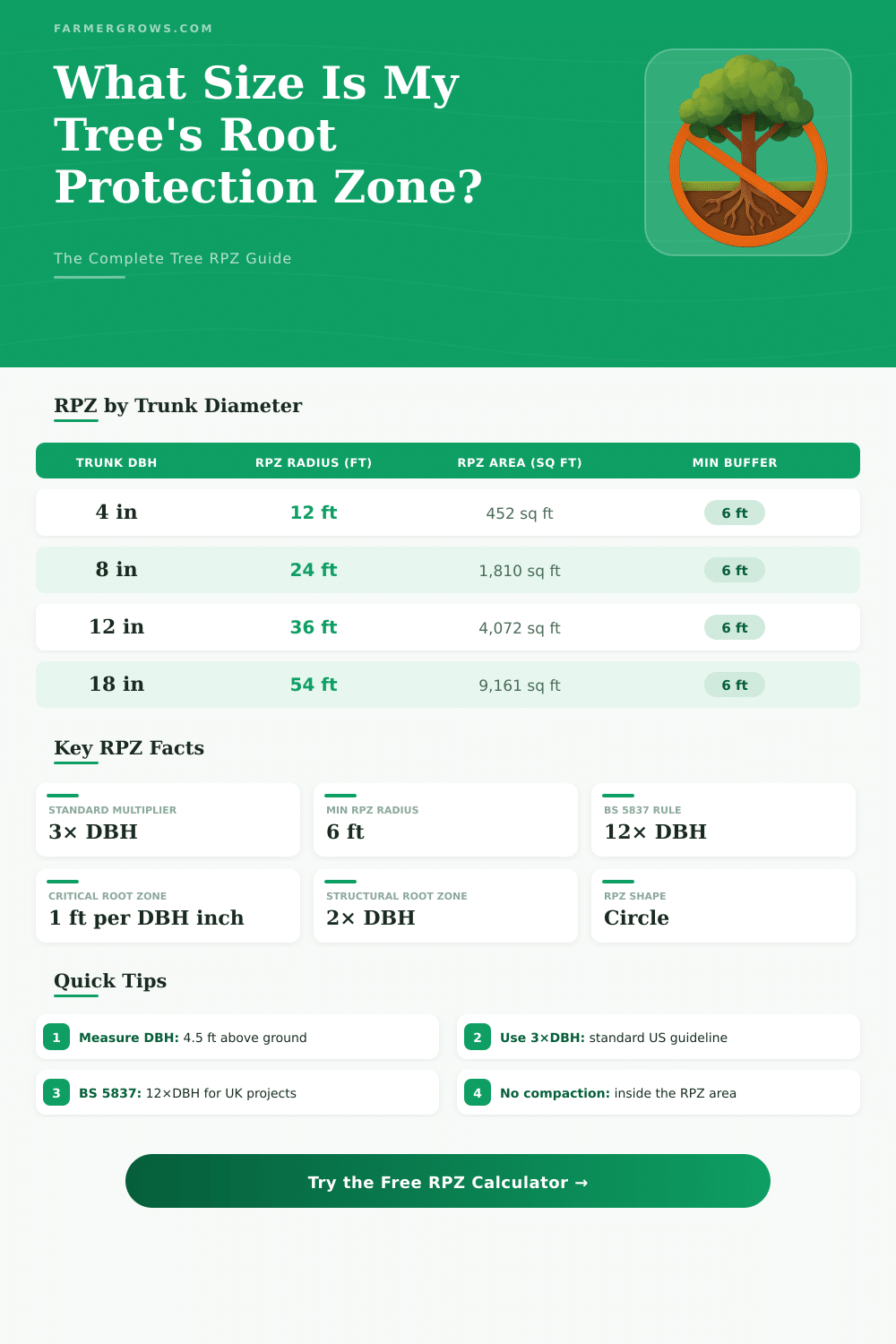
| DBH (in) | DBH (cm) | RPZ Radius – US 3× (ft) | RPZ Radius – BS5837 12× (m) | RPZ Area (sq ft) | RPZ Area (m²) |
|---|---|---|---|---|---|
| 3 | 7.6 | 9 | 0.91 | 254 | 23.6 |
| 4 | 10.2 | 12 | 1.22 | 452 | 42.0 |
| 6 | 15.2 | 18 | 1.83 | 1,018 | 94.5 |
| 8 | 20.3 | 24 | 2.44 | 1,810 | 168.2 |
| 10 | 25.4 | 30 | 3.05 | 2,827 | 262.6 |
| 12 | 30.5 | 36 | 3.66 | 4,072 | 378.3 |
| 18 | 45.7 | 54 | 5.49 | 9,161 | 851.0 |
| 24 | 61.0 | 72 | 7.32 | 16,286 | 1,513 |
| 36 | 91.4 | 108 | 10.97 | 36,644 | 3,404 |
| 48 | 121.9 | 144 | 14.63 | 65,145 | 6,052 |
| Soil Type | Root Spread Tendency | RPZ Adjustment | Notes |
|---|---|---|---|
| Loam | Average | ×1.0 (no change) | Standard baseline soil |
| Clay | Spreads further laterally | ×1.1 – 1.2 | Roots avoid clay depth, spread wide |
| Sandy | Spreads further laterally | ×1.1 – 1.2 | Low water retention drives spread |
| Compacted | Confined / shallow | ×0.85 – 1.0 | Still protect — tree more stressed |
| Urban / Disturbed | Unpredictable | ×1.15 – 1.25 | Use larger buffer for safety |
| Tree Species | Typical Mature DBH | RPZ Radius (US 3×) | RPZ Area (sq ft) |
|---|---|---|---|
| Ornamental Cherry | 4–6 in | 12–18 ft | 452–1,018 |
| Flowering Dogwood | 4–8 in | 12–24 ft | 452–1,810 |
| Silver Maple | 18–30 in | 54–90 ft | 9,161–25,447 |
| Red Oak | 20–40 in | 60–120 ft | 11,310–45,239 |
| American Elm | 24–48 in | 72–144 ft | 16,286–65,145 |
| Loblolly Pine | 12–24 in | 36–72 ft | 4,072–16,286 |
| European Beech | 30–60 in | 90–180 ft | 25,447–101,788 |
| London Plane | 24–48 in | 72–144 ft | 16,286–65,145 |
The tree root protection zone of trees forms something like an invisible fence that surrounds the roots to preserve them against harm. One also calls it simply tree root protection zone. Think of it as a circular cushion, that follows the location of the tree crown, so here, where the branches end above.
That inner space then becomes the most important part to preserve the tree in good shape.
How to Protect Tree Roots During Building
Tree root protection zones mark themselves during building works, and all of them serve one cause: preserve the lasting health of the tree together with its structural strength. In the critical root area lives the most of those roots, that absorb water and food for the tree. Usually this zone extends from the base of the tree until the edge of the crown.
Of course, every species has its own version of that zone, that adjusts according to the species itself and the local ground conditions.
To estimate the size of that area, we can use a simple tool: measure the diameter of the trunk. According to my experience, the preserved tree root protection zone extends around one foot for every icnh of that diameter. So, for a tree with a ten-inch trunk, we require at least ten feet of protected ground around it.
But for old, large trees, that distance grows a lot: fifteen times the diameter in chest height above the soil, or seven metres past the crown edge, according to which one is the biggest. Do that math during the planning, before some building starts, and it will change everything.
Here is something that surprises many folks: the roots of trees stay surprisingly shallow. They spread almost along the surface, lying mainly inside soil less than a metre below. On average, around eighty percent of the roots focus in a layer only twelve to eighteen inches below.
That is much more near the top, than one usually thinks.
If building machines enter the critical root area, the ground hardens, and the shallow roots suffer heavy damage. That risks the stability of the whole tree. Without those roots, the tree can no longer receive water and food well.
The main task during construction is too leave at least seventy percent of the tree root protection zone unaffected. Trees can recover after such works, but only if we care to not touch that zone.
The most effective protection is solid fence around the trees, that must stay standing during the whole time. Tree protection comes in different forms. Netting, wire, plastic, and they are built to handle local motion and tension.
They surround the important root part, giving reliable protection without blocking the natural growth. Also, cellular systems can protect the root structure against ground packing, when vehicles must pass closely. Trees form precious natural shelter, and inurban places they face big pressure from permanent buildings.