🌳 Tree Height Calculator
Measure any tree using shadow, angle, or two-stick methods — instant results in feet & meters
⚡Quick Presets
🔧Calculator Settings
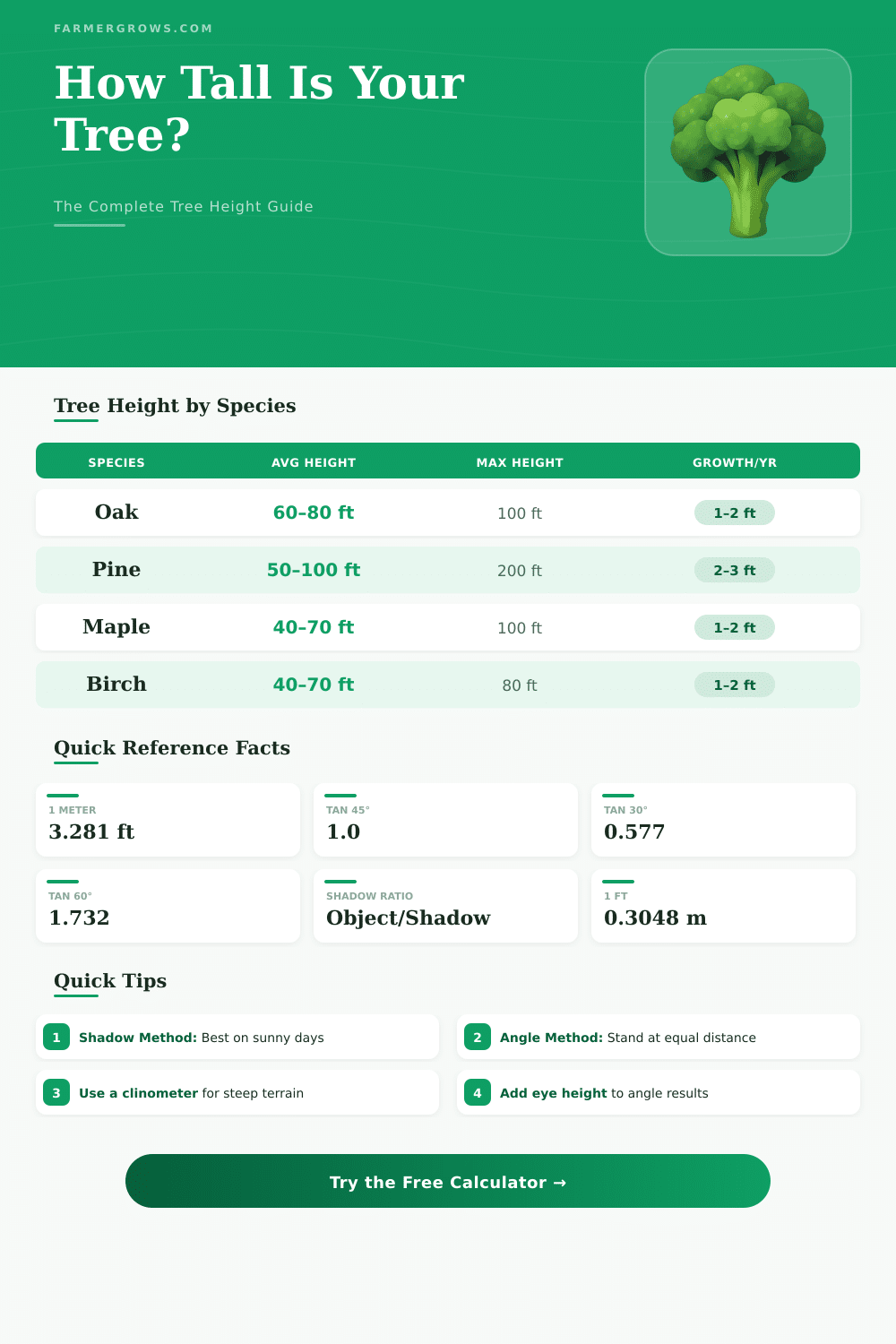
🌳Common Tree Heights by Species
📐Angle to Height Multiplier (tan values)
| Angle (°) | Tan Value | Height per 10 ft dist (ft) | Height per 10 m dist (m) |
|---|---|---|---|
| 15° | 0.268 | 2.68 ft | 2.68 m |
| 20° | 0.364 | 3.64 ft | 3.64 m |
| 25° | 0.466 | 4.66 ft | 4.66 m |
| 30° | 0.577 | 5.77 ft | 5.77 m |
| 35° | 0.700 | 7.00 ft | 7.00 m |
| 40° | 0.839 | 8.39 ft | 8.39 m |
| 45° | 1.000 | 10.00 ft | 10.00 m |
| 50° | 1.192 | 11.92 ft | 11.92 m |
| 60° | 1.732 | 17.32 ft | 17.32 m |
☀️Shadow Method Reference
| Object Height (ft) | Object Shadow (ft) | Tree Shadow (ft) | Estimated Tree Height (ft) |
|---|---|---|---|
| 6 ft (person) | 4 ft | 20 ft | 30 ft |
| 6 ft (person) | 4 ft | 40 ft | 60 ft |
| 6 ft (person) | 3 ft | 25 ft | 50 ft |
| 10 ft (stake) | 5 ft | 30 ft | 60 ft |
| 5 ft (child) | 5 ft | 50 ft | 50 ft |
| 6 ft (person) | 6 ft | 80 ft | 80 ft |
📏Unit Conversion Quick Reference
| Feet | Meters | Inches | Centimeters |
|---|---|---|---|
| 10 ft | 3.05 m | 120 in | 304.8 cm |
| 20 ft | 6.10 m | 240 in | 609.6 cm |
| 30 ft | 9.14 m | 360 in | 914.4 cm |
| 50 ft | 15.24 m | 600 in | 1524 cm |
| 75 ft | 22.86 m | 900 in | 2286 cm |
| 100 ft | 30.48 m | 1200 in | 3048 cm |
| 150 ft | 45.72 m | 1800 in | 4572 cm |
| 200 ft | 60.96 m | 2400 in | 6096 cm |
📊Tree Height Classification
| Category | Height (ft) | Height (m) | Common Examples |
|---|---|---|---|
| Dwarf / Shrub | Under 15 ft | Under 4.6 m | Dogwood, Serviceberry |
| Small Tree | 15–30 ft | 4.6–9.1 m | Cherry, Redbud |
| Medium Tree | 30–60 ft | 9.1–18.3 m | Maple, Birch |
| Large Tree | 60–100 ft | 18.3–30.5 m | Oak, Spruce |
| Very Large | 100–150 ft | 30.5–45.7 m | Tulip Poplar, Pine |
| Giant Tree | Over 150 ft | Over 45.7 m | Redwood, Douglas Fir |
When one talks about the Tree Height, usually about the vertical distance from the soil to the most upper tips of its branches. That is different from the measurement of the trunk itself. Here the trouble: if the tree leans to one side, the real length of the trunk could be bigger than the vertical height of the whole tree.
This difference really matters a lot when you try to get precise rating.
How to Measure Tree Height and How Tall Trees Can Grow
There are several ways to estimate the real Tree Height outside. One pretty easy way is to take a stick and hold it straight before yourself. Walk slowly from the tree, until the top of the stick lines up with the top of the tree.
When they match, mark your position. The distance from that place to the trunk of the tree? It almost matches the height of your tree.
Another way is based on shadows, which is practical and clever. First, measure yourself, your shadow and the shadow of the tree. Then, take your height, multiply it by the length of the tree shadow and divide the total by the length of your shadow.
Like this you get the Tree Height.
There is also a good triangle method, that works surprisingly. One can estimate tall objects; including trees, creating a right triangle with the arm, stick and the viewing point. A clinometer with measuring tape works well too.
Walk 66 feet backwards, then use the scale of the clinometer to reed the height directly. If you can not go that far, try 33 feet and double the reading. For better accuracy, use a wheel to measure the distance from the trunk, and the clinometer works best when you stand around one and a half times the Tree Height away.
Technology helps a lot too. Those apps work by measuring the angle from the base of the tree to its peak, while you walk to the tree, counting steps to estimate distance and noting the shape of the ground. The program then gives rough height.
Three basic tools can do it: measuring tape, simple calculator with cosine and tangent functions and a clinometer.
Trees indeed push upward to grab more sunshine. But here the catch. While they grow higher, the weight makes the carrying of water from the roots to the top much harder.
Those tiny channels for carrying water become narrower in the higher parts. So the delivery of water to the peak slows or stops entirely, leaving the upper branches dry and dying. Naturally, it puts a limit on the possible growth.
That theoretical ceiling sits around 400 to 426 feet. Above that, the water column breaks. Some tall species like coastal redwoods, mountain ash and yellow meranti trees currently reach 100 metres.
Most species however stay a lot under that, and honest, nobody knows for sure the reason.
Smaller species of trees max out around 25 feet, when they fully mature. At the other end is the Dwarf Arctic Willow, that barely reaches 2 or 3 inches tall, whenit stops growing.