🌳 Tree Age Calculator
Estimate any tree's age using trunk diameter, circumference, or species growth factor
| Species | Growth Factor | Growth Rate | Avg. Diameter/yr | Typical Lifespan |
|---|---|---|---|---|
| White Oak | 5.0 | Slow–Medium | 0.20 in (0.5 cm) | 200–600 yrs |
| Red Oak | 4.0 | Medium | 0.25 in (0.6 cm) | 200–400 yrs |
| Sugar Maple | 5.5 | Slow–Medium | 0.18 in (0.5 cm) | 200–400 yrs |
| Red Maple | 4.5 | Medium–Fast | 0.22 in (0.6 cm) | 80–200 yrs |
| E. White Pine | 5.0 | Medium–Fast | 0.20 in (0.5 cm) | 200–450 yrs |
| Ponderosa Pine | 5.5 | Medium | 0.18 in (0.5 cm) | 150–600 yrs |
| Paper Birch | 5.0 | Medium–Fast | 0.20 in (0.5 cm) | 50–140 yrs |
| American Beech | 6.0 | Slow | 0.17 in (0.4 cm) | 300–400 yrs |
| Tulip Poplar | 3.0 | Fast | 0.33 in (0.8 cm) | 150–300 yrs |
| Quaking Aspen | 3.0 | Fast | 0.33 in (0.8 cm) | 50–150 yrs |
| Norway Spruce | 5.0 | Medium | 0.20 in (0.5 cm) | 100–400 yrs |
| Balsam Fir | 5.5 | Medium | 0.18 in (0.5 cm) | 60–150 yrs |
| American Elm | 4.0 | Medium–Fast | 0.25 in (0.6 cm) | 100–300 yrs |
| White Ash | 4.0 | Medium | 0.25 in (0.6 cm) | 200–300 yrs |
| DBH (inches) | DBH (cm) | Factor 3.0 (Fast) | Factor 4.5 (Medium) | Factor 5.5 (Slow) | Factor 7.0 (Very Slow) |
|---|---|---|---|---|---|
| 4 in | 10 cm | 12 yrs | 18 yrs | 22 yrs | 28 yrs |
| 8 in | 20 cm | 24 yrs | 36 yrs | 44 yrs | 56 yrs |
| 12 in | 30 cm | 36 yrs | 54 yrs | 66 yrs | 84 yrs |
| 18 in | 46 cm | 54 yrs | 81 yrs | 99 yrs | 126 yrs |
| 24 in | 61 cm | 72 yrs | 108 yrs | 132 yrs | 168 yrs |
| 36 in | 91 cm | 108 yrs | 162 yrs | 198 yrs | 252 yrs |
| 48 in | 122 cm | 144 yrs | 216 yrs | 264 yrs | 336 yrs |
| 60 in | 152 cm | 180 yrs | 270 yrs | 330 yrs | 420 yrs |
| Circumference (in) | Circumference (cm) | Diameter (in) | Diameter (cm) | Radius (in) |
|---|---|---|---|---|
| 12.6 in | 32 cm | 4 in | 10 cm | 2 in |
| 25.1 in | 64 cm | 8 in | 20 cm | 4 in |
| 37.7 in | 96 cm | 12 in | 30 cm | 6 in |
| 56.5 in | 144 cm | 18 in | 46 cm | 9 in |
| 75.4 in | 191 cm | 24 in | 61 cm | 12 in |
| 113.1 in | 287 cm | 36 in | 91 cm | 18 in |
Figuring out the tree age can be difficult. There is a whole scientific field called dendrochronology that focuses on this topic. Everything is based on a simple truth about trees: every year they form fresh wood.
The most basic way to estimate the tree age is by counting its rings. Each dark ring in the wood shows one year of growth. During the active season trees form a wider ring of light wood, then follows a thinner and dark ring when the growth slows.
How to Tell a Tree’s Age
Counting rings can give precise results, even though lack of rain can mess up the norml rhythm of growth and reduce the accuracy.
Of course, to count rings you usually need to cut down the tree, which kills it for most of them. A safer way is to take a core sample from a living tree. One can take the core near the base of the crown for full age, or at 1.3 metres above the soil to avoid odd growth patterns close too the ground.
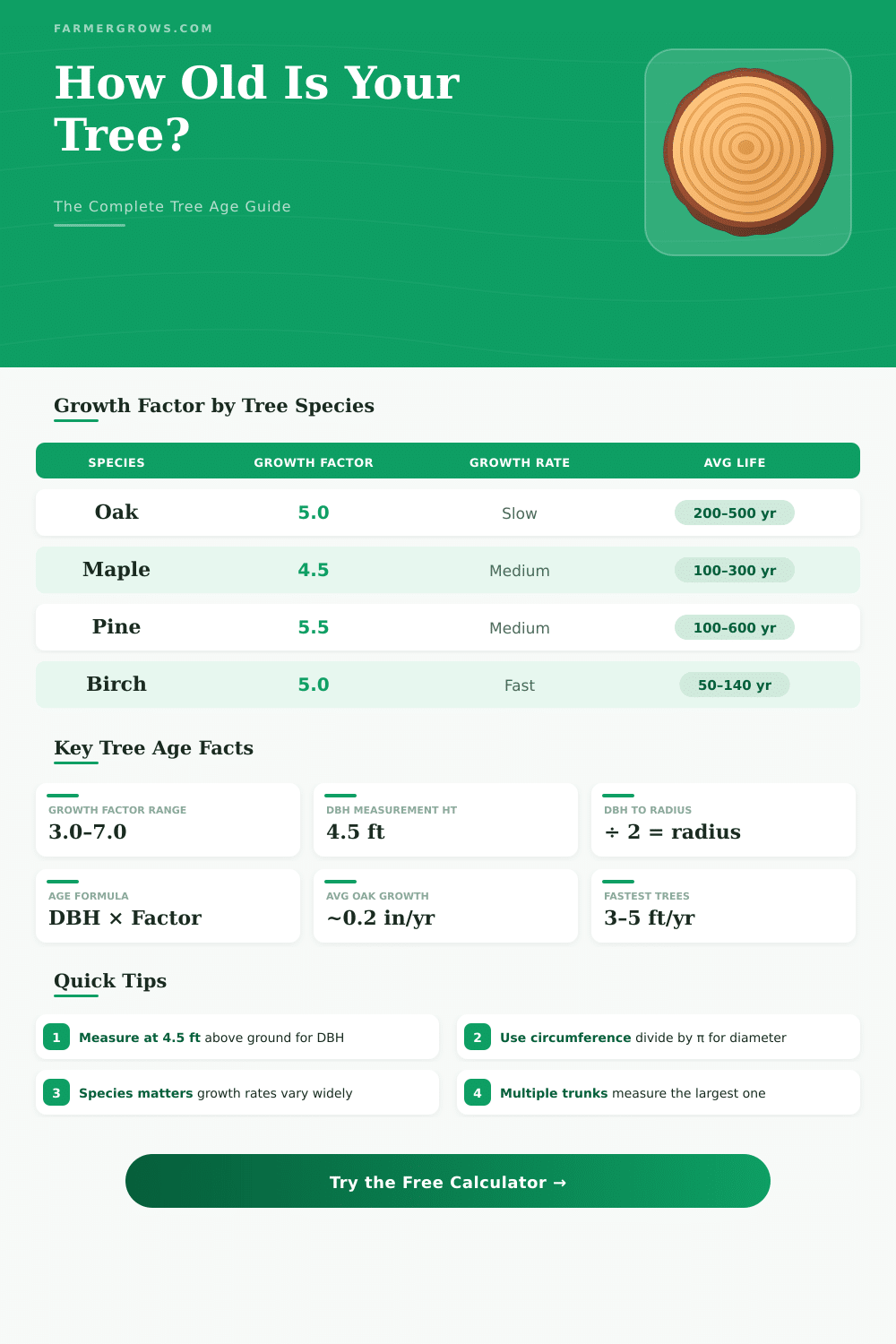
Another way is to use the circumference of the trunk. The process goes like this: one measures the circumference in inches at four and a half feet above the soil, then divides it by 3.14 to get the diameter. Then one multiplies the diameter by a specific growth factor of the species.
For instance, red oak has a factor of four. So, if the diameter is ten inches, the tree age is about forty years.
However the size of the trunk does not always deserve trust. A tree of hundred years in a good place could have a trunk twice as big as the same old tree in bad conditions. Soil, amount of rain and exposure to sun all affect that.
In north Canada, trees reaching twenty metres of height can be even hundred years younger than nearby trees only ten metres high. Size of a tree and age do relate, but not directly equally. One case showed a difference of twenty-two years, where the smaller tree actually was older than the bigger.
Some trees live an extremely long time. Bristlecone pines can reach around five thousand years. One of them was discovered at five thousand and sixty-six years.
Alaskan red cedars can exist until 3 500 years. Palm trees, on the other hand, are short-lived and reach only forty to fifty years. There are also clonal trees like Pando, a group of quaking aspen trees, that one estimates at between sixteen thousand and eighty thousand years.
A big mystery about Pando is whether it lasted covered by glaciers during the Ice Age. The individual aspen trees in the group seem at most about 130 years old, but the parent rootsystem keeps going.
Trees also do not truly age the same way as animals. They age gradually. An old tree is at the same time very old and very new, with most of its mass being middle-aged.
A tree with a cavity has indeed lost parts of its oldest growth.