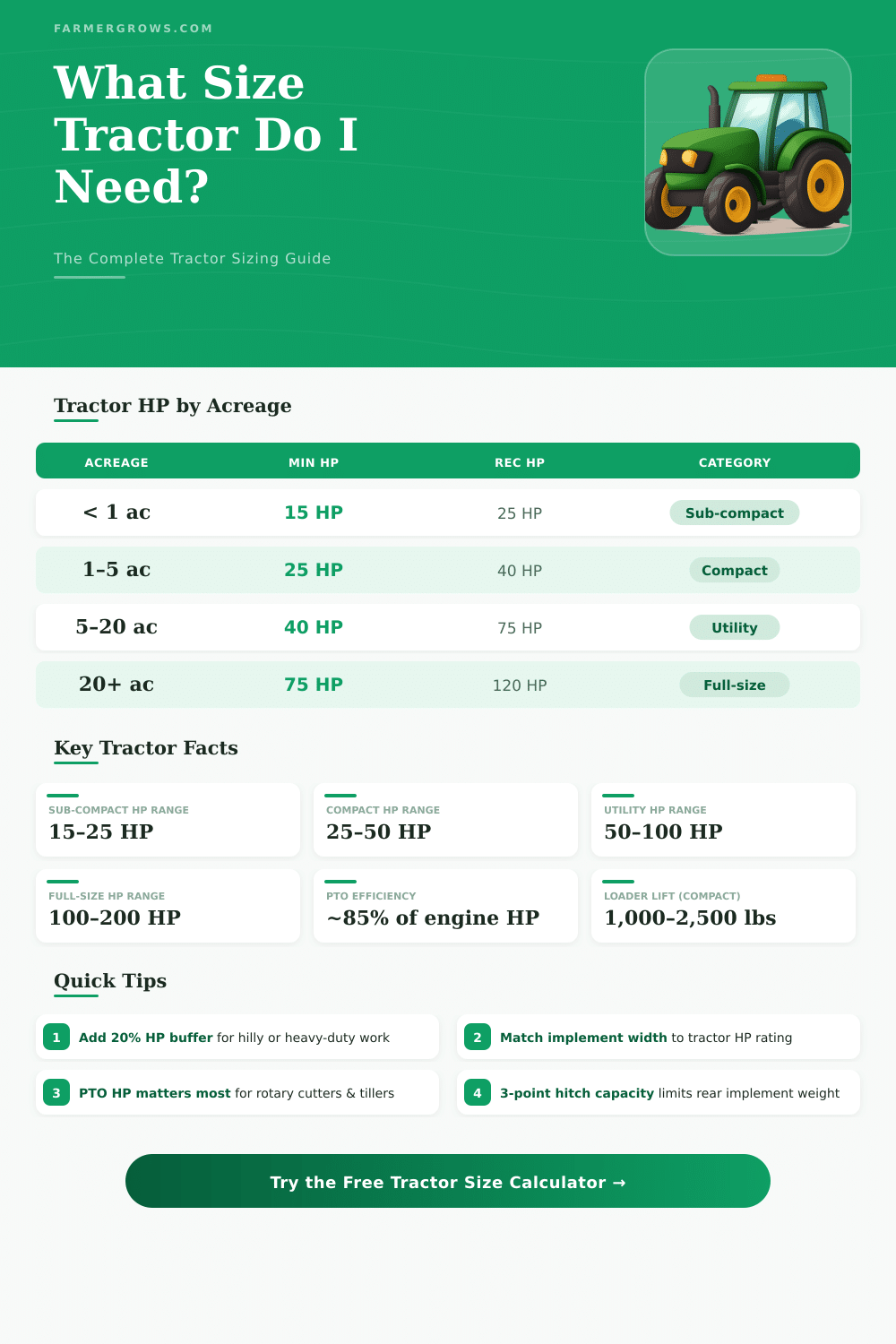
🚜 Tractor Size Calculator
Find the right tractor horsepower and category for your acreage and tasks
| Property Size | Min HP | Recommended HP | Tractor Category | Metric (ha) |
|---|---|---|---|---|
| Under 1 acre | 15 HP | 20–25 HP | Sub-Compact | < 0.4 ha |
| 1–3 acres | 20 HP | 25–35 HP | Compact | 0.4–1.2 ha |
| 3–5 acres | 30 HP | 35–45 HP | Compact | 1.2–2 ha |
| 5–10 acres | 40 HP | 45–65 HP | Utility | 2–4 ha |
| 10–20 acres | 55 HP | 65–85 HP | Utility | 4–8 ha |
| 20–50 acres | 70 HP | 85–110 HP | Utility / Full-Size | 8–20 ha |
| 50–100 acres | 100 HP | 110–150 HP | Full-Size | 20–40 ha |
| 100–300 acres | 130 HP | 150–200 HP | Full-Size / Row Crop | 40–120 ha |
| 300+ acres | 200 HP | 250–400 HP | Row Crop / Articulated | 120+ ha |
| Task / Implement | HP per Foot Width | Min HP | Notes |
|---|---|---|---|
| Finish Mowing | 5–7 HP/ft | 15 HP | Light-duty, flat terrain |
| Brush / Rotary Cutter | 7–10 HP/ft | 20 HP | Heavy brush adds 20% |
| Tilling / Rotary | 10–15 HP/ft | 25 HP | Depends on soil type |
| Disk Harrowing | 8–12 HP/ft | 35 HP | Heavy clay +30% |
| Subsoiling | 15–25 HP/shank | 50 HP | Depth affects HP draw |
| Front Loader Work | — | 35 HP | Lift capacity scales with HP |
| Hay Baling (square) | — | 40 HP | Round bale needs 60+ HP |
| Snow Blower (6 ft) | 8–12 HP/ft | 45 HP | Wet snow adds 25% |
| Logging / Grapple | — | 55 HP | 4WD strongly recommended |
| Grading / Box Blade | — | 25 HP | Rocky ground +20% |
| Category | Typical HP Range | Lift Capacity | Hitch Category |
|---|---|---|---|
| Sub-Compact | 15–25 HP | 700–1,200 lbs (318–544 kg) | Cat 1 / 0 |
| Compact | 25–50 HP | 1,200–2,600 lbs (544–1,179 kg) | Cat 1 |
| Utility | 50–100 HP | 2,600–5,000 lbs (1,179–2,268 kg) | Cat 2 |
| Full-Size | 100–200 HP | 5,000–12,000 lbs (2,268–5,443 kg) | Cat 2 / 3 |
| Row Crop | 200–400 HP | 12,000–20,000 lbs (5,443–9,072 kg) | Cat 3 / 4 |
| Factor | Condition | HP Multiplier | Example |
|---|---|---|---|
| Terrain | Flat | 1.0× | No adjustment needed |
| Terrain | Rolling | 1.15× | Add 15% to base HP |
| Terrain | Hilly | 1.30× | Add 30% to base HP |
| Terrain | Steep | 1.50× | Add 50%, consider track tractor |
| Soil | Light / Sandy | 1.0× | Easiest tillage |
| Soil | Medium / Loam | 1.15× | Standard condition |
| Soil | Heavy / Clay | 1.30× | Most common challenge |
| Soil | Rocky | 1.40× | High wear, higher HP needed |
| Attachments | Heavy multi-implement | 1.20× | Loader + rear implement |
Choosing the right Tractor size is more important than most folks believe. If the tractor is too small for medium tasks, it takes more time and the output drops. Too big a machine for those medium works causes extra cost during purchase and trouble to move in the workspace.
The solution does not lie simply in the area of the ground. It relates to the land shape the workload, the used tools and the goals for the long time.
How to Pick the Right Tractor Size
Tractors come in a broad range of sizes. Some of them are quite small for moving in cities, what gives bigger ease in use. Other models are built for dragging heavy loads.
Good knowledge about the available sizes helps during research of a model, that fits needs and budget.
For small farms between one and five acres, a small or compact tractor with around 20 until 25 horsepowers usually works. Those machines turn very well and easily move in narrow areas. Small tractors have the benefit of small Tractor size like a garden tractor, but can use many tools or attachments.
For farms under one acre, one of the moer small and cheap lawn tractors can handle the everyday tasks.
A tractor with 25 horsepowers would be too small to handle logs, with maximum lift of around 1,000 pounds. Various brands produce 25-horsepower tractors in many different versions, because that is the natural limit. For brush cutting or use of a tiller, you should choose no less than 35 horsepowers.
Something in the range of 35 until 40 horsepowers for PTO works well as a general starting point.
Medium tractors with 55 until 63 raw horsepowers come in models with two- or four-wheel drive system, with options for gear or automatic transmission. They fit to do almost every work. For hay tasks, worth to consider 75 horsepowers or more.
A tractor with 65 horsepowers can be used, but lacks power for standard hay tools. For bigger operations, you may kneed 80 horsepowers or more in tractors with a loader, to handle 10-to-15-foot blade without loading the clutch or engine.
Tractor size of the farm is a key factor, but the tasks, that we must do, matter even more. Eight acres one can plough in some hours by means of a 40-horsepower diesel tractor. On the other hand, folk with 45 acres successfully managed during more than 35 years using a 60-horsepower two-wheel-drive tractor.
To lift wet six-foot packages, you need 50 horsepowers or more. Tractor size also plays a role at small tractors.
Using both a small and bigger tractor, one forms a good pair, if the budget allows. The best brand to choose is that, that offers good service after sale andhave excellent name at home.