🌵 Succulent Watering Calculator
Calculate exactly how much water your succulents need based on pot size, season & soil type
Days (d) = approximate days between watering sessions under moderate conditions
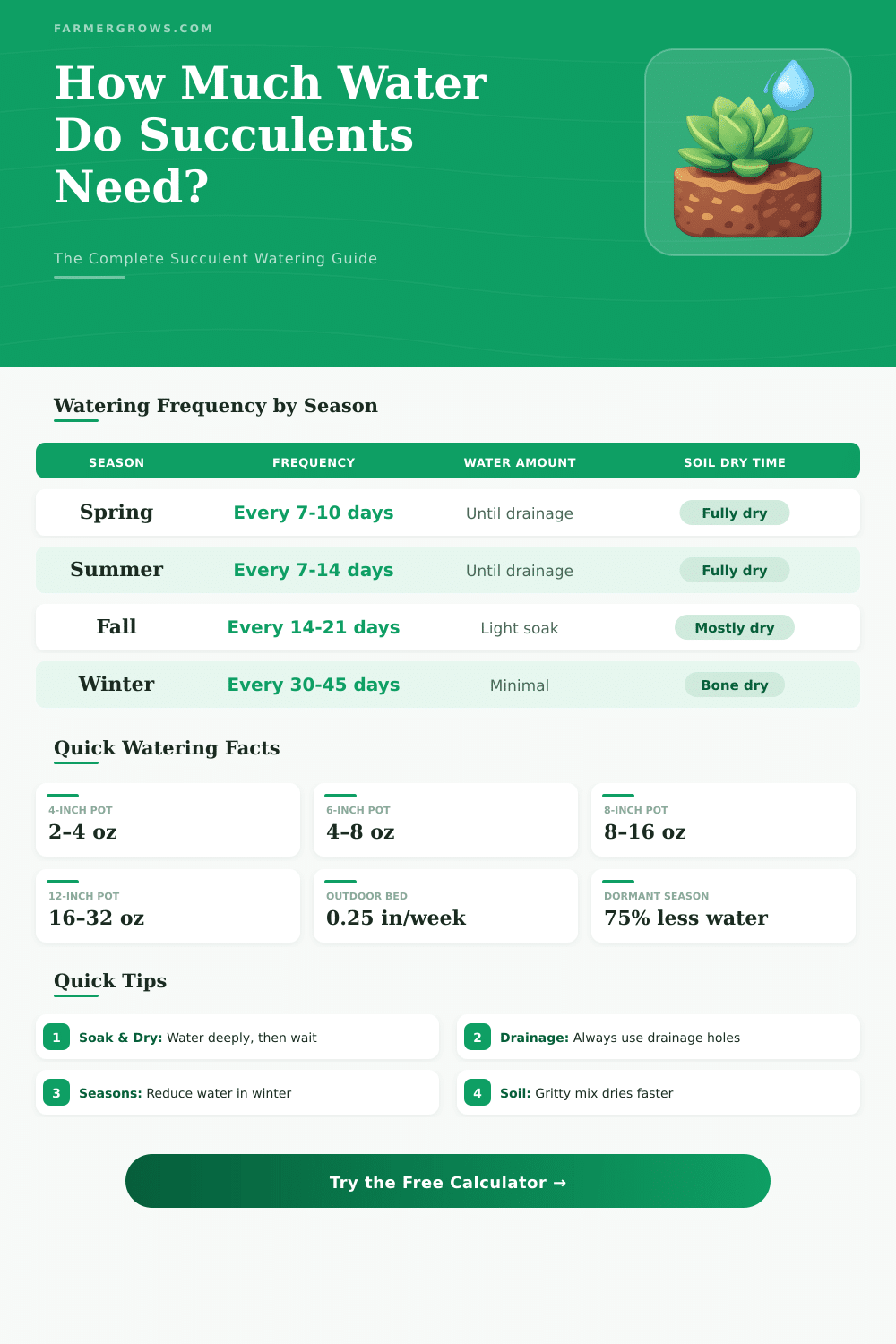
| Season | Frequency | Water per 4" Pot | Water per 6" Pot | Water per 8" Pot | Soil State Before Watering |
|---|---|---|---|---|---|
| 🌱 Spring | Every 7–10 days | 2–3 oz (60–90 ml) | 4–6 oz (120–180 ml) | 8–12 oz (240–360 ml) | Completely dry |
| ☀️ Summer | Every 7–14 days | 3–4 oz (90–120 ml) | 5–8 oz (150–240 ml) | 10–16 oz (300–480 ml) | Completely dry |
| 🍂 Fall | Every 14–21 days | 1.5–2 oz (45–60 ml) | 3–4 oz (90–120 ml) | 5–8 oz (150–240 ml) | Bone dry + 2–3 days |
| ❄️ Winter | Every 30–45 days | 0.5–1 oz (15–30 ml) | 1–2 oz (30–60 ml) | 2–3 oz (60–90 ml) | Bone dry + 5+ days |
| Pot Diameter | Approx. Soil Vol. | Water per Session (oz) | Water per Session (ml) | Annual Water Use |
|---|---|---|---|---|
| 2 inch | 0.05 qt | 0.5–1 oz | 15–30 ml | ~8–16 oz/yr |
| 3 inch | 0.12 qt | 1–2 oz | 30–60 ml | ~16–32 oz/yr |
| 4 inch | 0.25 qt | 2–4 oz | 60–120 ml | ~32–64 oz/yr |
| 6 inch | 0.75 qt | 4–8 oz | 120–240 ml | ~64–128 oz/yr |
| 8 inch | 1.5 qt | 8–16 oz | 240–480 ml | ~96–192 oz/yr |
| 10 inch | 3 qt | 12–24 oz | 355–710 ml | ~144–288 oz/yr |
| 12 inch | 5 qt | 16–32 oz | 480–950 ml | ~192–384 oz/yr |
| 16 inch | 10 qt | 28–48 oz | 830–1420 ml | ~288–576 oz/yr |
| Location / Condition | Water Adjustment | Frequency Change | Notes |
|---|---|---|---|
| Indoor – Low Light | −40% | +5–7 days between | Very slow evaporation |
| Indoor – Bright Window | Baseline | Standard | Good light, moderate dry-out |
| Outdoor – Partial Shade | +10% | −1–2 days | Slight wind effect |
| Outdoor – Full Sun | +30–50% | −2–4 days | Fast evaporation |
| Greenhouse | −15% | +2–3 days | Humid, stable temp |
| Low Humidity (<30%) | +20% | −2–3 days | Soil dries faster |
| High Humidity (>60%) | −25% | +3–5 days | Roots stay moist longer |
succulent plants look nice and are simple to take care of, so they should be owned by every lover of plants. Succulent plants in botany have thick fleshy parts that store water. That means they last through dry spells in dry environments and tough territories.
One sometimes calls them “thick plants” thanks to the heavy leaves and stems.
How to Care for Succulent Plants
Known species of succulent plants include Kalanchoe, Sedum, Echeveria, Haworthia and Sempervivum. Each of them grows in its own way. Echeveria is known because of wonderful shades and rich flowers.
Aeonium show coloured leaves. Agave attract by means of their grand beauty. Sempervivum lasts in cold and needs little attention.
Between other known succulent plants one finds aloe vera, jade plant, snake plant and desert rose.
Echeveria elegans create flat rosettes alike to flowers, with curved banks. It produces every year nice bell-shaped flowers. Sempervivum tectorum also creates rosettes, however its leaves are slimmer and pointed, with little star flowers.
Both generate offsets, that is tiny copies a bit separated from the parent plant. They offer many types with attractive colours, so collecting them is fun.
Sedum morganianum, known also as burro’s tail, is a nice succulent plant that works well as a hanging plant because of its impressive curved parts. It owns thick leaves and cascading green branches. Euphorbia, or “crown of thorns”, is a common house plant with spiny stems.
succulent plants widely like light. Most require many hours of direct sunshine daily, so they are light-loving plants. A shelf beside a sunny window works well for them.
If you grow them indoors, Haworthia is a good start, because many species accept little light. Haworthia and Haworthiopsis are not poisonous for creatures, which is useful too owners of pets. In cold locations, Sempervivum is the best choice.
Too much water kills more succulent plants than any other cause. Jade plants especially easily suffer root rot, so leave the ground dry fully before the next watering. Succulent plants well handle the dry air in heated houses and workplaces.
They forgive those who often forget to water, with only little penalty.
succulent plants can be grown from seeds, spread by means of cuttings or separate offsets. In jars without drainage holes soil and careful watering are needed, so never allow the ground to fully dry. Planting the plant higher in the jar helps for airflow and protects the roots against too much moisture.
These plants impress, care forthemselves almost and work for indoor and outdoor spaces.