🍓 Strawberry Plant Spacing Calculator
Calculate exactly how many strawberry plants you need and how to space them for any bed shape or size
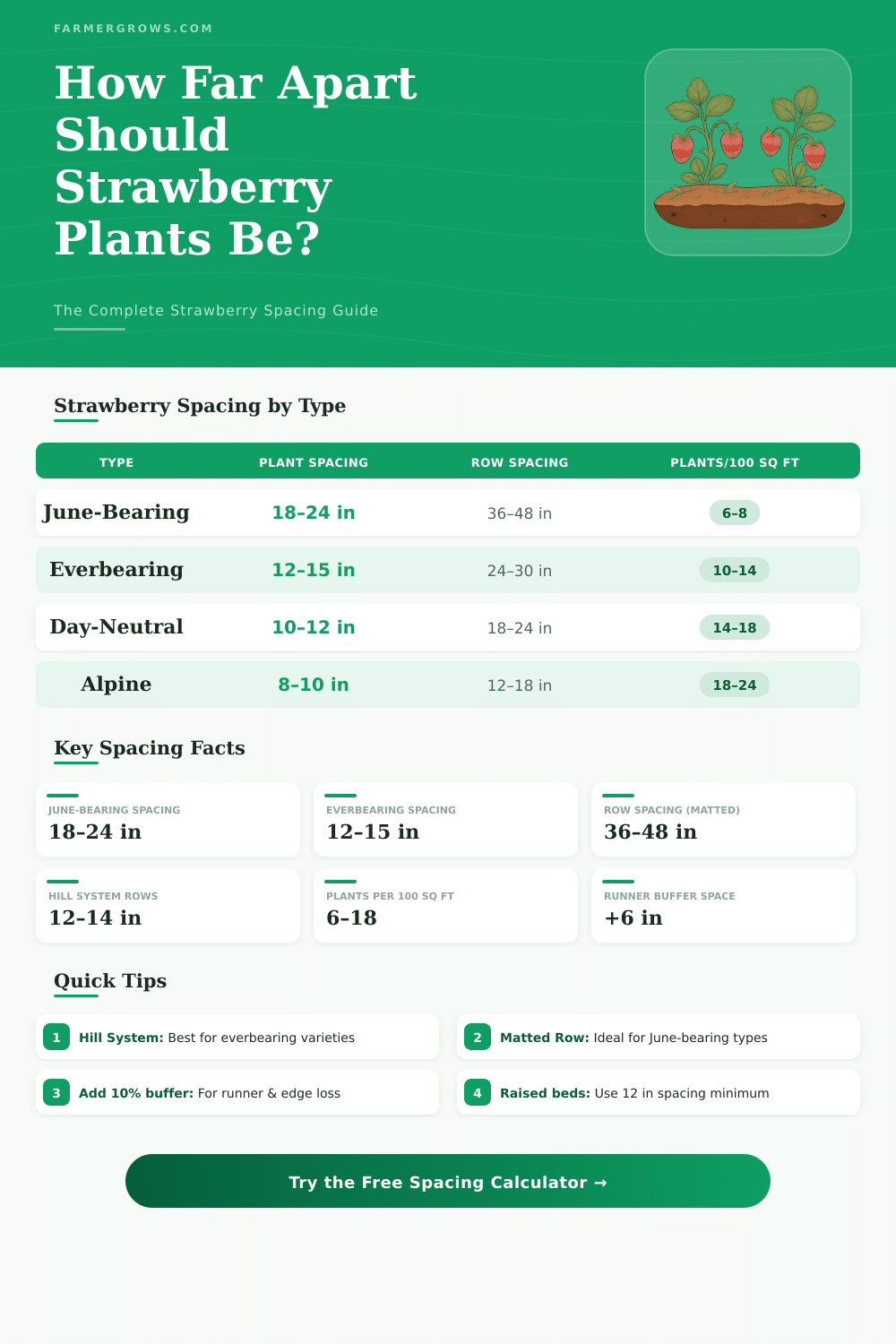
| Variety | Plant Spacing | Row Spacing | System | Plants per 100 sq ft |
|---|---|---|---|---|
| June-Bearing | 18–24 in (45–61 cm) | 36–48 in (91–122 cm) | Matted Row | 6–8 |
| June-Bearing | 18 in (45 cm) | 36 in (91 cm) | Spaced Row | 8 |
| Everbearing | 12–15 in (30–38 cm) | 24–30 in (61–76 cm) | Hill System | 10–14 |
| Day-Neutral | 10–12 in (25–30 cm) | 18–24 in (45–61 cm) | Hill System | 14–18 |
| Alpine / Wild | 8–10 in (20–25 cm) | 12–18 in (30–45 cm) | Hill System | 18–24 |
| All (raised bed) | 12 in (30 cm) | 12 in (30 cm) | Grid / Square Foot | ~100 |
| System | Best For | Plant Density | Runner Management | Yield Style |
|---|---|---|---|---|
| Matted Row | June-Bearing | Low (6–8 per 100 sq ft) | Runners allowed to fill row | Large seasonal harvest |
| Hill System | Everbearing, Day-Neutral | High (14–24 per 100 sq ft) | Remove all runners | Continuous harvest |
| Spaced Row | June-Bearing | Medium (8–10 per 100 sq ft) | Selective runner control | High-quality fruit |
| Square Foot | Raised beds / containers | 1 per sq ft | Remove all runners | Compact, tidy beds |
| Bed Size | Area (sq ft) | Plants (18" x 36") | Plants (12" x 18") | Area (m²) |
|---|---|---|---|---|
| 4 x 8 ft | 32 | 6–8 | 14–18 | 3.0 |
| 4 x 12 ft | 48 | 9–12 | 21–28 | 4.5 |
| 8 x 16 ft | 128 | 24–32 | 56–74 | 11.9 |
| 10 x 20 ft | 200 | 38–50 | 88–115 | 18.6 |
| 20 x 30 ft | 600 | 114–150 | 265–345 | 55.7 |
| 50 x 50 ft | 2,500 | 475–625 | 1,100–1,440 | 232.3 |
| Inches | Centimeters | Feet | Meters |
|---|---|---|---|
| 8 in | 20.3 cm | 0.67 ft | 0.20 m |
| 10 in | 25.4 cm | 0.83 ft | 0.25 m |
| 12 in | 30.5 cm | 1.00 ft | 0.31 m |
| 15 in | 38.1 cm | 1.25 ft | 0.38 m |
| 18 in | 45.7 cm | 1.50 ft | 0.46 m |
| 24 in | 61.0 cm | 2.00 ft | 0.61 m |
| 36 in | 91.4 cm | 3.00 ft | 0.91 m |
| 48 in | 121.9 cm | 4.00 ft | 1.22 m |
strawberry plants are a very liked hybrid berry because of their sweet taste, nice smell and pretty red. One commonly uses them in chocolates, cakes beer and sweets. The flesh of the berry itself is a kind of container that bears up to two hundred little ovaries on its surface.
Those ovaries, called achenes, form the real fruit, and each carries one seed. The strawberry itself is a bushy, low plant with shallow roots, that belongs to the family of roses. It originally appeared in Europe through chance crossing between species from North America and another from Chile.
How to Grow and Care for Strawberries
The current strawberries developed during the 1830s as hybrids. Royce Bringhurst from UC-Davis created everlasting strawberry plants from wild copies stripped in the Mountains Wasatch of Utah. There are three main kinds of strawberry plants: those that bear in June, everlasting and day-neutral.
With everlasting strawberries, one receives two harvests during one year. The first comes in June, while the second shows at the end of summer. One can plant everlasting strawberries in spring and still reach fall harvest in the same year.
But both everlasting and day-neutral have truobles flowering and fruiting when the temperatures pass 90°F.
For giving the most berries, strawberries need full light of the sun. Space the plants 12 to 18 inches one from the other. The secret lies in the planting during cool weather, but not too early so that they bloom before the danger of bad frosts disappear.
Colds can injure the tender tiny flowers. Water matters a lot for strawberry plants. It feeds the roots and helps the whole plant stay upright.
Fill the planting whole by means of water and also, make the ground drain well.
strawberry plants can grow from runners or from seeds, even though from seeds it is almost impossible. Most plants root from runners, so the amount of plants can grow quickly. Removing the flowers expands the making of runners.
On the other hand, cutting them leads more force to the fruiting, what gives bigger and better berries.
Renew the strawberry beds every two to three years. Runners spread and cause crowding. Strawberries also tend to get fungal diseases over time.
Rotate the crops each three years helps against soil diseases. Apply full plant garden fertilizer every three to four weeks to care about the food needs of the plants. After the flowers appear, reduce the feeding.
Halt the feeding entirely three to four weeks before the harvest. Choose strawberries when they are fully red and ripe, because they no longer ripen after thepicking.
Some great types deserve to mention, for instance Malwina for extending the season, Mara des Bois because of the best taste and smell between everlasting, and San Andreas for high output with big berries. Seascape is a top performer and the standard for taste in commercial day-neutral. Two-year plants usually have better taste, although the berries turn out more small.