🌱 Square Foot Garden Planner
Calculate exactly how much soil mix you need for your raised beds
| Depth | Sq Ft per Cu Yd | Metric (m² per m³) | Cu Ft per 100 Sq Ft |
|---|---|---|---|
| 1 in (2.5 cm) | 324 | 40.0 m²/m³ | 8.3 |
| 2 in (5 cm) | 162 | 20.0 m²/m³ | 16.7 |
| 3 in (7.6 cm) | 108 | 13.2 m²/m³ | 25.0 |
| 4 in (10 cm) | 81 | 10.0 m²/m³ | 33.3 |
| 6 in (15 cm) | 54 | 6.7 m²/m³ | 50.0 |
| 8 in (20 cm) | 40.5 | 5.0 m²/m³ | 66.7 |
| 10 in (25 cm) | 32.4 | 4.0 m²/m³ | 83.3 |
| 12 in (30 cm) | 27 | 3.3 m²/m³ | 100.0 |
| Bag Size | Volume per Bag | Bags per Cu Yard | Coverage at 6 in Deep |
|---|---|---|---|
| Small Bag | 1 cu ft (28.3 L) | 27 bags | 2 sq ft |
| Medium Bag | 1.5 cu ft (42.5 L) | 18 bags | 3 sq ft |
| Standard Bag | 2 cu ft (56.6 L) | 13.5 bags | 4 sq ft |
| Large Bag | 3 cu ft (85.0 L) | 9 bags | 6 sq ft |
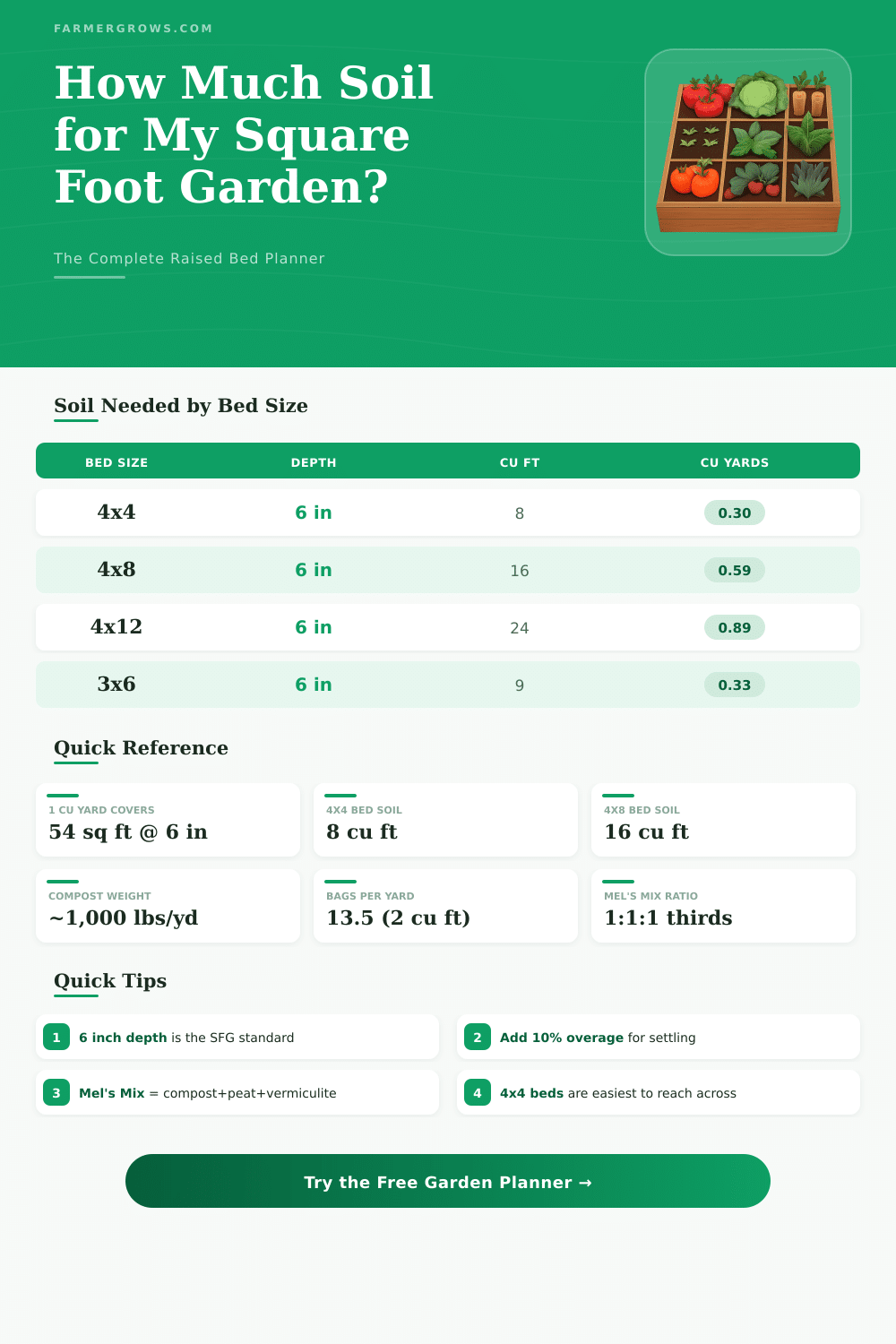
| Bed Size | Area (sq ft) | Cu Ft at 6 in | Cu Yards |
|---|---|---|---|
| 2 ft × 4 ft | 8 | 4.0 | 0.15 |
| 3 ft × 6 ft | 18 | 9.0 | 0.33 |
| 4 ft × 4 ft | 16 | 8.0 | 0.30 |
| 4 ft × 8 ft | 32 | 16.0 | 0.59 |
| 4 ft × 12 ft | 48 | 24.0 | 0.89 |
| 4 ft × 16 ft | 64 | 32.0 | 1.19 |
| 8 ft × 8 ft | 64 | 32.0 | 1.19 |
| 10 ft × 10 ft | 100 | 50.0 | 1.85 |
A 4×8 raised bed at 6 inches deep needs 16 cubic feet of fill, which is only about 0.59 cubic yards. Doesnt sound like much until youre hauling 9 bags of the 2 cu ft size. Mels Mix weighs somewhere around 800 to 1,000 pounds per yard so even that small bed can top 500 pounds.
The information below was not done by means of any calculator or another tool on this page. It is based on real feedback, forum discussions and experiences of Gardening communities found through the net.
How to Do Square-Foot Gardening
Square-foot Gardening is almost exactly what the name suggests. One shares the growth area in tiny squares, each around one foot by one foot. For that one commonly lays grid above the bed to clearly separate the space in individual squares.
Later one plants different crops in different squares according to their size. Like this it is possible to grow a little, tidy and very productive Garden that focuses on square feet.
The method developed in 1981, when Mel Bartholomew coined it and wrote a book about it. He later had also a series at PBS. The target was to leave the traditional row Gardening and instead arrange everything in squares.
Now the book already is in its third printing and stays the main resource for anyone that cares about the method. Bartholomew planned it so that it be less scary for gardeners of all ages and skill levels, with less time spent on weeding and digging.
One commonly ties the method with raised beds. One builds a raised box, and inside the beds are shared in squares. Usual size is about four feet by four feet, with grid laid up.
The beds normally have depth between six and twelve inches, what gives to plants many rich nutrients and good drainage. It is best to stay at nothing bigger than 4×4 or 4×6 feet, because bigger boxes make it hard too reach the plants in the centre. If one does beds only three feet broad, that means less bending and tension.
It is not serious that the sections be exactly twelve inches. Squares about eleven by eleven inches commonly work even more well, because of usual sizes of beds and because of the thickness of materials. What matters is the soil state.
One plants in ideal soil instead of directly in the ground, because the tight spacing works only with good soil.
One estimates that the method costs around 50% less, uses 20% less space, 10% of the water and only 2% of the work compared with average row Gardening. Even so one can do it also without raised beds. Planting in squares in little space without raised beds works well as adapted access.
Some plants need more place than one would assume. Tomatoes and squash can need around four square feet even with a trellis. Also peppers sometimes need broader spacing, depending on the climate.
Crawling plants especially can need more space than the standard grid suggests. Planting alike crops one beside another is a bit risky, because one pest can erase everything immediately.
People notice, that although the method works well, it can be a costly way to set up a Garden. Costs for a big setup quicklyadd up.