🌱 Soybean Seed Spacing Calculator
Calculate seeding rates, seed quantities, and spacing for any field size and row configuration
seeds/lb
seeds/lb
seeds/lb
seeds/lb
seeds/lb
seeds/lb
seeds/lb
seeds/lb
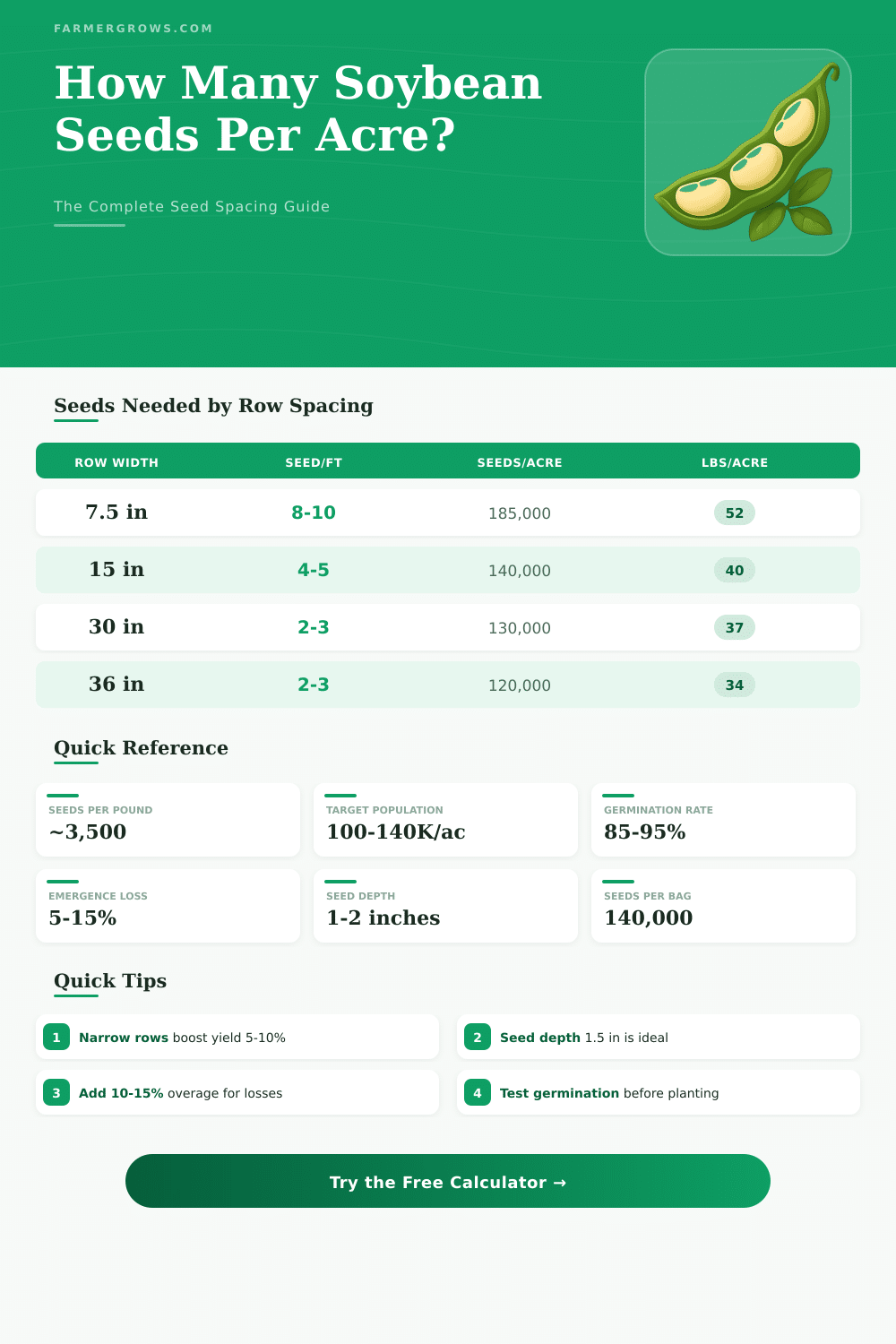
| Row Spacing | Target Pop (seeds/acre) | Seeds per Foot of Row | Lbs/Acre (3,000 seeds/lb) |
|---|---|---|---|
| 7.5 in (Drilled) | 175,000 – 200,000 | 2.5 – 2.9 | 58 – 67 |
| 15 in (Narrow) | 130,000 – 150,000 | 3.7 – 4.3 | 43 – 50 |
| 20 in (Twin Row) | 130,000 – 140,000 | 5.0 – 5.4 | 43 – 47 |
| 30 in (Standard) | 120,000 – 140,000 | 6.9 – 8.1 | 40 – 47 |
| 36 in (Wide) | 100,000 – 120,000 | 6.9 – 8.3 | 33 – 40 |
| Unit Size | Seeds per Unit | Weight (lbs) | Acres Covered (130K pop) |
|---|---|---|---|
| Standard Unit (140K seeds) | 140,000 | ~47 | ~1.08 |
| 50 lb Bag | ~150,000 | 50 | ~1.15 |
| Bulk (per bushel — 60 lb) | ~180,000 | 60 | ~1.38 |
| Mini Bag (25 lb) | ~75,000 | 25 | ~0.58 |
| Seeds/Foot of Row | Seed-to-Seed Spacing (in) | Seeds/Acre at 30 in Rows | Seeds/Acre at 15 in Rows |
|---|---|---|---|
| 2 | 6.0 | 34,848 | 69,696 |
| 3 | 4.0 | 52,272 | 104,544 |
| 4 | 3.0 | 69,696 | 139,392 |
| 5 | 2.4 | 87,120 | 174,240 |
| 6 | 2.0 | 104,544 | 209,088 |
| 7 | 1.7 | 121,968 | 243,936 |
| 8 | 1.5 | 139,392 | 278,784 |
| Field Description | Area (acres) | Area (sq ft) | Seeds Needed (130K/ac) |
|---|---|---|---|
| Small Test Plot | 0.23 | 10,000 | 29,900 |
| Quarter Acre | 0.25 | 10,890 | 32,500 |
| 1 Acre | 1.0 | 43,560 | 130,000 |
| 5 Acres | 5.0 | 217,800 | 650,000 |
| 10 Acres | 10.0 | 435,600 | 1,300,000 |
| 40 Acres | 40.0 | 1,742,400 | 5,200,000 |
| Quarter Section | 160.0 | 6,969,600 | 20,800,000 |
At rows of 30 inches with intended density of 130 000 seeds in acre, you should have around 7 seeds each foot of row (what results in spacing of around 1).7 inches between seeds. That is denser than in many other crops. Rows of only 15 inches can reach around 140 000 seeds in acre but every foot of row requires only around 4 seeds, so that the farmer must not work like this a lot for line.
One acre requires between 43 and 50 pounds of seeds, depending on the variety. Big types have around 2500 seeds in pound, while little seeds reach 3500, that makes a 40-percent difference in weight for same amount of plants. I did not expect that the differences would be like this big.
How to Plant and Use Soybeans
For a 40-acre field with 130 000 seeds in acre, you require around 1750 pounds of seeds to sow or gather. Spacing of 7.5 inches uses seeds quickly, easily more than 60 pounds in acre.
The information below is not done by means of any calculator or converter. It is based on actual research, forum changes and shared community experiences found through the net.
soybean seeds belong to the most ancient crops of the world. They were grown in Asia during thousands of years. In Japan, especially in Okinawa, one eats soy, commonly as tofu, in big amounts.
That region one calls “blue zone” because of the unusually high number of folks passing 100 years. One believes that their food plays a lead in their long life.
Beans are dried pods from plants. Dry beans have 36 percent of protein and 20 percent of fat by weight. The rest is made up of 30 percent of carbohydrates, 9 percent of water and 5 percent of ash.
A bean stores around 8 percent of seed skin, 90 percent of cotyledons and 2 percent of germ. They form a basic plant protein with 18 grams in a 100-gram serving, plus rich fiber and micro-nutrients.
Beans are rich in protein and serve well for carbohydrates and fat. They are rich in fiber, have little packed fat, do not carry cholesterol or lactose. Moreover, they provide omega-3-acids and antioxidants.
Soybean seeds help hart health thanks to polyunsaturated fat, that lowers cholesterol and hampers inflammation. Beans reduce risk of heart-diseases, strokes, coronary diseases and some cancerous types, together with improvement of bones.
Non-GMO heritage soybean seeds provide vitamins A, B, C and E, likewise as calcium, iron, magnesium, phosphorus and proteins. Organic or rare types answer for home gardens.
Cook beans instead of eat them raw. Soak them first, later cook in a pressure cooker or slow cooker for good result. Other way is boil them during two and half until three hours, until they soften and split.
After cooking, pour out extra water and season if you want. Roasted dry beans prepare at home without dip, easily. One cup of roasted dry beans stores 418 calories.
Beans come from Asia, and their fresh or dry forms are valued because of amount of product, protein and oil. Typical uses are edamame in green state, or flour, soy milk, tofu, soy sauce and miso. Around 70 percent of beans feed animals, and many human soy-products come as side-effects of that.
Foraging-beans answer surprisingly for food plots to deer or feed for animals. They give high proteins and are very easily digested by such creatures. Sow them in half-inch depth, with 2-3 inches between them, after the last cold.
Beans also feed the ground. Seeds from harvest canbe saved next year, what pushes them practical for home growers.