🌱 Soybean Fertilizer Calculator
Calculate exact NPK fertilizer amounts for your soybean field based on area, yield goal, and soil conditions
56 lbs/ft³
62 lbs/ft³
66 lbs/ft³
69 lbs/ft³
58 lbs/ft³
63 lbs/ft³
58 lbs/ft³
75 lbs/ft³
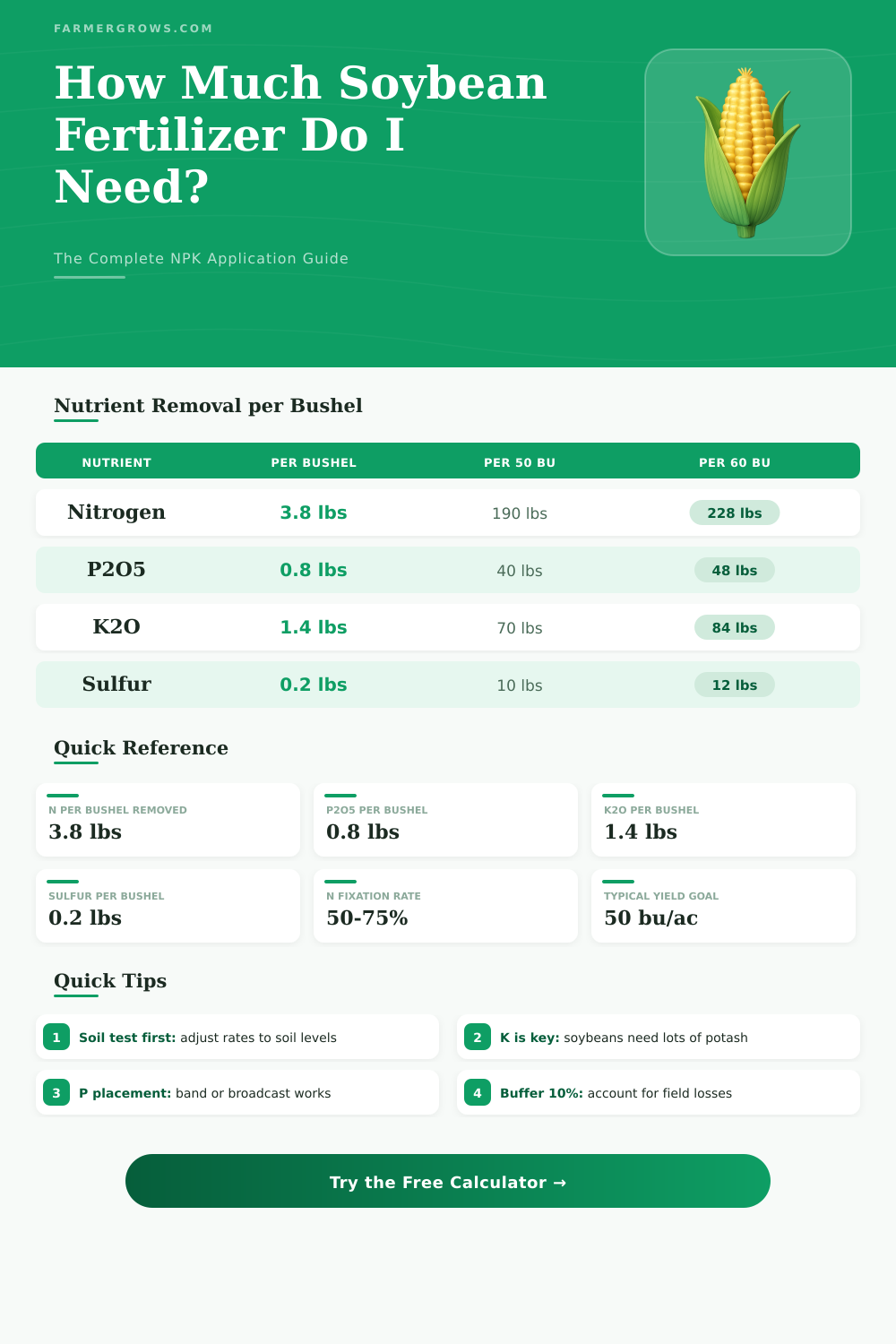
| Nutrient | lbs/bushel | kg/bushel | Per 50 bu/ac |
|---|---|---|---|
| Nitrogen (N) | 3.8 | 1.72 | 190 lbs/ac |
| Phosphorus (P₂O₅) | 0.80 | 0.36 | 40 lbs/ac |
| Potassium (K₂O) | 1.40 | 0.64 | 70 lbs/ac |
| Sulfur (S) | 0.20 | 0.09 | 10 lbs/ac |
| Calcium (Ca) | 0.28 | 0.13 | 14 lbs/ac |
| Magnesium (Mg) | 0.18 | 0.08 | 9 lbs/ac |
| Soil Level | P₂O₅ (lbs/ac) | K₂O (lbs/ac) | S (lbs/ac) |
|---|---|---|---|
| Very Low | 80–100 | 120–150 | 15–25 |
| Low | 60–80 | 90–120 | 10–20 |
| Medium (Maintenance) | 40–60 | 70–90 | 5–15 |
| High | 20–30 | 30–50 | 0–10 |
| Very High | 0–15 | 0–20 | 0 |
| Bag Size | Volume | Bags per Ton | Coverage at 200 lbs/ac |
|---|---|---|---|
| 50 lb bag | ~0.9 ft³ | 40 bags | 0.25 acres/bag |
| 40 lb bag | ~0.7 ft³ | 50 bags | 0.20 acres/bag |
| 2 cu ft bag | 2.0 ft³ | Varies | Varies by product |
| 3 cu ft bag | 3.0 ft³ | Varies | Varies by product |
| 1 ton bulk | ~28–32 ft³ | 1 | 5–10 acres |
| Project | Area | P₂O₅ Need (med soil) | DAP Needed (50 bu goal) |
|---|---|---|---|
| Garden Plot | 0.25 acres | 12.5 lbs | 27 lbs DAP |
| Small Field | 1 acre | 50 lbs | 109 lbs DAP |
| Medium Field | 5 acres | 250 lbs | 543 lbs DAP |
| Large Field | 10 acres | 500 lbs | 1,087 lbs DAP |
| Quarter Section | 40 acres | 2,000 lbs | 4,348 lbs DAP |
| Half Section | 80 acres | 4,000 lbs | 8,696 lbs DAP |
| Full Section | 160 acres | 8,000 lbs | 17,391 lbs DAP |
Note: This article is based on retail information and practical experiences about fertilizer for soybean.
soybean belong to legumes, so they set their own nitrogen. Hence one requires less fertilizer for them than for crops like corn. Corn eats a lot of nutrients, on the other hand soybean are less greedy.
How to Fertilize Soybeans
All plants remove elements from the ground, and if one does not restore them, the soil becomes worn out after time. Corn seems more harmful than most other crops.
soybean receive nitrogen chiefly by means of nitrogen fixing. One does not advise to add nitrogen fertilizer, if the plants have good nodules. Soybean with good nodules commonly manage to gather enough nitrogen for good growth.
They still use much sulfate nitrogen, around 130 pounds per acre. The best nitrogen amount during crop is almost zero. For the first planted soybean in a new field, one maybe will have to use nitrogen fertilizer, even with seed treatment.
Diseases, soybean cyst nematode or long warm and dry weather can block the taking in of nutrients, causing signs similar to nitrogen absence.
Do not assume about the fertility of the soil. Get the ground tested commonly. One should take soil samples for control nutrients and farming.
Ideally, do test each two to three years. The test stage at almost same time each year for sameness. When one does not apply fertilizer yearly, test every second year.
The tests tell about large and small elements, pH of the soil, buffer pH, organic matter and skill to exchange nutrients.
Now some advice about ground fertility suggests to add nitrogen fertilizer to soybean, usually 20 to 40 pounds per acre. A common method is to sow 100 pounds of DAP and 100 pounds of potash, what gives around 18-46-60. When one reaches bigger yields, fewer nutrients stay in the soil, so the suggestions for fertilizer grow.
One can give potassium nitrate through foliar nutrition too the leaves. But research in Iowa shows, that foliar fertilizer rarely expands the yield. Such nutrition during the fruiting growth stage helps probably only in 15 to 20 percent of cases.
Adding organic fertilizer can help the growth of soybean on poor soil, increasing the number of pods and the weight of grains.
soybean meal itself works as a source of nitrogen in organic farming. It stores around 7-2-1 in NPK ratio. It works well as a addition to soil for outdoor garden, but not for indoor potting mix.
Sometimes plants burn or their sprouting drops, when one uses soybean meal. Dry dug leaves also serve as fertilizer, but they break down slowly and maybe do not have the right NPK values. Soybean hulls have very little nitrogen, hence theirorganic matter is more useful than the nitrogen that they deliver.