☀️ Solar Farm Profit Calculator
Estimate annual energy output, revenue, and return on investment for your solar farm project
| Region | Peak Sun Hrs | kWh/kW/yr | Capacity Factor |
|---|---|---|---|
| Pacific Northwest | 3.5 | 1,100 | 12.5% |
| Northeast US | 4.0 | 1,250 | 14.3% |
| Midwest US | 4.5 | 1,400 | 16.0% |
| Southeast US | 5.0 | 1,550 | 17.7% |
| Southwest US | 5.5 | 1,700 | 19.4% |
| Desert (AZ/NV) | 6.0–6.5 | 1,850–2,000 | 21–23% |
| System Size | Panels (400W) | Acres Needed | Hectares |
|---|---|---|---|
| 10 kW | 25 | 0.05–0.1 | 0.02–0.04 |
| 100 kW | 250 | 0.5–1.0 | 0.2–0.4 |
| 500 kW | 1,250 | 2.5–5.0 | 1.0–2.0 |
| 1 MW | 2,500 | 5–8 | 2.0–3.2 |
| 5 MW | 12,500 | 25–40 | 10–16 |
| 10 MW | 25,000 | 50–80 | 20–32 |
| 20 MW | 50,000 | 100–160 | 40–65 |
| Mounting Type | Output Boost | Land Efficiency | Maintenance |
|---|---|---|---|
| Fixed Ground Mount | Baseline | 5–8 acres/MW | Low |
| Single-Axis Tracker | +15–25% | 6–10 acres/MW | Moderate |
| Dual-Axis Tracker | +25–40% | 8–12 acres/MW | Higher |
| Rooftop Mount | –5–10% | N/A | Low |
| Rate Type | $/kWh Range | Revenue per MW/yr | Typical Contract |
|---|---|---|---|
| Wholesale Market | $0.02–$0.04 | $28,000–$56,000 | Spot / Short-term |
| PPA (Low) | $0.04–$0.05 | $56,000–$70,000 | 10–15 years |
| PPA (Average) | $0.05–$0.07 | $70,000–$98,000 | 15–25 years |
| Retail / Net Metering | $0.08–$0.15 | $112,000–$210,000 | Varies |
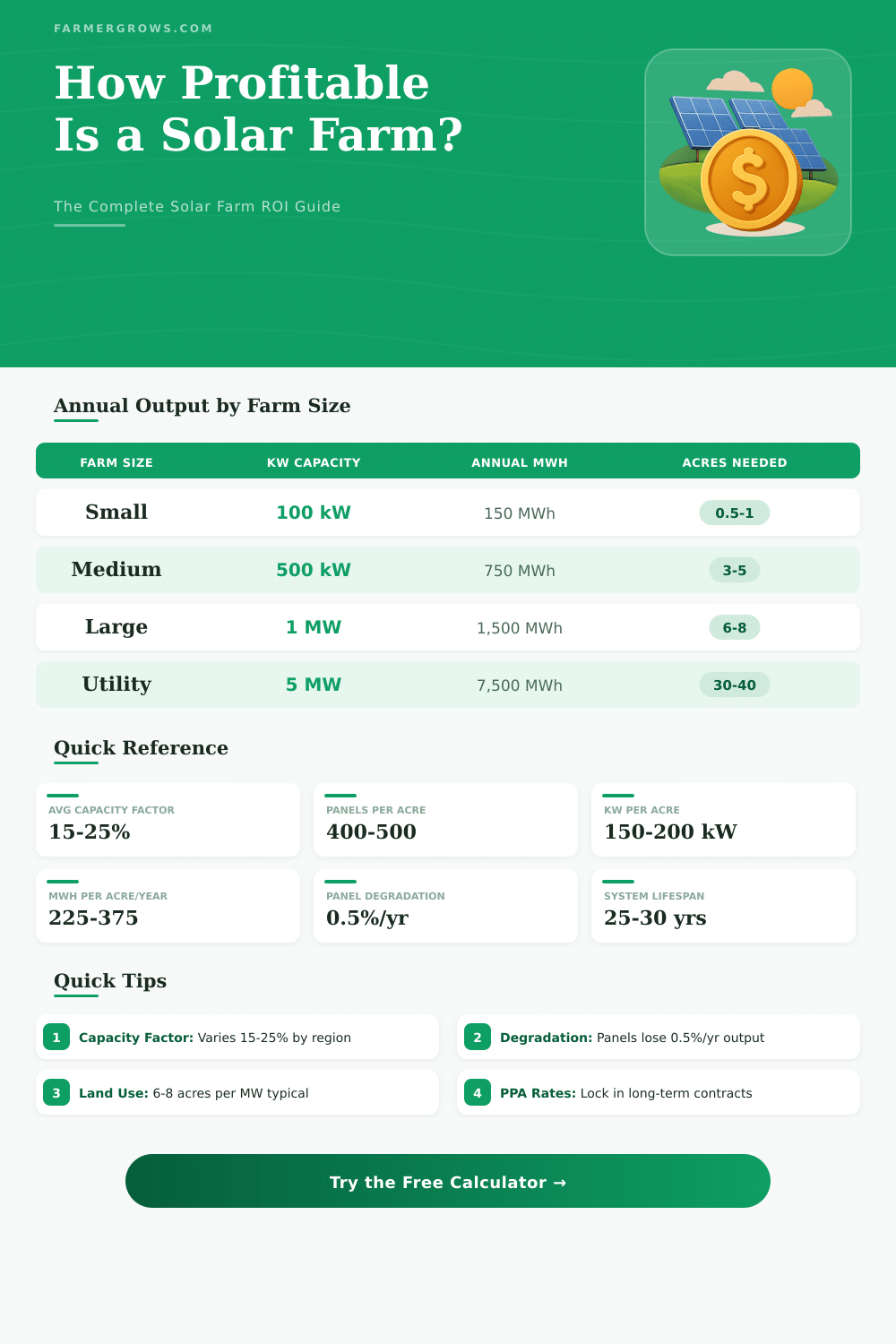
1 MW solar farm with fixed tilt normally produces around 1400 to 1600 megawatt-hours yearly in a typical American location. I commonly see the number of 4.5 peak sun hours per day. Add single-axis trackers, and you arrive to almost 1700 MWh so a good 20 percent boost.
The range of capacity factor is wide, from 15% in the cloudy northern states to 23% in areas like Arizona or Nevada. It makes a big difference for 25-year forecasts.
Solar Farms: Size, Power, Land and Cost
The needs for land are 6 to 8 acres each megawatt for systems with fixed tilt, but trackers require a bit more space, say 8 to 10 acres per MW. About the panels themselves, 0.5% yearly degradation is the standard, so after 20 years you have around 90% of the original output. Not bad for somthing like that.
With PPA price of 0.05 dollars each kWh, a 5 MW farm brings around 375 thousand dollars in first year revenue, and maybe 8 millions during the whole 25-year life after the gradual decline.
Solar farms have many names. Sun parks, sun gardens, solar power stations. But everything comes down to the same: big, grid-tied set of panels that grab sunlight and turn it into electricity.
Much bigger than rooftop setups, those utility-scale projects can use solar or focused sun energy to generate much energy, just like traditional coal plants but with much more little footprint.
Size one measures by means of megawatts of capacity, and utility-scale one starts at 1 MW up. Community solar farms usually involve 5-40 acres, while mid-size commercial or industrial projects require 20-250 acres. Everything under 5 MW probably does not work for independent use and more likely joins a community solar program.
The hole cost for 100 MW solar farm sites are around 100 millions of dollars, take or leave. Location and sunlight levels are the main influences. Oh, and you never can build one in a marsh; that is not allowed.
Flood-prone sites require extra planning and permission also.
The Long Island Solar Farm is a 32 MW monster done through teamwork between BP Solar, the local energy authority and the Department of Energy. Down in South Carolina there is a volunteer testing program that helps solar developers create pollinator-friendly habitats on their sites. And up in Alaska, a 45-acre agrivoltaic pilot case in Houston has crops and animals living with the solar panels.
Agrivoltaic is the general word for mixing farming with solar energy, one can grow plants, graze animals or grow pollinator-friendly grasses while panels gather the sunlight. The secret is find the right setups and spacing to help both energy output and food or farming. You must be smart about what crops and animals will benefit in the particular climate under and around the panels.
For ranchers, solar energy can give good profit through land leasing, local panels or agrivoltaic systems. But not each farm works for that. Many things to think about before entering.
Some will be ideal, others sometimes not like that.
Cornell University energy program stores a whole series of solar projects, from rooftop setups at the school to full solar farms. Wonderful sight when one sees it all arranged. Withoutdoubt, it leads in the space of higher education for sustainability.