🌿 Soil pH Adjustment Calculator
Calculate exactly how much lime, sulfur, or amendment you need to reach your target soil pH
| Depth | Sq Ft / Yd³ | Sq M / Yd³ | Sq Ft / M³ |
|---|---|---|---|
| 1 in (2.5 cm) | 324 | 30.1 | 424 |
| 2 in (5 cm) | 162 | 15.1 | 212 |
| 3 in (7.6 cm) | 108 | 10.0 | 141 |
| 4 in (10 cm) | 81 | 7.5 | 106 |
| 6 in (15 cm) | 54 | 5.0 | 71 |
| Bag Size | Volume / Bag | Bags / Cubic Yard | Coverage at 3 in |
|---|---|---|---|
| Small (2 cu ft) | 0.074 yd³ | 13.5 bags | 8 sq ft |
| Large (3 cu ft) | 0.111 yd³ | 9 bags | 12 sq ft |
| 40 lb bag (Lime) | ~0.5 cu ft | 54 bags | ~1.5 sq ft |
| 50 lb bag (Sulfur) | ~1.0 cu ft | 27 bags | ~4 sq ft |
| Project | Area (sq ft) | Cubic Yards (3 in) | Bags (2 cu ft) |
|---|---|---|---|
| Small Flower Bed | 100 | 0.93 | 13 |
| Garden Plot | 250 | 2.31 | 32 |
| Medium Lawn Section | 500 | 4.63 | 63 |
| Large Garden | 1,000 | 9.26 | 125 |
| Half-Acre Lawn | 2,500 | 23.15 | 313 |
| Full-Acre Property | 5,000 | 46.30 | 625 |
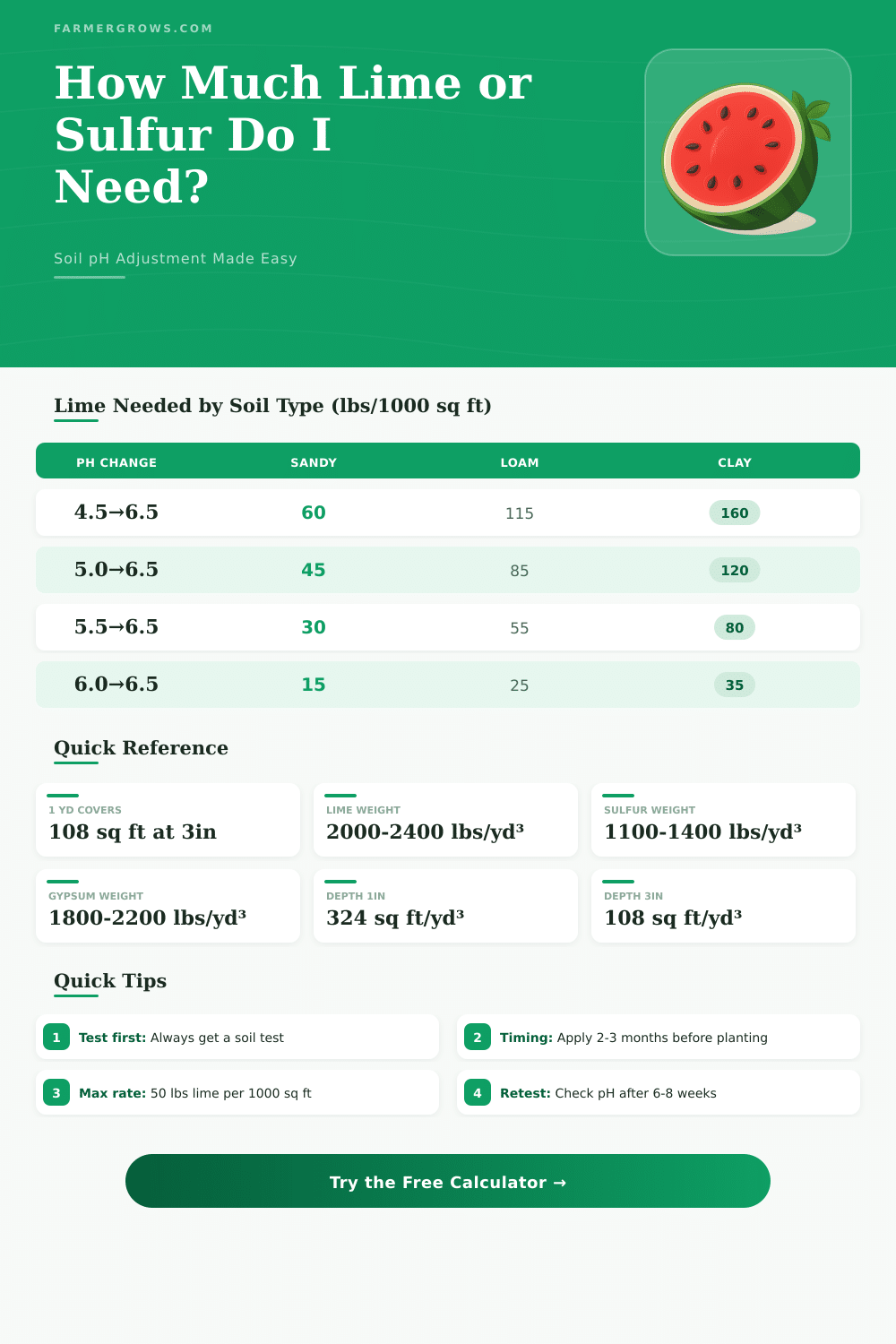
One cubic yard of granulated chalk forms a dense crowd, that weighs around 2000 to 2400 pounds. I should double check that heavy number. So, three inches of that material cover only 108 square feet what really does not help a lot.
What surprised me are, that sandy soils require 40 to 60 percent less chalk than clay to move the ph in one spot. Surprisingly, the type of soil can hide such differences.
How Much Lime to Use and Why Soil pH Matters
For 1000 square feet of lawn, you require more than 9 cubic yards in three-inch depth. That is a huge amount, I understand now, why extension offices usually limit one lime application to 50 pounds for 1000 square feet. Heavier corrections commonly require two or three rounds, separated by 6 to 8 weeks.
I always add extra 10 percent to be sure, because snowy stretches commonly consume the material more quikcly than one expected.
The following info does not come from the above mentioned calculator. It is based on actual experience, forum talks and opinions from the big gardening community.
The soil ph measures how bitter or basic the ground is. It forms a scale of 0 to 14, where 7.0 marks the neutral. Everything under 7 one considers sour or “bitter”, while above 7 it is basic, sometimes called “sweet”.
Most soils sit somewhere between very bitter 3 and strongly basic 10.
The main reason to understand is, that the ph scale is logarithmic… One point difference is not small, but really a 10-times bigger change. For instance, going from 6.5 too 7.5 makes the soil 10-times less bitter.
That is a big slide.
Widely, most plants grow best, when the ph sits between 5.5 and 7.0, with 6.5 commonly mentioned as the perfect level for nutrient access. Naturally, there are exceptions, azaleas and blueberries like more bitter conditions, while tomatoes do well between 6.0 and 6.8. The reason, that certain plants favour particular ph ranges, sits in the mineral access.
In very bitter ground, aluminium and manganese can become poisonous, while calcium, phosphorus and magnesium become less available.
Liming helps commonly to raise the soil ph and reduce the bitterness. When one adds chalk to bitter soil, those nutrients become more available for the roots of plants to absorb. Different chalk products, like powder, granulated, granulated or hydrated, give different speeds of impact, where the more ground ones act more soon.
It also matters to know, that the change of soil ph happens step by step, not sharply and easily.
Local plants and local conditions seriously affect the starting ph levels. Soils under grasses tend to be less bitter, while those under trees commonly become more bitter because of aging leaves. Steady rain can clear basic nutrients like calcium over time, slowly dropping the ph.
Even the kind of mulch, like wooden chips from conifers, can grow the bitterness.
A proper soil ph test is important. Those cheap home ph meters commonly prove unreliable, usually showing around neutral regardless of the reality. A better glass ph meter gives precise results, although the tender glass tips easily break.
Chemical test kits also work well, likewise the old method of mixing soil with distilled water, letting it settle, filtering and testing the liquid.
Interestingly, healthy grass can grow at ph levels even above 8, if one gives the right extra nutrients. But widely, trying to dramatically alter the soil ph usually becomes a difficult struggle. More modest, gradual corrections bymeans of sulphur or ammonium sulfate products form a more practical way.