🌱 Snake Plant Water Calculator
Calculate exactly how much water your snake plant needs based on pot size, season & soil type
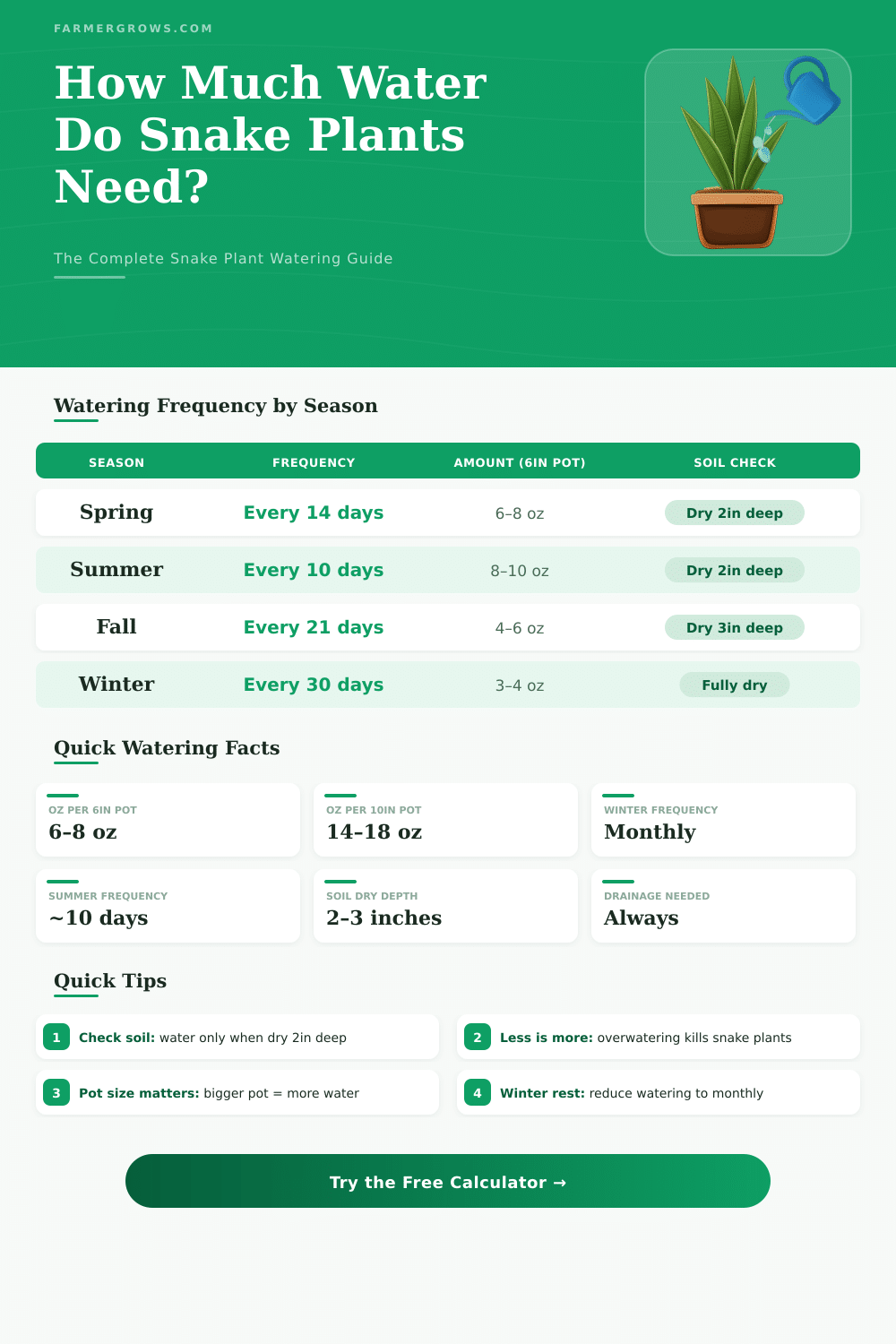
| Season | Small (4 in) | Medium (6 in) | Large (8–10 in) | XL (12+ in) |
|---|---|---|---|---|
| Spring | Every 14 days | Every 14 days | Every 12 days | Every 10 days |
| Summer | Every 10 days | Every 10 days | Every 8 days | Every 7 days |
| Fall | Every 21 days | Every 18 days | Every 18 days | Every 16 days |
| Winter | Every 35 days | Every 30 days | Every 28 days | Every 25 days |
| Soil Type | Drainage Rate | Frequency Adjustment | Notes |
|---|---|---|---|
| Well-Draining Potting Mix | Fast–Moderate | Baseline | Ideal for snake plants |
| Succulent / Cactus Mix | Very Fast | Water 10% more often | Best for beginners |
| Sandy Mix | Very Fast | Water 15% more often | Low moisture retention |
| Peat-Based Mix | Slow–Moderate | Water 15% less often | Retains more moisture |
| Clay-Heavy Mix | Slow | Water 25% less often | Risk of root rot |
| Loam Mix | Moderate | Water 5% less often | Balanced, good option |
| Perlite-Enriched Mix | Fast | Water 5% more often | Excellent for drainage |
| Pot Diameter | Per Watering (oz) | Per Watering (ml) | Annual Total (oz) |
|---|---|---|---|
| 4 in (10 cm) | 3–4 oz | 90–120 ml | ~36–48 oz |
| 6 in (15 cm) | 6–8 oz | 180–240 ml | ~72–96 oz |
| 8 in (20 cm) | 10–14 oz | 300–415 ml | ~120–168 oz |
| 10 in (25 cm) | 14–18 oz | 415–535 ml | ~168–216 oz |
| 12 in (30 cm) | 18–24 oz | 535–710 ml | ~216–288 oz |
snake plants rank among the most liked houseplants around the world, and that is not random. They bear the scientific name Dracaena trifasciata, although before one classified it in the genus Sansevieria. Thanks to progress in genetic study one reclassified it to the genus Dracaena, even so many still call them Sansevieria.
Among the usual nicknames is mother-in-law’s tongue, sword of Saint George and bowstring hemp.
How to Care for Snake Plants
All these plants come from West Africa, from Nigeria until Congo in the east. They grow in rocky, dry regions and adapted to last long periods without rain. So they certainly do not like too much water.
In warmer areas of United States, especially in USDA zone 8 and warmer, one can grow snake plants outside almost during the whole year.
The leaves are tall, straight and sword-like with smooth surface. They stay evergreen with deep, dark green colour. Usually stripes mark the leaves, and around the edges they are bright, sometimes green or yellow.
For instance, the variety Laurentii has bright yellow edges on its straight leaves. Long leaves show serpent-like pattern, from that comes the usual name. Every leaf ends with a sharp spike, that one should handle carefully.
snake plants work well for newcomers or for those with busy schedules. They require only little care and rarely struggle because of new positions. Low light they last, and can manage for some months in such conditions, but best they grow in bright indirect light.
One should avoid direct sunlight, because that can burn the leaves. Sudden move of the plant from dark place to direct sun, without slowly adjusting it, can shock it.
Watering is simple, but it requires attention. Snake plants require water only when the ground fully dried, and not according to strict schedule. Light conditions, moisture and soil mix all affect that.
Too much water is the biggest threat. Practically the only weigh to kill a snake plant is to give it too much water, what causes root rot. In cold regions, watering once a month is enough, with more during the summer.
Well draining soil is key. Sandy or clay ground, that is a bit acidic, works, similar to mix for succulents or cacti. Some gardeners choose only pumice-based plant stone.
Also the size of the jar matters. A small jar can itself push stronger growth than a big and spacious one.
snake plants live long and are rugged. They last through neglect and only improve with time. It is rare that a snake plant flowers indoors, but it happens sometimes.
These succulents belong to theeasiest and most brilliant houseplants that one can get.