
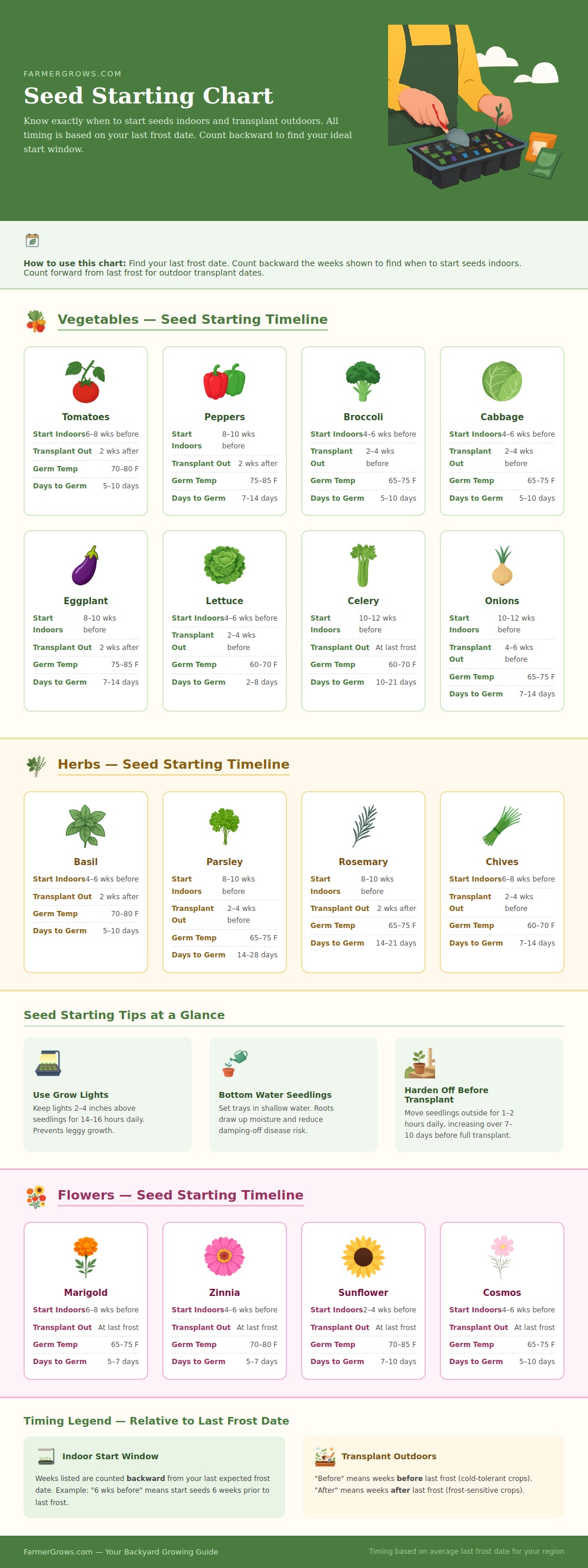
Seed starting chart is a useful tool that helps count the planting time of seeds according to cold data and place. You enter the date of the last spring cold and the calculator gives advice for seed starting and transplant of many garden crops. You can set these charts according to zip code so that they show dates about when to start vegetables, herbs and fruits
Interactive seed starting calendar makes a planting guide according to zip code for help to decide when to sow vegetables, flowers and herbs. You can prepare a custom chart for a spring or autumn garden. It points when to start seeds indoors or outside and gives transplant dates according to your zpi code.
When to Start Seeds and When to Plant Them
Some seeds start indoors, while others go directly sowed outside. In average charts “sow” means sowing outside and usually relates to peas, carrots, corn, radish, spinach, beans and turnip. “Start” means starting seeds indoors in pots, soil blocks, flats, trays or cell packs, most commonly for broccoli, cabbage, cauliflower, tomatoes, peppers and eggplant.
Looking at frost dates helps to set the date of the last spring cold for any region.
Best split seed order in two parts. First, you take varieties that start indoors for transplant in the garden after the cold-free date. That date you find by means of a chart of the National Oceanic and Atmospheric Administration.
All seed packets instruct planting according to cold data, not hardiness zone. Hardiness zone helps to know that plants will last the winter, but does not deal with annual crops.
Different varieties have different timing. For instance, one broccoli can belong to one group, another to another. The seed packet will point the needed indoor growing time.
Seeds for twelve weeks before the last cold start twelve weeks before. Follow the advice of the package, for instance six until eight weeks before the cold, and check the average date of the last cold for counting the weeks.
Many crops, as salads, carrots, beetroots, bush beans and coriander, best sow in succession, a bit every two weeks, of the chart date. Think about soil temperature as a starting gun for a race. Too cold soil leaves seeds simply sleep.
Cold and wet soil perfectly feeds fungus and rot, that kills seeds before they wake up. Too warm soil can burn the tender seed before it will grow. Minimal soil temperature is the lowest, in that seed germinates, and slow or poor germination happens planting below or above the ideal range.