🌿 Scotts Fertilizer Calculator
Calculate how much Scotts fertilizer you need for your lawn or garden area
✅ Your Fertilizer Results
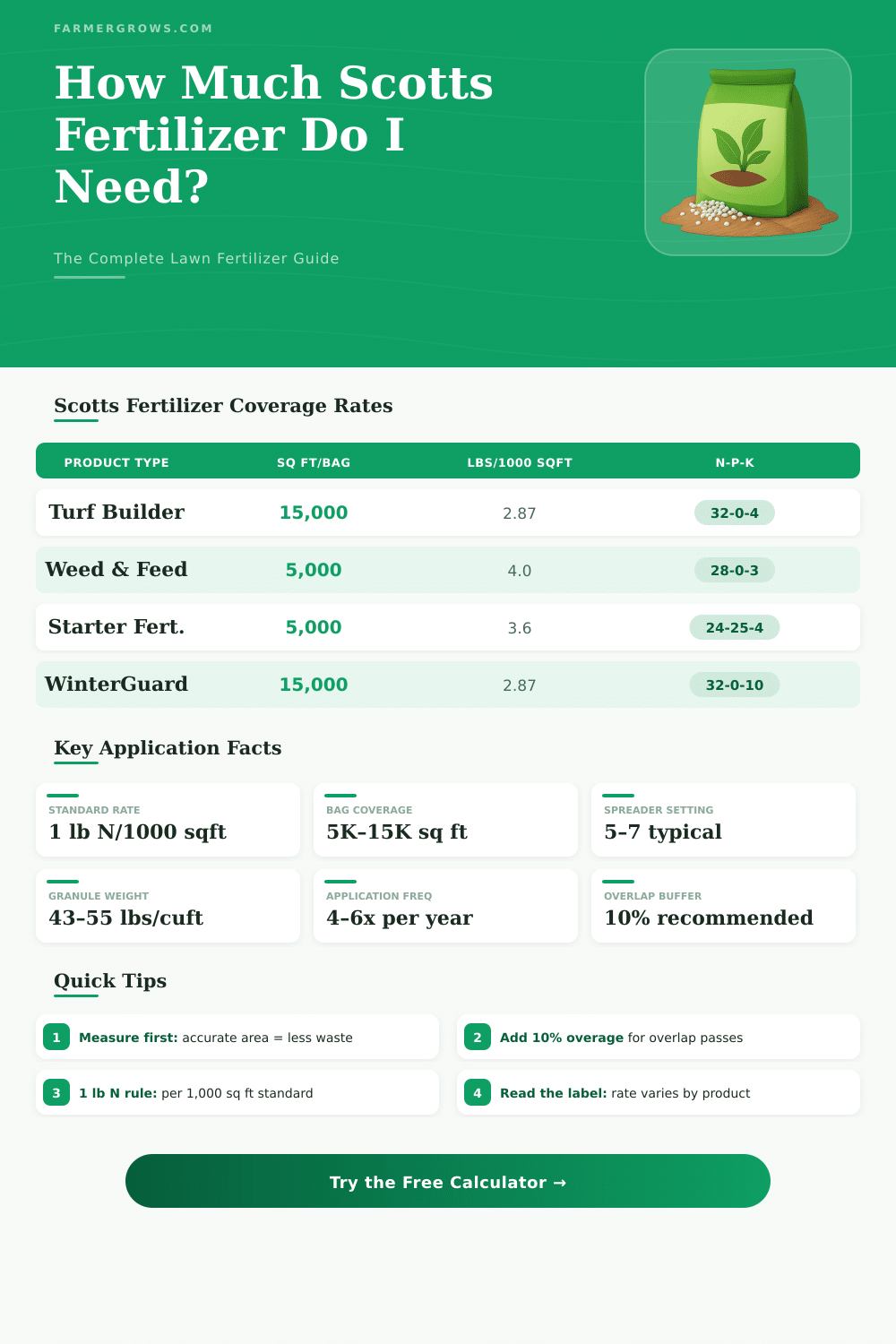
| Scotts Product | N-P-K | Lbs per 1,000 sqft | Bag Coverage (sqft) | Bag Weight (lbs) |
|---|---|---|---|---|
| Turf Builder | 32-0-4 | 2.87 | 15,000 | 43.1 |
| Weed & Feed | 28-0-3 | 4.00 | 5,000 | 20.0 |
| Starter Fertilizer | 24-25-4 | 3.60 | 5,000 | 18.0 |
| WinterGuard | 32-0-10 | 2.87 | 15,000 | 43.1 |
| Lawn Food | 30-0-6 | 3.00 | 10,000 | 30.0 |
| Moss Control | 25-0-5 | 4.00 | 5,000 | 20.0 |
| Triple Action | 29-0-5 | 3.00 | 10,000 | 30.0 |
| SummerGuard | 28-2-10 | 3.00 | 10,000 | 30.0 |
| Lawn Area (sqft) | Lawn Area (m²) | Bags Needed (5K) | Bags Needed (10K) | Bags Needed (15K) |
|---|---|---|---|---|
| 1,000 | 92.9 | 1 | 1 | 1 |
| 2,500 | 232.3 | 1 | 1 | 1 |
| 5,000 | 464.5 | 1 | 1 | 1 |
| 7,500 | 696.8 | 2 | 1 | 1 |
| 10,000 | 929.0 | 2 | 1 | 1 |
| 15,000 | 1,393.5 | 3 | 2 | 1 |
| 20,000 | 1,858.1 | 4 | 2 | 2 |
| 30,000 | 2,787.1 | 6 | 3 | 2 |
| Project | Dimensions (ft) | Area (sqft) | Bags (15K coverage) | Bags (5K coverage) |
|---|---|---|---|---|
| Small Front Lawn | 20 x 15 | 300 | 1 | 1 |
| Average Backyard | 50 x 30 | 1,500 | 1 | 1 |
| Medium Lawn | 80 x 50 | 4,000 | 1 | 1 |
| Large Lawn | 100 x 80 | 8,000 | 1 | 2 |
| Extra Large Lawn | 150 x 100 | 15,000 | 1 | 3 |
| Half Acre Lawn | 147 x 147 | 21,780 | 2 | 5 |
| Full Acre Lawn | 208 x 208 | 43,560 | 3 | 9 |
Walk off your lawn with a measuring tape or use a lawn measuring app. Divide irregular shapes into rectangles or triangles and add the areas together before entering into the calculator. Accuracy within 5% is sufficient.
A 10% overage buffer is recommended to account for overlapping spreader passes and irregular edges. For spreader patterns that overlap by 1–2 feet, this ensures complete, even coverage across your entire lawn area.
Fertilizer is made up of anything, natural or fake, that one uses to feed ground or to feed plant roots with nourishments. Simply said fertilizers work as food for plants. They deliver the elements that plants need to grow and stay healthy.
Like folks and creatures that need nourishment, plants can not lack it. New, clean ground can store enough nourishments on its own, but grounds that one used to grow crops during many years, become worn out. Here fertilizers step in, to bring back what lacks in the soil.
What fertilizers are and how they help plants
In the most many fertilizers one finds three main elements that one shortens to NPK. The nitrogen, so the N, backs the general growth and the green colour in the palnt leaves that thickens. The phosphorus, the P, helps to move nourishments in the plant over there, where they are needed.
Potassium, the K, strengthens the stems and cares about the whole health of the plant. Fertilizer with label 10-5-5 has 10 percent of nitrogen and each 5 percent of phosphorus and potassium. Any sold fertilizer that stores all those three nourishments is called complete fertilizer.
Even such balanced types as 10-10-10 or 12-12-12 work well for general use.
Fertilizers split into two main kinds: organic and inorganic. Organic include stuff as waste of birds, animals or horses, bone meal, cotton seed and other natural things. Inorganic fertilizers are factory-made products.
Some chemical types stress nitrogen, while others base on phosphate or potassium.
The most many soils in regions as Minnesota already own enough calcium, magnesium, sulphur and micro-nutrients. Nitrogen, phosphorus and potassium are the nourishments that most commonly lack, hence one usually must add them by means of fertilizer.
Fertilizers appear in form of pellets, dusts, crystals or liquids. One applies them commonly by sowing above the field or by pouring on the plants. No matter how one uses the fertilizer, there always stays part that does not reach the plant ideally.
When the growth limits because of absence of one element, adding more other element will not benefit. Hence it matters a lot to adapt the portions of the fertilizer to that, what the plant truly consumes. Factors as pH and temperature can also block how many nourishments are open four the plant.
For lawns, Scotts fertilizer boosts strong and thick grassy growth. It improves the look of the lawn and helps the ground recover after usage. It backs also the grass in struggle against insects, bad grasses and harsh weather.
Even so too much fertilizer is real danger, so one must reach the right balance. Composting offers another way to feed plants. Bokashi method allows folks to turn garbage in little tins, what gives compost tea that acts as fertilizer.
Even grass clippings canserve as cheap supply of nitrogen, phosphorus and potassium.