🌱 Rubber Plant Water Calculator
Find exactly how much water your rubber plant needs based on pot size, season & light conditions
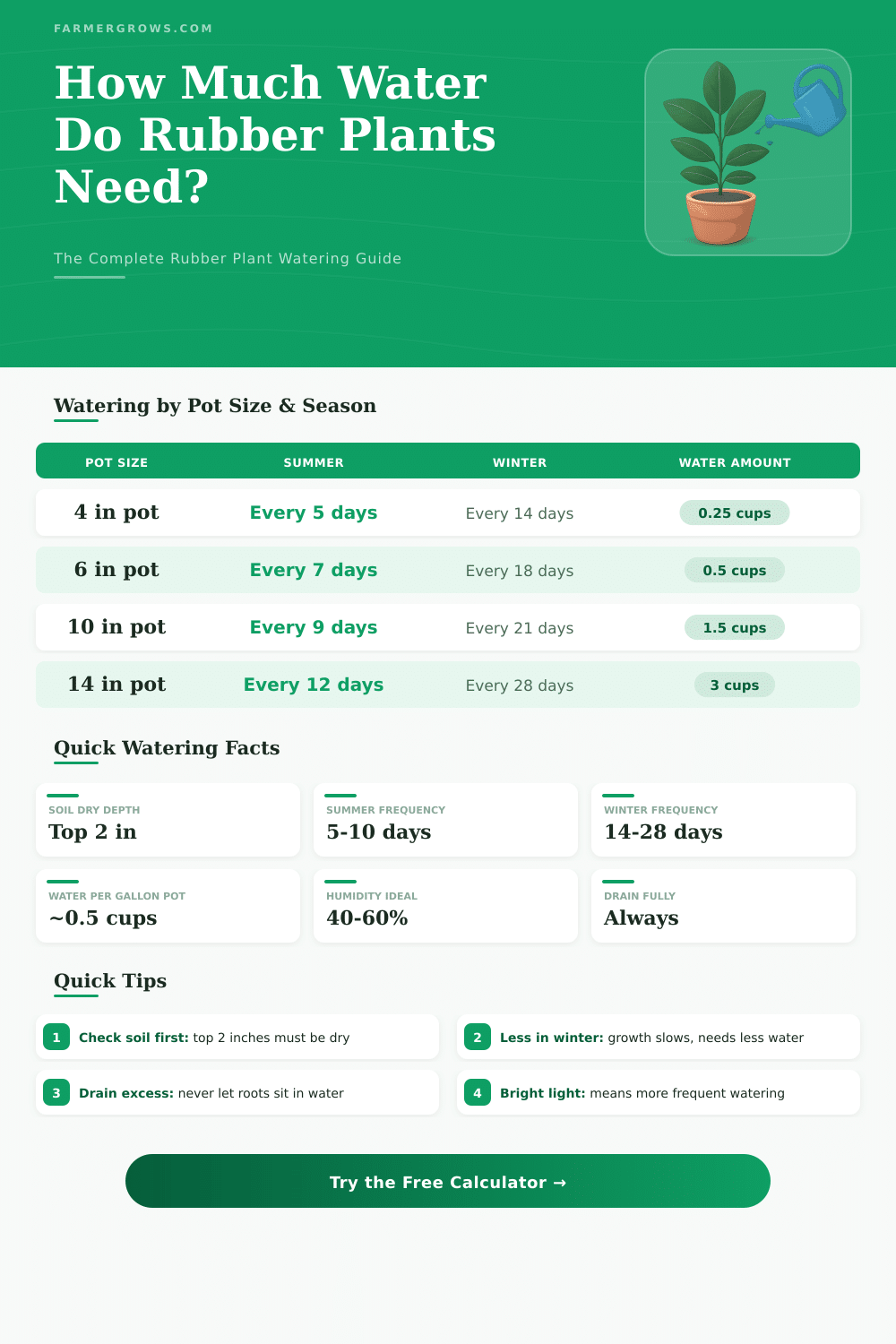
| Pot Size | Summer (cups) | Winter (cups) | Summer (ml) | Winter (ml) | Summer Frequency | Winter Frequency |
|---|---|---|---|---|---|---|
| 4 in (10 cm) | 0.25 cups | 0.12 cups | 59 ml | 30 ml | Every 5–7 days | Every 14–18 days |
| 6 in (15 cm) | 0.5 cups | 0.25 cups | 118 ml | 59 ml | Every 6–9 days | Every 16–21 days |
| 8 in (20 cm) | 1 cup | 0.5 cups | 237 ml | 118 ml | Every 7–10 days | Every 18–24 days |
| 10 in (25 cm) | 1.5 cups | 0.75 cups | 355 ml | 177 ml | Every 8–11 days | Every 20–26 days |
| 12 in (30 cm) | 2 cups | 1 cup | 473 ml | 237 ml | Every 9–12 days | Every 21–28 days |
| 14 in (36 cm) | 3 cups | 1.5 cups | 710 ml | 355 ml | Every 10–14 days | Every 24–30 days |
| 16 in (41 cm) | 4 cups | 2 cups | 946 ml | 473 ml | Every 11–15 days | Every 25–35 days |
Dries Fastest
Baseline
Retains Well
Dries Quickest
Slowest Dry
Slightly Fast
Very Fast Drain
Holds Moisture
| Factor | Condition | Water Amount Adjustment | Frequency Adjustment |
|---|---|---|---|
| Season | Summer / Spring | Baseline | Baseline |
| Season | Fall | −20% | +20% days between |
| Season | Winter | −45% | +50% days between |
| Light | Direct Sun | +20% | −2 days between |
| Light | Bright Indirect | Baseline | Baseline |
| Light | Medium Indirect | −10% | +2 days between |
| Light | Low Light | −25% | +4 days between |
| Humidity | Low (<30%) | +15% | −1 day between |
| Humidity | Medium (30–50%) | Baseline | Baseline |
| Humidity | High (>50%) | −15% | +2 days between |
| Temperature | Cool (60–65°F) | −15% | +2 days between |
| Temperature | Normal (65–80°F) | Baseline | Baseline |
| Temperature | Warm (80–90°F) | +20% | −2 days between |
| Measurement | Fluid Oz | Cups (US) | Milliliters | Liters |
|---|---|---|---|---|
| 1 tablespoon | 0.5 fl oz | 0.06 cups | 15 ml | 0.015 L |
| 1/4 cup | 2 fl oz | 0.25 cups | 59 ml | 0.059 L |
| 1/2 cup | 4 fl oz | 0.5 cups | 118 ml | 0.118 L |
| 1 cup | 8 fl oz | 1 cup | 237 ml | 0.237 L |
| 2 cups | 16 fl oz | 2 cups | 473 ml | 0.473 L |
| 4 cups (1 qt) | 32 fl oz | 4 cups | 946 ml | 0.946 L |
Note: This article is based on real feedback about care of plants in homes and practical growth advice.
Rubber plants, also known as Ficus elastica, are among the most popular indoor plants. They come from northeast India and belong to the mulberry and fig family. Most people find them easy to care for but when it comes to Water they can be a bit tricky.
How to Water Rubber Plants
It matters to find the right rhythm, because they do not like to be too wet.
On average, Rubber plants need Water once every 7 to 14 days, but that depends on the conditions in your home. They prefer that the soil gets slightly dry between waterings. A simple way to check is to put your finger in the upper two inches of the soil.
If it feels dry, you can Water. If the soil is still wet and a lot of dirt sticks to your finger, check again after some days. For small four-inch pots, let the upper half inch dry before watering.
A moisture meter can also help detect when to Water. Watering when it shows “dry” for three or more days usually works well. One clear sign that Rubber plants need Water is slightly curling leaves that hang.
The big leaves can end up pointing toward the cieling and instead hang down. They quickly straighten again after a good drink.
When watering, pour Water only on the soil, not on the leaves. Water until it freely spills from the drainage holes, not only some drops, but truly fully. Then let everything fully drain.
Overwatering is more about how often the plant receives Water, not about the amount at one time. So it is fine to keep watering even after it starts to spill below, to ensure that the whole soil is well soaked. Even so, never let the plant sit in a saucer with standing Water.
Rubber plants need pots with drainage holes. Whether from terracotta, ceramics or plastic, good drainage is key. Without that, the roots stay in standing Water and can get root rot.
If a fancy pot does not have a hole, use it as an outer pot with an inner pot that drains right.
It also matters to have well draining soil. Soil that keeps to much moisture leads to soggy roots. The mix should let extra Water flow out, while it still holds enough moisture for the plant.
In spring and summer, check the soil more often to keep the plant hydrated when it is warm. In winter, Rubber plants still need Water, but less often. Plants that actively grow need more Water than those resting during cooler months.
To raise humidity, you can place indoor plants on trays filled with pebbles and Water. Just keep the pot bottom above the level of the Water. It also helps to let tap Water stand a bit before you use it, so that the chlorine fades and does notbother the plant.
Rubber plants also prefer steady amounts of Water and bright, indirect light. Without enough light, they simply do not grow very well.