🌿 Rosemary Spacing Calculator
Calculate how many rosemary plants fit your space & get exact spacing recommendations
🌿 Your Rosemary Spacing Results
| Spacing (in) | Spacing (cm) | Plants per 100 sq ft | Plants per 10 m² | Best For |
|---|---|---|---|---|
| 12 in | 30 cm | 100 plants | 108 plants | Dense groundcover |
| 18 in | 46 cm | 44 plants | 47 plants | Hedge / border |
| 24 in | 61 cm | 25 plants | 27 plants | Standard upright |
| 30 in | 76 cm | 16 plants | 17 plants | Relaxed planting |
| 36 in | 91 cm | 11 plants | 12 plants | Mature upright |
| 48 in | 122 cm | 6 plants | 7 plants | Wide landscape |
| Variety | Height | Spread | Rec. Spacing | Growth Rate |
|---|---|---|---|---|
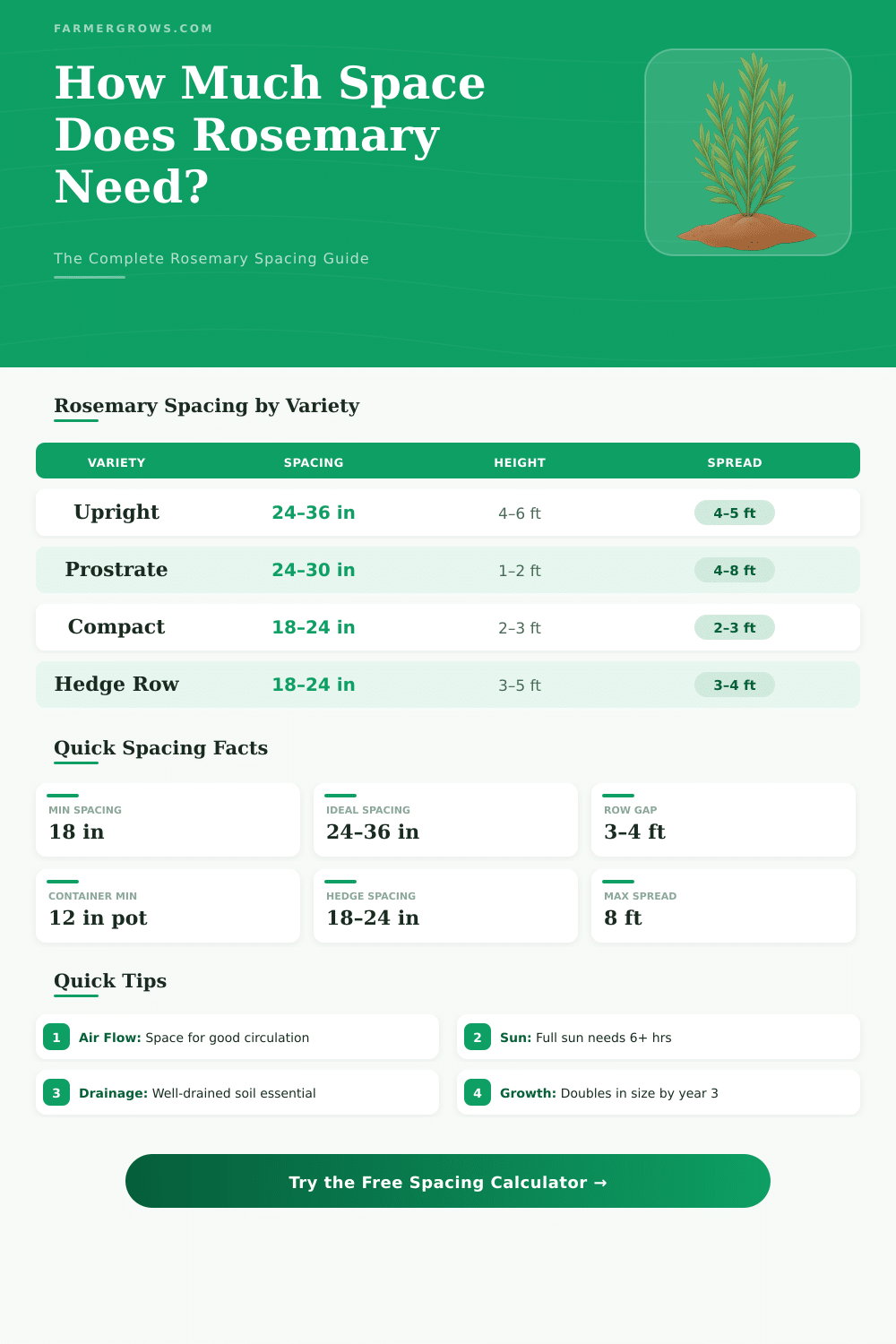
| Tuscan Blue (upright) | 4–6 ft | 4–5 ft | 36 in | Moderate–Fast |
| Arp (hardy upright) | 3–5 ft | 3–4 ft | 30–36 in | Moderate |
| Prostratus (prostrate) | 1–2 ft | 4–8 ft | 24–30 in | Moderate |
| Spice Island (compact) | 2–3 ft | 2–3 ft | 24 in | Slow–Moderate |
| Huntington Carpet | 1.5–2 ft | 6–8 ft | 24–36 in | Fast |
| Miss Jessup Upright | 4–6 ft | 3–4 ft | 36 in | Fast |
| Blue Boy (dwarf) | 1–2 ft | 1–2 ft | 12–18 in | Slow |
| Salem (hedge) | 3–4 ft | 3–4 ft | 18–24 in | Moderate |
| Project | Area (sq ft) | Area (m²) | Plants (sq grid) | Plants (staggered) |
|---|---|---|---|---|
| Small herb bed 4×6 | 24 sq ft | 2.2 m² | 6 plants | 7 plants |
| Foundation strip 4×12 | 48 sq ft | 4.5 m² | 12 plants | 14 plants |
| Border bed 5×20 | 100 sq ft | 9.3 m² | 25 plants | 29 plants |
| Slope bank 6×15 | 90 sq ft | 8.4 m² | 23 plants | 26 plants |
| Hedge row 3×30 | 90 sq ft | 8.4 m² | 23 plants | 26 plants |
| Landscape bed 10×20 | 200 sq ft | 18.6 m² | 50 plants | 58 plants |
| Formal garden 15×15 | 225 sq ft | 20.9 m² | 56 plants | 65 plants |
| Large property 20×30 | 600 sq ft | 55.7 m² | 150 plants | 173 plants |
Rosemary is one of those evergreen bushes that attracts attention with its thin needle-like leaves and soft flowers of light blue to white, that bloom during the spring and summer. In the USDA zones 8 to 10 it can live outside without big issue. Want to grow it inside?
Keep the temperatures between 55 and 80 degrees and everything will be fine.
How to Grow Rosemary
The Space between plants matters a lot when you plant Rosemary in the soil. For dense, even fence plant them about 12 to 24 inches one from the other. If you prefer a more free arrangement, Space them 2 to 3 feet, and that will work perfectly.
Here the secret: Rosemary does not like to be too crowded. Start with small seedlings from shops commonly gives better results than using big mature copies directly.
After it is well rooted, Rosemary surprisingly easily cares for itself. It genuinely likes to be left in peace, forget it a bit, and it will thank you. Prefer plant it in pots with soil always, if possible.
The ground needs good drainage and should be a bit bitter, with pH between 5 and 8. The seeds sprout after around 15 to 20 days, but the ground warmth matters, keep it between 55 and 77 degrees for the best results. It needs full sun, that can not lack.
For home plants copy the Mediterranean climate, from which Rosemary comes. Bright light, stable temperatures that stay gentle without cold, steady flow of air and soil that drains fast, all that is key. West window works, but south facing is even better.
Here something useful to no: after two or three years inside, your Rosemary can grow this fast, that it beats the Space. Start with a 6-to-8-inch jar for tiny seedlings. When it is fully settled, switch it to 8 to 12 inches.
If you have room and want something big, a 14-to-18-inch jar works for full plant. For pot growing use a light mix of soil, the usual potting soil gets too heavy.
During harvest always cut in the green, growing parts of the plant. Rosemary does not regrow well after deep cuts to bare wood, so avoid going too far. Trailing types of Rosemary surprisingly work for planting at walls.
They give nice color with their flowers and do not care about strong sun, because heat and dryness it enjoys fully.
Vertical growing systems work well for Rosemary, especially if you plant it beside thyme. The steady, small moisture at the roots it enjoys. Also pot growing works; try mixing it with basil, turmeric, coriander, chives, oregano or mint in root packages.
Rosemary belongs to those lasting herbs, that dry almost just as well as fresh in taste, plus it is easy to grow if you have enough Space. Take cuttings or layer are reliable ways for spreading, if dividing does not work.
Mind powdery fungus on home plants; it can cover everything like flour. When the winters become harsh, outdoor growing simply is not possible. Even so, using edible herbs like Rosemary in public landscaping is a clear idea, thatdeserves more interest.