🌱 Raspberry Plant Water Calculator
Calculate exactly how much water your raspberry plants need based on bed size, growth stage, and method
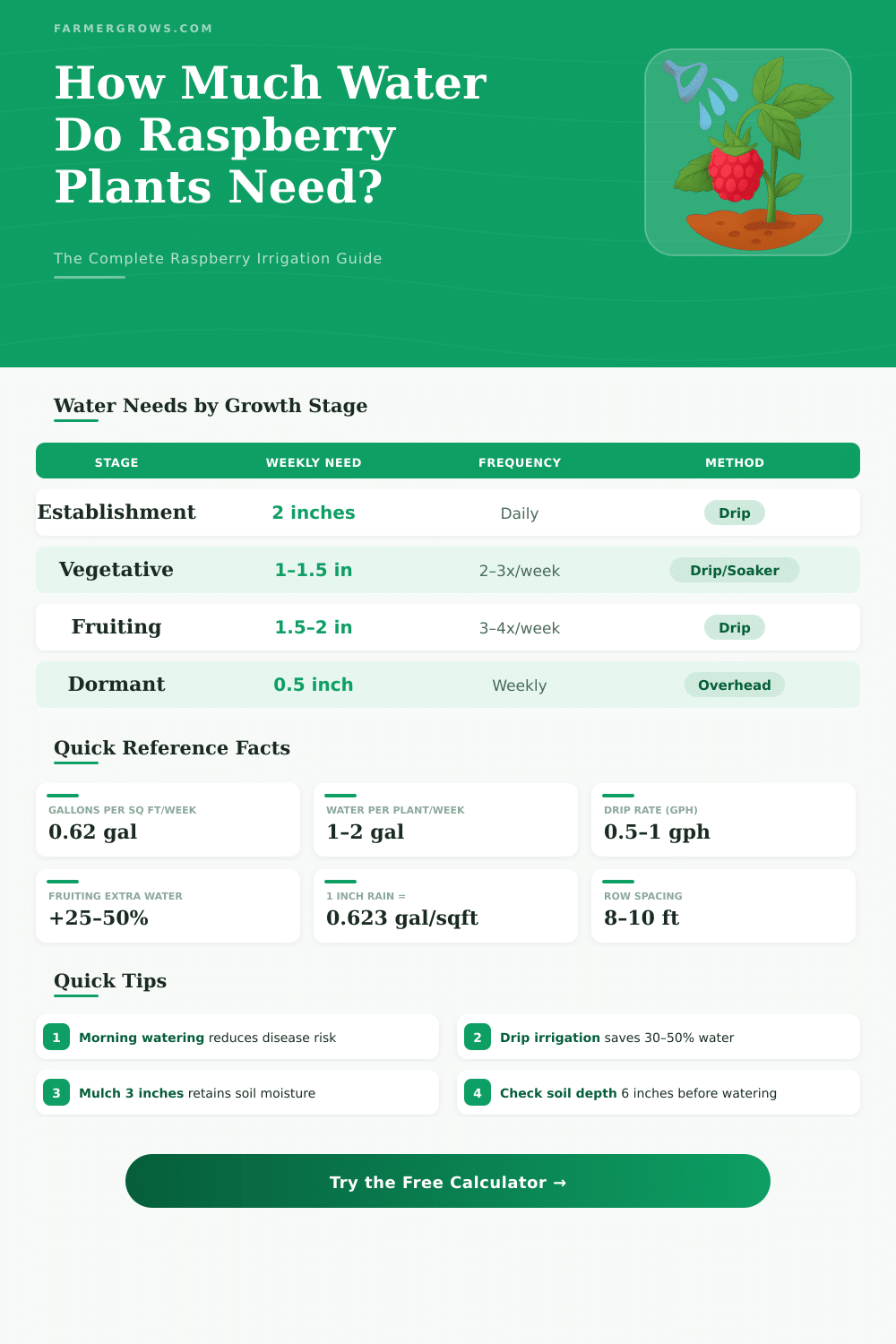
| Growth Stage | Weekly Water (inches) | Gallons per 100 sq ft | Liters per 10 m² | Frequency |
|---|---|---|---|---|
| Establishment (new) | 1.5 – 2.0 in | 93 – 125 gal | 353 – 472 L | Daily or every 2 days |
| Vegetative growth | 1.0 – 1.5 in | 62 – 93 gal | 235 – 353 L | 2–3 times/week |
| Fruiting / Peak season | 1.5 – 2.0 in | 93 – 125 gal | 353 – 472 L | 3–4 times/week |
| Dormant / Winter | 0.5 – 0.75 in | 31 – 47 gal | 117 – 178 L | Once a week |
| Method | Efficiency | Water Needed vs Ideal | Best For |
|---|---|---|---|
| Drip Irrigation | 90–95% | 1.0x (baseline) | Rows, large beds |
| Soaker Hose | 80–90% | 1.1x more | Rows, raised beds |
| Overhead / Sprinkler | 60–75% | 1.4x more | Large areas |
| Hand Watering | 70–80% | 1.25x more | Small beds, pots |
| Soil Type | Drainage | Frequency Adjust | Volume Adjust |
|---|---|---|---|
| Sandy | Very fast | +1 session/week | +20% per session |
| Loam | Ideal | Baseline | Baseline |
| Clay | Slow | –1 session/week | –15% per session |
| Raised Bed Mix | Fast-moderate | +0.5 session/week | +10% per session |
| Bed Size | Area (sq ft) | Gal/Week (vegetative) | Gal/Week (fruiting) | Liters/Week (fruiting) |
|---|---|---|---|---|
| 10 x 4 ft row | 40 sq ft | 25–37 gal | 37–50 gal | 140–189 L |
| 20 x 4 ft row | 80 sq ft | 50–75 gal | 75–100 gal | 284–379 L |
| 50 x 4 ft row | 200 sq ft | 124–186 gal | 186–249 gal | 704–942 L |
| 100 x 4 ft row | 400 sq ft | 249–374 gal | 374–498 gal | 1416–1885 L |
| 30 x 6 ft bed | 180 sq ft | 112–168 gal | 168–224 gal | 636–848 L |
| 1 inch of water on... | = US Gallons | = Liters | = Cu Ft |
|---|---|---|---|
| 1 sq ft | 0.623 gal | 2.36 L | 0.0833 cu ft |
| 10 sq ft | 6.23 gal | 23.6 L | 0.833 cu ft |
| 100 sq ft | 62.3 gal | 235.8 L | 8.33 cu ft |
| 1,000 sq ft | 623 gal | 2,358 L | 83.3 cu ft |
Note: This article is based on real gardening experience and practical advice about farming.
Raspberries require quite a lot of permanent Water supply but the amount changes according to the season and the growing conditions. Mostly, after the first year of growth, only rain can cover the Water needs. Even so that does not count, if the plants stand in a very dry region, in a place with little rain, or if one grows them in pots.
How to Water Raspberries
In such cases one must add irrigation.
The most important period for well watered Raspberries is from flowering until harvest. During the growth of the fruits, they require about one to one and a half inch of Water weekly, whether from rain or from manual watering. Some sources even say that they require one to four inches weekly, depending on the phase.
Around one inch usually is enough during most of the year, but in the productive stage four inches can be really importnat.
In the summer heat Raspberries commonly require Water all two or three days, and that includes any natural rain. The target is keep the soil damp, but not fully soaked. In normal garden soil, watering daily most commonly is to much.
Such overwatering can cause too wet conditions, root rot and other plant diseases. The key is give only that much, as far as needed so that the root zone stays damp.
The roots of Raspberries sit mostly in the upper two feet of the soil, so regular watering works better than rare deep soaking. Drip tubes are a good choice, because they deliver Water directly to the base of the plant. Watering best happens during the day, and the moisture stays near the surface, because the roots are fairly shallow.
Less Water commonly means smaller berries. If the plants receive very warm, strong sun the whole day, it helps to provide a bit of shade during the worst part of the day to escape burned berries. Raspberries also have there own needs about soil, so the growing conditions really matter.
Raspberries grown in high tunnels require more Water than those in open field. Because in a tunnel the plants grow bigger, give more fruit and face higher temperatures, they get more thirsty. Raspberries in pots also dry more quickly.
A simple way to guess if the plant requires a drink is to check the soil moisture by putting a finger in the ground before watering. In pots, watering almost every second day is common, because Raspberries like to stay a bit damp.
A drip system is an excellent way to Water Raspberries. If one waters all three or four days by means of a drip system and lets the Water enter more deeply, that helps to make bigger, more tasty berries. Without enough Water, the size and taste of the fruit simply will not be as it should be.
A local garden center once found shrinking leaves, smaller berries and dying plants as Water stress. Because of that, correctlyhandling the watering really does make a big difference.