🌧 Rain Garden Size Calculator
Calculate the ideal rain garden area based on your drainage catchment, soil type, and site conditions
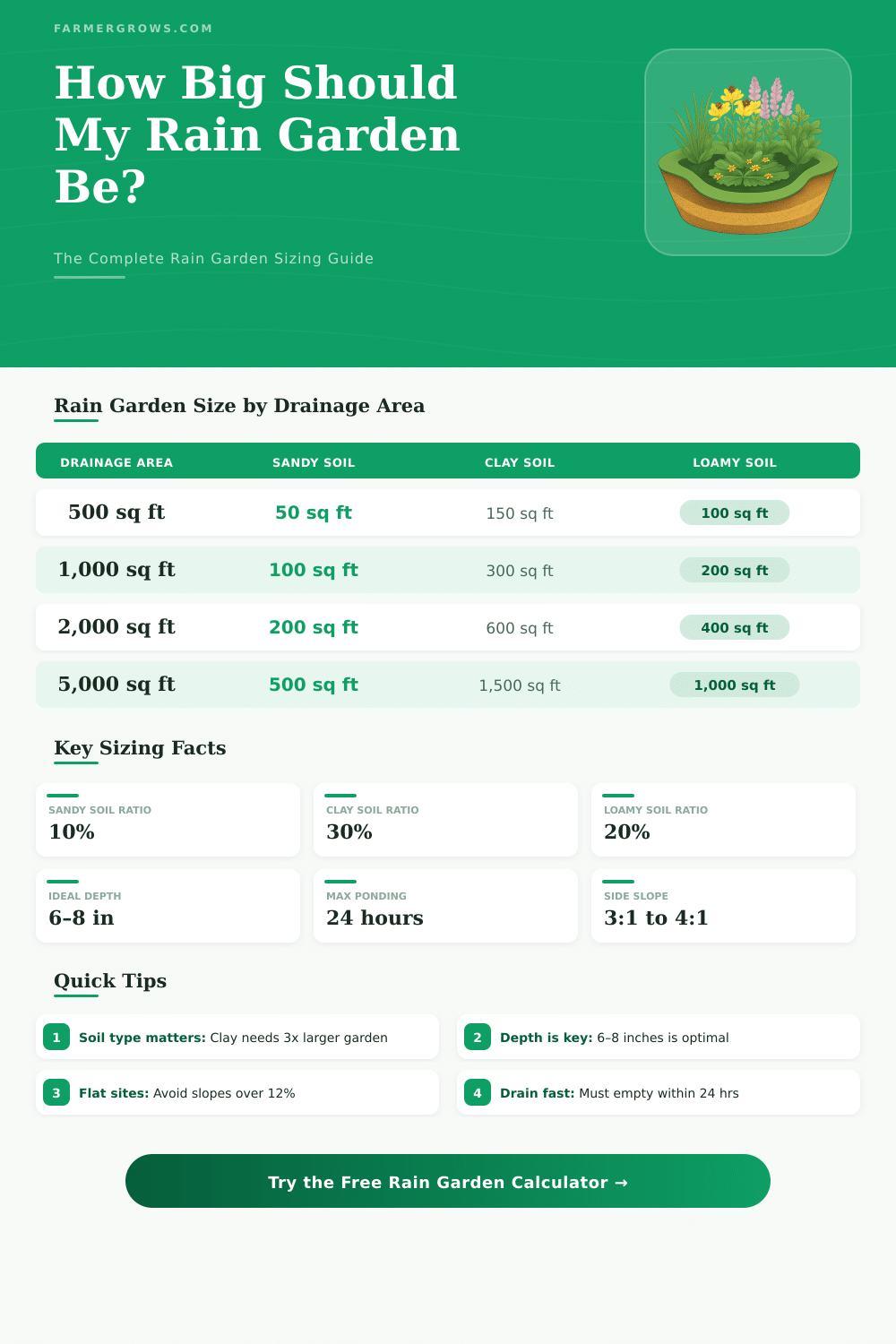
| Drainage Area | Sandy Soil | Loamy Soil | Clay Soil | Garden Area (m²) |
|---|---|---|---|---|
| 500 sq ft (46 m²) | 50 sq ft | 100 sq ft | 150 sq ft | 4.6–13.9 m² |
| 1,000 sq ft (93 m²) | 100 sq ft | 200 sq ft | 300 sq ft | 9.3–27.9 m² |
| 1,500 sq ft (139 m²) | 150 sq ft | 300 sq ft | 450 sq ft | 13.9–41.8 m² |
| 2,000 sq ft (186 m²) | 200 sq ft | 400 sq ft | 600 sq ft | 18.6–55.7 m² |
| 3,000 sq ft (279 m²) | 300 sq ft | 600 sq ft | 900 sq ft | 27.9–83.6 m² |
| 5,000 sq ft (465 m²) | 500 sq ft | 1,000 sq ft | 1,500 sq ft | 46.5–139 m² |
| Surface Type | Runoff Coefficient | Effective Runoff (1 in storm) | Typical Use |
|---|---|---|---|
| Rooftop / Asphalt | 0.95 | 0.95 inches | Downspout drainage |
| Concrete / Pavers | 0.85 | 0.85 inches | Driveway, patio |
| Compacted Gravel | 0.70 | 0.70 inches | Parking areas |
| Lawn / Turf | 0.50 | 0.50 inches | Residential lawn |
| Landscape / Mulch | 0.35 | 0.35 inches | Garden beds |
| Wooded / Natural | 0.20 | 0.20 inches | Forest, meadow |
| Media Type | Infiltration Rate | Weight (lbs/cu yd) | Best For |
|---|---|---|---|
| Native Loam Mix | 0.2 in/hr | 2,200–2,600 | Established gardens |
| Sandy Loam Mix | 0.5–1.0 in/hr | 1,800–2,200 | Most rain gardens |
| Bioretention Mix | 1.0–2.0 in/hr | 1,600–2,000 | High-flow sites |
| Compost Blend | 0.3–0.6 in/hr | 1,400–1,800 | Native plantings |
| Amended Native Soil | 0.1–0.3 in/hr | 2,000–2,800 | Low-budget projects |
| Commercial Rain Garden Mix | 1.0–3.0 in/hr | 1,500–1,900 | Professional installs |
| Gravel/Sand Blend | 2.0–5.0 in/hr | 2,400–3,000 | Very clay-heavy sites |
| Project Type | Drainage Area | Recommended Garden Size | Ponding Volume |
|---|---|---|---|
| Small Downspout | 300–500 sq ft | 50–100 sq ft | 25–50 cu ft |
| Standard Home Roof | 1,000–1,500 sq ft | 150–300 sq ft | 75–200 cu ft |
| Large Roof Section | 2,000–2,500 sq ft | 300–500 sq ft | 150–300 cu ft |
| Driveway / Patio | 800–1,200 sq ft | 200–350 sq ft | 100–200 cu ft |
| HOA Common Area | 5,000–10,000 sq ft | 1,000–3,000 sq ft | 500–2,000 cu ft |
Note: This article is based on real feedback and practical guides, shared by gardeners and sources about landscaping.
The Rain Garden Size is very important. If one gets the right size, the garden truly works to handle the water that it receives. Average home rain gardens commonly range between 100 and 300 square feet.
How Big Should a Rain Garden Be
However the right Rain Garden Size depends on several factors, for instance how many hard surfaces it feeds, and what the soil is in the yard.
First, count the area of the roof, driveway or other surface that directs water to the garden. Measure length and width, and then count the area in square feet. When that number is known, one can find the needed Rain Garden Size.
One common method is divide the drainage area by 6. That calculation means that the garden can keep one inch of water in a garden around 6 inches deep. Another way is multiply the hard surface area by 5 to 10 percent to get the Rain Garden Size.
For instance, at a school in Opelika, Alabama, a roof that drained to a rain garden had an area of 7,881 square feet. One counted the Rain Garden Size dividing that area by 20 for a 6-inch water-holding depth. In another case, a roof and catch area of about 1,000 square feet led to a rain garden of around 200 square feet.
Also the soil type plays a big role. A bit of engineering commonly is needed to match the Rain Garden Size with the drainage area and the soil. Sometimes bad draining soil needs to be dug out and replaced with lighter material, so that the rain garden works well.
A simple test is dig a hole around 6 to 12 inches deep and at least 4 inches wide at the garden spot. Fill it with water and leave it standing for an hour or too to pre-wet the soil, before seeing how quickly it drains.
Rain gardens usually are around 3 inches deep for clay soils, and 6 to 12 inches deep for sandy and slightly loamy soils. A general guideline says that a rain garden should be about one-sixth of the drainage area. Commonly the depth falls between four and eight inches.
One source suggests that the deepest spot be 8 to 10 inches. For small rain gardens, it is better to expand the surface area and stay at 6-inch depth, instead of going too deep.
Sometimes a question comes up about how to measure the depth. Guides widely say that 4 to 6 inches is standard depth, and plants need around 6 inches to grow in a middle useful bed of two inches. It matters to carefully think whether the depth is measured from the top of the growing mix to the berm, or from the top of the bed to the berm.
The slope of the yard also matters. A flat yard has less than 4 percent slope. A mild slope is 5 to 7 percent.
A steep slope is 8 to 12 percent. A general rule is keep safe distance limits, for instance 15 feet in landscapes with a slope of 8 percent or more. Online calculators can help enter those numbers to receive suggested size and depth.
Most roofs are even, so counting the downspouts tied to the measured surface areas helps with the right sizing. All values count for one downspout. If more than one downspout connects to the garden, multiply the garden size by the total number of connections.
Even a tiny rain garden tied to only one downspout moves water away from the foundation, and that already is an improvement.
Ideally, a rain garden should be big enough to hold and then drain the runoff of a strong storm within a day or two. Its size can range from 100 square feet to some hundreds of squarefeet, depending on the expected drainage volume. Plan it in the shape of a kidney bean, with the curved side facing the source of the drainage.
While one adds plants, space them at around one foot to give the roots room to grow. A rain garden can have only three plants or tens, depending on the Rain Garden Size. Looking at the available space in the yard and the current slopes helps to decide where to place the garden for the best results.