🐔 Poultry Feed Formulation Calculator
Calculate exact ingredient quantities for balanced poultry feed mixes
| Ingredient | Crude Protein (%) | ME (kcal/lb) | Calcium (%) |
|---|---|---|---|
| Corn (Yellow) | 8.5 | 1,520 | 0.02 |
| Soybean Meal (44%) | 44.0 | 1,050 | 0.29 |
| Fish Meal (60%) | 60.0 | 1,210 | 5.10 |
| Wheat | 11.0 | 1,400 | 0.05 |
| Wheat Bran | 15.5 | 635 | 0.13 |
| Barley | 12.0 | 1,240 | 0.05 |
| Sorghum | 9.0 | 1,480 | 0.03 |
| Sunflower Meal | 37.0 | 820 | 0.33 |
| Rice Bran | 12.0 | 1,100 | 0.07 |
| Limestone | 0 | 0 | 38.0 |
| DCP (Dicalcium Phosphate) | 0 | 0 | 22.0 |
| Salt | 0 | 0 | 0 |
| Vitamin/Mineral Premix | 0 | 0 | 0 |
| Bird Type / Stage | lbs/bird/day | kg/bird/day | Protein Needed (%) |
|---|---|---|---|
| Chick (0–4 weeks) | 0.055 | 0.025 | 20–22 |
| Pullet (4–8 weeks) | 0.15 | 0.068 | 18–20 |
| Grower (8–18 weeks) | 0.20 | 0.091 | 15–17 |
| Layer Hen | 0.25 | 0.113 | 16–18 |
| Broiler (avg.) | 0.33 | 0.150 | 20–24 |
| Duck Layer | 0.40 | 0.181 | 16–18 |
| Turkey Grower | 0.55 | 0.249 | 22–26 |
| Game Bird | 0.22 | 0.100 | 20–24 |
| Ingredient | Layer (%) | Broiler Starter (%) | Chick Starter (%) |
|---|---|---|---|
| Corn | 55 | 50 | 48 |
| Soybean Meal | 22 | 30 | 30 |
| Wheat Bran | 8 | 5 | 7 |
| Fish Meal | 4 | 7 | 7 |
| Limestone | 8 | 1.5 | 1.5 |
| DCP | 1.5 | 1.5 | 1.5 |
| Salt | 0.3 | 0.3 | 0.3 |
| Vit/Min Premix | 0.5 | 0.5 | 0.5 |
| Oil/Fat | 0.7 | 4.2 | 4.2 |
| Batch Total | 50 lb Bags Equiv. | Metric (kg) | Approx. Duration (25 Layers) |
|---|---|---|---|
| 50 lbs | 1 | 22.7 kg | 8 days |
| 100 lbs | 2 | 45.4 kg | 16 days |
| 200 lbs | 4 | 90.7 kg | 32 days |
| 500 lbs | 10 | 226.8 kg | 80 days |
| 1,000 lbs | 20 | 453.6 kg | 160 days |
| 2,000 lbs | 40 | 907.2 kg | 320 days |
The information below does not come from some computer program or tool used on this website. They base on actual experiences, changes and shared knowledge of cooks that one finds spread on the net.
poultry feed intends to ensure to the birds proper food according to every life stage. From chicks until egg layers and meat birds, every stage requires different nutritious provisions. Starter feed answers for chicks, laying feed helps egg-laying chickens, during meat bird feed backs the increase for flesh.
Chicken Feed Basics
For egg layers one passes to growing feed around the seventh week that usually stores 17 until 18 percentages of proteins.
In poultry feed the main elements are made up of amino acids from proteins, extra vitamins and minerals. To stay healthy, the birds require enough proteins, carbohydrates, those vitamins and mineral parts plus a lot of water. The most many recipes for chicken feeds prepare from corn, wheat, sorghum barley or alike cereals, combined with high-protein materials as soy meal, canola meal or bone meal.
Commonly one adds boosting by means of D3, B12 and calcium.
Premix forms focused mix of vitamin, mineral and nutritious stuff, that one mixes with cereals to form whole feed. This suits for farms with big amount of grains, that does not want to stock every vitamin and mineral separately. In poultry nutrition one uses also supplements as dicalcium phosphate or monocalcium phosphate.
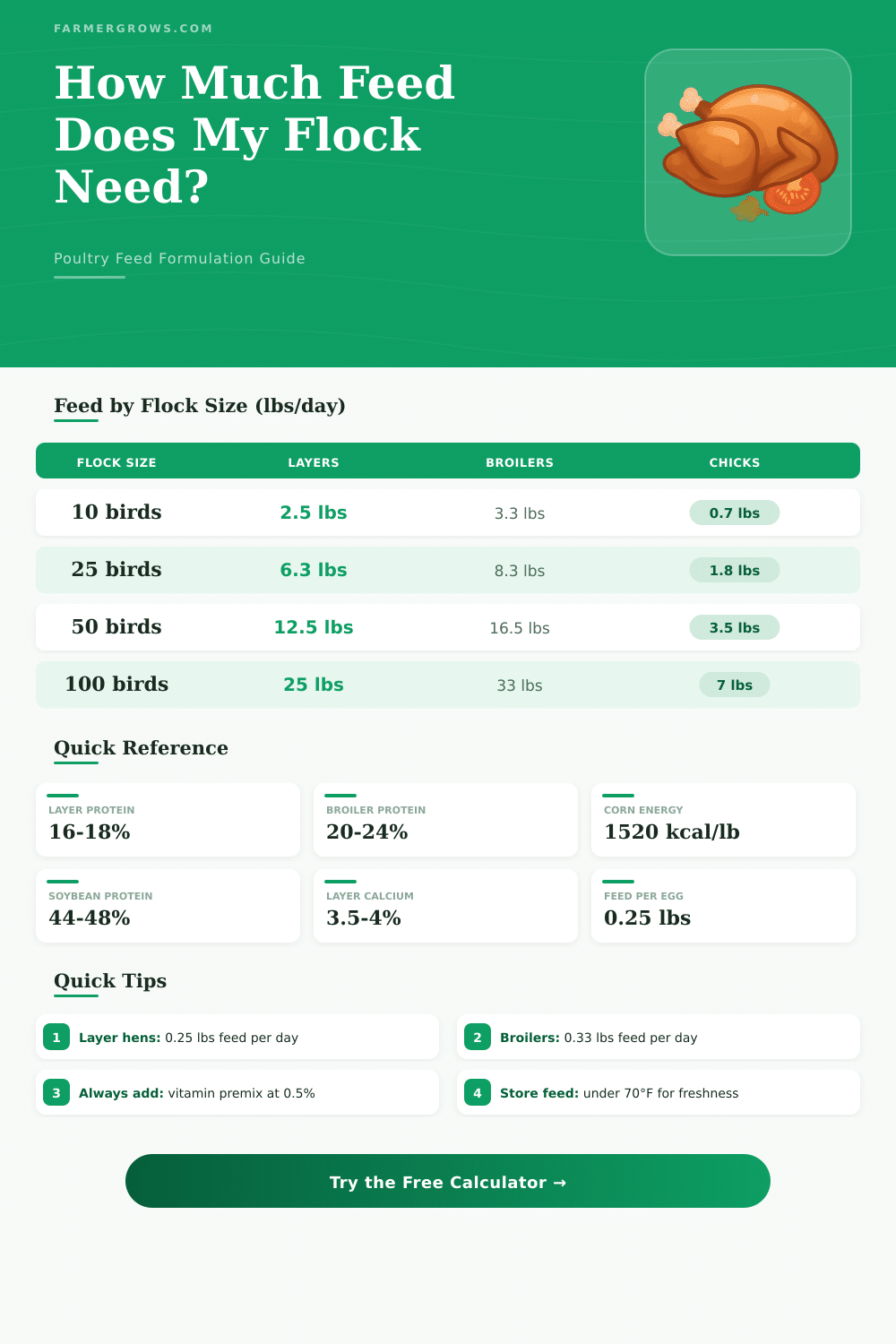
The amount that chicken eats, changes according too several factors. The weather, the body type of the bird, its age, growth rate, egg production and the food from range everything affects that. Typical egg-laying chicken eats around quarter until third of pound of feed daily.
For group of ten birds suffice about two and half pounds of feed daily, shared between morning and evening before dusk.
Some feeds include whole grains, seeds and pellets, that one can spread on ground to boost natural range. Free walking birds can add balanced food from green plants, when those are around, what slightly lowers the costs for feed. Fermented mix from oats, cracked corn and split peas forms other method, that works well.
Pellets usually less salty than wet masses.
Costs for feed commonly worry. Buying of corn directly at mill or growing and use of it can reduce the cost by 50 until 75 percentages, although that requires more effort. For nutrients as niacin one needs to add boosted supplements.
Prices of feed not always drop, even when grains return to normal levels, what frustrates. Research of local store or mill helps topreserve the costs cheap.
Meat birds stay on finishing diet until reaching of market weight. Chicks and young birds need unrolling feed at least until 20 weeks of age. When egg production starts, one switches to laying supply as the best mode.